O'Neill: 'UK Union Is Cracking at the Seams' as Stormont Tensions with DUP Intensify
First Minister Michelle O'Neill has delivered her most forthright assessment yet of the constitutional trajectory of the United Kingdom, declaring that the union is "cracking at the seams" and accusing the DUP of systematically obstructing the work of the Stormont executive — claims that have sharpened the already considerable tensions within Northern Ireland's power-sharing institutions.Background
O'Neill became the first nationalist First Minister in Northern Ireland's history when the power-sharing institutions were restored in February 2024, following a two-year collapse triggered by the DUP's withdrawal over the Northern Ireland Protocol. Her elevation to the role was the direct consequence of Sinn Féin's victory in the 2022 Assembly election — the first time a nationalist party had topped the poll in the region's history. By 2024, Sinn Féin had consolidated its position as the largest party in Northern Ireland across all levels of representation: Westminster, Stormont, and local councils.
The restoration of the executive was welcomed across the political spectrum as a return to stability, but the underlying tensions between Sinn Féin and the DUP have never been far from the surface. The two parties are bound together by the mandatory coalition structure of the Good Friday Agreement, which requires the largest unionist and largest nationalist parties to share power regardless of their political differences. That structure has produced a functioning government, but it has also produced a government in which fundamental disagreements about identity, culture, and constitutional direction are a permanent feature of the landscape.
O'Neill's remarks reflect a broader Sinn Féin strategy of framing the constitutional question not as a distant aspiration but as an imminent political reality. The party has been pointing to nationalist and independence movements in Scotland and Wales as evidence that the UK's internal cohesion is weakening — a narrative that serves its long-term goal of a border poll on Irish unity.
Key Developments
Speaking publicly this week, O'Neill stated that the UK union is "cracking at the seams," citing prospective nationalist victories in Scotland and Wales and what she described as a fundamental failure by Westminster to adequately support Northern Ireland. She articulated a feeling of persistent neglect, stating that regardless of which party holds power in Westminster, a "contempt and complete disregard for people and communities here" remains a constant.
O'Neill directly accused the DUP of attempting to "block and delay progress on issues that would make a real difference to people's lives" and of attacking "everything to do with Irish national identity." The DUP has rejected these characterisations. Gavin Robinson, the DUP leader, has separately alleged that the UK government is "engaging with the New IRA" — a claim denied by the government — in what appears to be a broader effort to position the DUP as the defender of unionist interests against a hostile establishment.
O'Neill highlighted a series of upcoming by-elections in the Republic of Ireland alongside elections in Northern Ireland and for Westminster, framing these as potential "tipping points" for driving constitutional change across the island. Sinn Féin continues its long-standing policy of abstentionism, refusing to take its seats in the UK Parliament.
Why It Matters
O'Neill's language is significant precisely because it is not the language of aspiration — it is the language of momentum. "Cracking at the seams" is a phrase designed to convey inevitability, to suggest that the constitutional question is not a matter of if but when. That framing is politically potent, and it is one that unionists will need to counter with something more than denunciation.
The DUP's position is genuinely difficult. It is simultaneously trying to demonstrate that power-sharing works — because the alternative is direct rule from Westminster, which it fears would be more sympathetic to nationalist interests — while also maintaining its identity as the party that will never compromise on the union. Those two imperatives are in constant tension. Unlike the Ulster Unionist Party, which has shown some willingness to engage with the language of constitutional change, the DUP has no room for manoeuvre on the fundamental question.
Local Impact
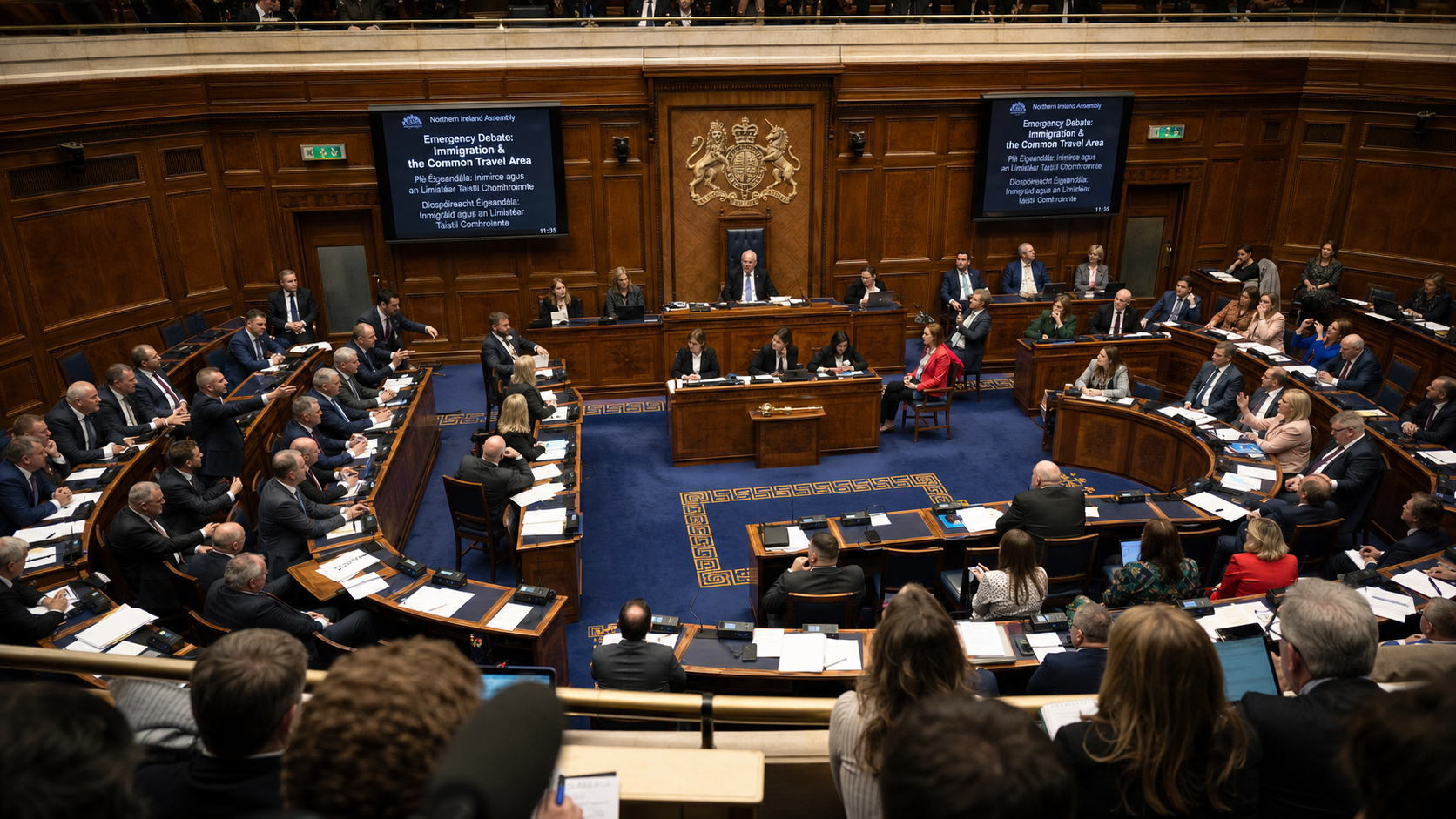
For people in Belfast and across Northern Ireland, the political temperature at Stormont has real consequences. When the executive is functioning, it delivers decisions on health, education, infrastructure, and housing. When it is paralysed by inter-party conflict, those decisions are delayed or deferred. The communities of north and west Belfast — where public services are most stretched and where the legacy of the Troubles is most acutely felt — have the most to lose from a return to political dysfunction. The sign language bill that passed the Assembly this week is a reminder of what the institutions can achieve when they work. The question is whether they can sustain that momentum.
What's Next
The next significant political milestone in Northern Ireland is the series of by-elections referenced by O'Neill, which Sinn Féin hopes will demonstrate continued nationalist momentum. At Stormont, the executive's programme for government is due for a mid-term review in the coming months, which will test whether the DUP and Sinn Féin can agree on a shared set of priorities. Westminster's role — particularly on the question of a border poll — remains the ultimate arbiter of the constitutional question, and that decision rests with the Secretary of State for Northern Ireland.
Sources: BBC News | BBC News NI Institutions