Oberstown Children Detention Campus Staff Strike Over Staffing Crisis as Care Workers Warn Facility 'Running on Fumes'
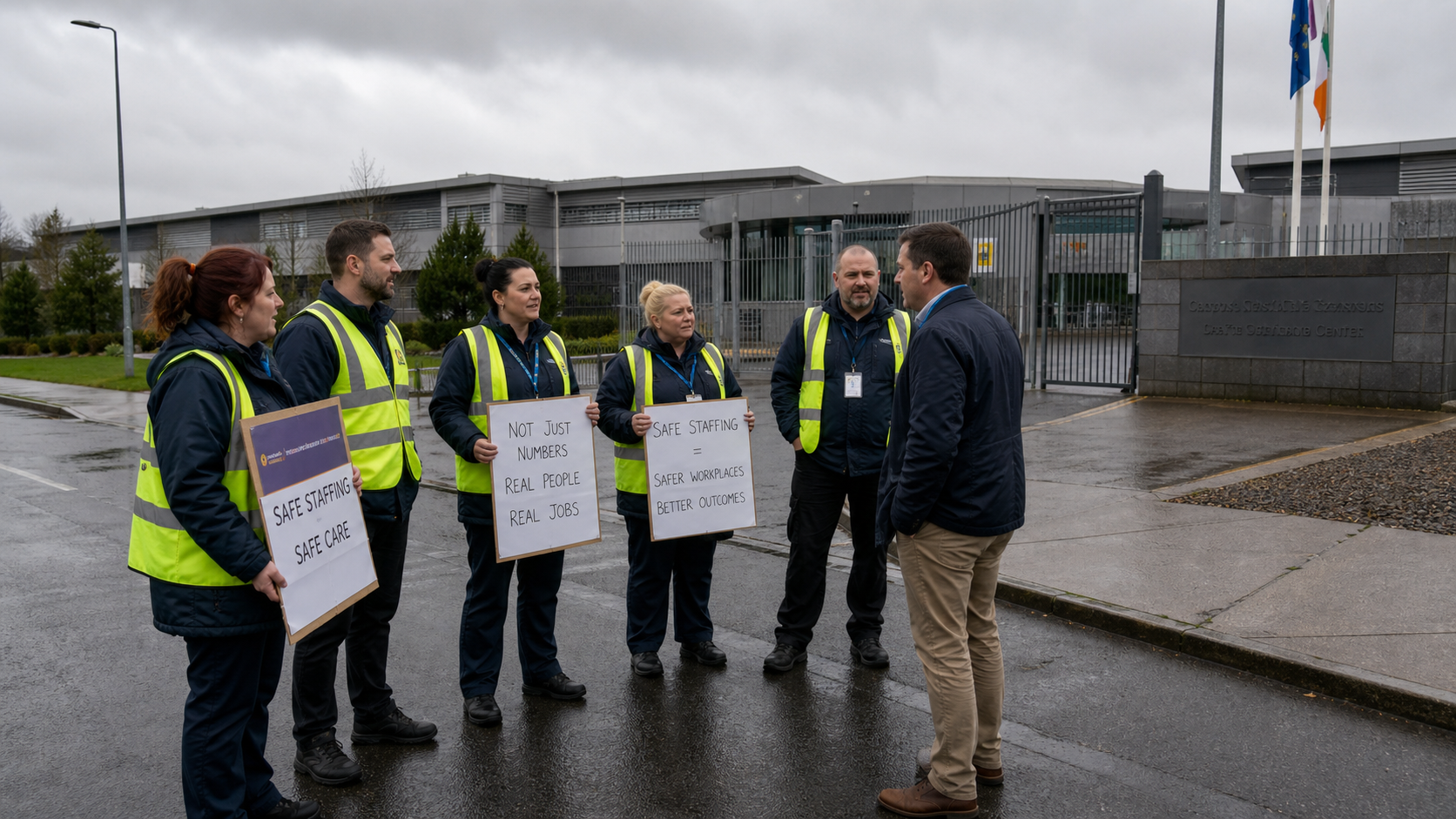
Care workers at the Oberstown Children Detention Campus in County Kildare have staged a series of work stoppages throughout August, with Fórsa union representatives warning that the facility has been "running on fumes for years" — a characterisation that management disputes but which reflects a deep and unresolved dispute about staffing levels, recruitment, and the safety of both staff and the young people detained at the campus.
Background
Oberstown Children Detention Campus is Ireland's only dedicated detention facility for young people under the age of 18 who have been remanded in custody or sentenced by the courts. It is located in Lusk, County Kildare, and is operated by the Oberstown Children Detention Campus Board under the aegis of the Department of Children, Disability and Equality. The campus houses young people who have been convicted of serious offences or who are awaiting trial, and it provides a range of educational, therapeutic, and rehabilitative services alongside the secure detention function.
The facility has been the subject of ongoing concern about staffing levels for several years. Care workers — the frontline staff who work directly with the young people detained at the campus — have consistently argued that the number of staff on duty at any given time is insufficient to deliver the level of care and supervision that the young people require and that the safety of both staff and residents demands. The Fórsa trade union, which represents care workers at Oberstown, has been in dispute with management and the Department of Children over these issues since at least 2025.
The industrial action that began in June 2026 — initially a work-to-rule, subsequently escalated to weekly work stoppages — follows the breakdown of talks at the Workplace Relations Commission in June and July. The WRC process failed to produce an agreement, with the union arguing that management refused to include critical measures to address recruitment difficulties in the business case submitted to the Department of Children.
Key Developments
Work stoppages took place on August 18 and are scheduled for August 25, with further action planned if the dispute is not resolved. Fórsa assistant general secretary Deirdre O'Connell and national secretary Hazel Nolan have been the primary union voices in the dispute, consistently emphasising that the core issue is not pay but the safety of staff and residents.
"Oberstown has been running on fumes for years," O'Connell said in a statement this week. "The management and the Department have been told repeatedly that the staffing levels are not adequate. We are not asking for anything unreasonable — we are asking for enough staff to do the job safely. That should not be a controversial demand."
Management has disputed the union's characterisation, citing the recruitment of 11 additional whole-time equivalent staff posts funded by a €2.2 million allocation in Budget 2026. They have also noted that two-thirds of the staff have over five years of service, suggesting that retention is not as severe an issue as the union claims. The Department of Children has described the industrial action as "regrettable" and "not in keeping with agreed dispute resolution processes."
Why It Matters
The Oberstown dispute matters for several reasons. First, the young people detained at the campus are among the most vulnerable in Irish society — young people who have, in many cases, experienced significant trauma, disadvantage, and family breakdown before coming into contact with the criminal justice system. The quality of care they receive at Oberstown has a direct bearing on their prospects for rehabilitation and reintegration into society. A facility that is understaffed cannot deliver the therapeutic and educational programmes that are essential to that process.
Second, the dispute highlights a broader tension in Irish social care policy between the ambition of the statutory framework — which commits to a rights-based, therapeutic approach to youth detention — and the resource allocation decisions that determine whether that ambition can be realised in practice. The Department of Children's reluctance to engage directly in local negotiations, cited by the union as a key obstacle to resolution, suggests a degree of institutional distance from the operational realities of the campus.
Third, the safety of care workers is a legitimate concern in its own right. Working with young people who have complex needs and who may present challenging behaviour requires adequate staffing to ensure that incidents can be managed safely. The union's argument that current staffing levels create unacceptable risks for staff is not merely a negotiating position; it reflects a genuine assessment of the working conditions at the campus.
Local Impact
For the young people currently detained at Oberstown, the industrial action has practical consequences. Work stoppages affect the delivery of educational and therapeutic programmes, and the uncertainty created by the ongoing dispute is itself a source of stress for residents and their families. The campus management has indicated that contingency plans are in place to maintain essential services and safety standards during the stoppages, but the disruption to normal routines is unavoidable.
For the local community in Lusk and the surrounding area, Oberstown is a significant employer, and the dispute has generated local interest and some sympathy for the care workers involved. The campus is not a prominent feature of local life — its secure nature means that it operates largely out of public view — but the industrial action has brought it to wider attention.
What's Next
The Department of Children has indicated it is open to further engagement through the WRC, but the union has made clear that it will not return to talks unless the Department commits to direct participation in the negotiations rather than leaving management to represent the State's position. A further work stoppage is scheduled for August 25, and the union has indicated that it is prepared to escalate the action further if the dispute is not resolved. The Minister for Children, Norma Foley, is expected to be briefed on the situation this week and may intervene directly to seek a resolution.