New Water Birth Guidelines Aim to Standardise Care for Women Across Irish Maternity Units
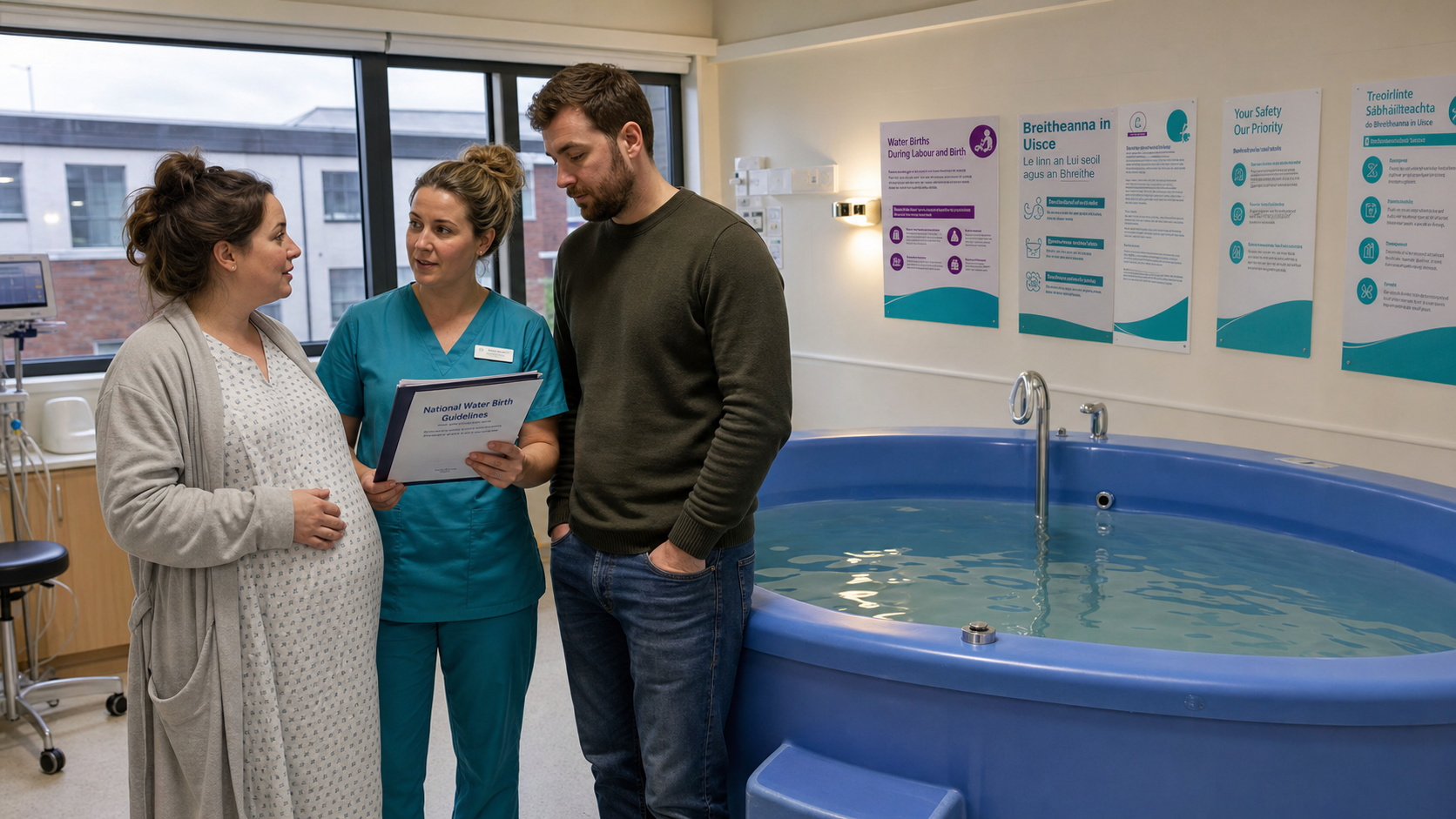
The HSE has published new national guidelines on water births, designed to standardise the care available to women who choose to labour or give birth in water across Irish maternity units. The guidelines, which were developed following extensive consultation with midwives, obstetricians, and women who have experienced water births, aim to ensure that women across the country have access to consistent, evidence-based care regardless of which maternity unit they attend.
Background
Water birth — the practice of labouring and/or giving birth in a pool of warm water — has been available in some Irish maternity units for many years, but the provision has been inconsistent and the guidelines governing the practice have varied significantly between hospitals. Some units have well-established water birth programmes with dedicated pools and experienced midwives; others have limited or no water birth facilities, leaving women who want this option with few choices.
The evidence base for water birth has grown substantially over the past decade. Research consistently shows that labouring in water can reduce the need for pain relief, shorten the duration of labour, and improve women's experience of childbirth. The evidence on the safety of water birth — both for the mother and the baby — is also broadly reassuring, though it is important that appropriate selection criteria are applied to ensure that water birth is offered only to women for whom it is clinically appropriate.
The demand for water birth facilities has been growing in Ireland, driven by a broader shift toward woman-centred maternity care and by the increasing availability of information about the benefits of water birth. Many women who want a water birth find that their local maternity unit does not have the facilities or the staffing to offer it, and some travel significant distances to access the option. The new guidelines are intended to address this inequality by setting a national standard for water birth provision.
Key Developments
The new guidelines, published by the HSE's National Women and Infants Health Programme, set out clear criteria for the selection of women who are appropriate candidates for water birth, as well as detailed protocols for the management of labour and birth in water. The guidelines cover a range of clinical scenarios, including the management of complications that may arise during a water birth, and provide clear guidance on when a woman should be asked to leave the pool.
RTÉ reported on the guidelines on Sunday, noting that they represent a significant step toward standardising maternity care across Ireland. The guidelines were developed following extensive consultation with midwives, obstetricians, and women who have experienced water births, and they reflect the latest evidence on the safety and effectiveness of the practice. The HSE has indicated that all maternity units will be expected to implement the guidelines, though the timeline for full implementation will depend on the availability of facilities and staffing.
The guidelines also address the training requirements for midwives who support women in water births, setting out the competencies that midwives must demonstrate before they can provide this care. This is an important element of the guidelines, as the safety of water birth depends critically on the skill and experience of the midwives involved.
Why It Matters
The new water birth guidelines matter because they represent a commitment to woman-centred maternity care — the principle that women should have genuine choices about how they give birth, and that those choices should be supported by evidence-based, consistent care. For too long, the availability of water birth in Ireland has depended on which maternity unit a woman happened to attend, rather than on her clinical needs and preferences. The new guidelines begin to address that inequality.
The guidelines also matter because they reflect a broader shift in Irish maternity care toward a model that respects women's autonomy and supports their informed decision-making. The National Maternity Strategy, published in 2016, set out a vision for maternity care in Ireland that placed women at the centre of their own care, and the new water birth guidelines are a concrete expression of that vision.
The standardisation of water birth provision will also have benefits for the healthcare system as a whole. Women who labour in water typically require less pain relief and have shorter labours, which reduces the demand on midwifery and medical staff and frees up resources for women who need more intensive support. The investment in water birth facilities and training is therefore not merely a cost — it is an investment that can generate savings elsewhere in the maternity system.
Local Impact
For women across Ireland who want a water birth, the new guidelines represent a significant improvement in the consistency and quality of the care available to them. Women attending maternity units in Dublin, Cork, Galway, Limerick, and other major centres will benefit from clearer protocols and better-trained midwives. For women in more rural areas, where maternity services are provided by smaller units with more limited resources, the implementation of the guidelines may take longer, but the HSE has committed to supporting all units in meeting the new standards. The National Women and Infants Health Programme will monitor implementation and will provide additional support to units that are struggling to meet the guidelines.
What's Next
The HSE will now work with individual maternity units to implement the new guidelines, with a particular focus on units that currently have limited water birth provision. The implementation process will include an assessment of the facilities and staffing available at each unit, and a plan for addressing any gaps. The HSE has indicated that it expects all maternity units to be in a position to offer water birth to appropriate candidates within two years, though the timeline may vary depending on the scale of the investment required. A review of the guidelines is planned for 2028, to assess their impact on women's experiences and outcomes and to incorporate any new evidence that has emerged in the interim.