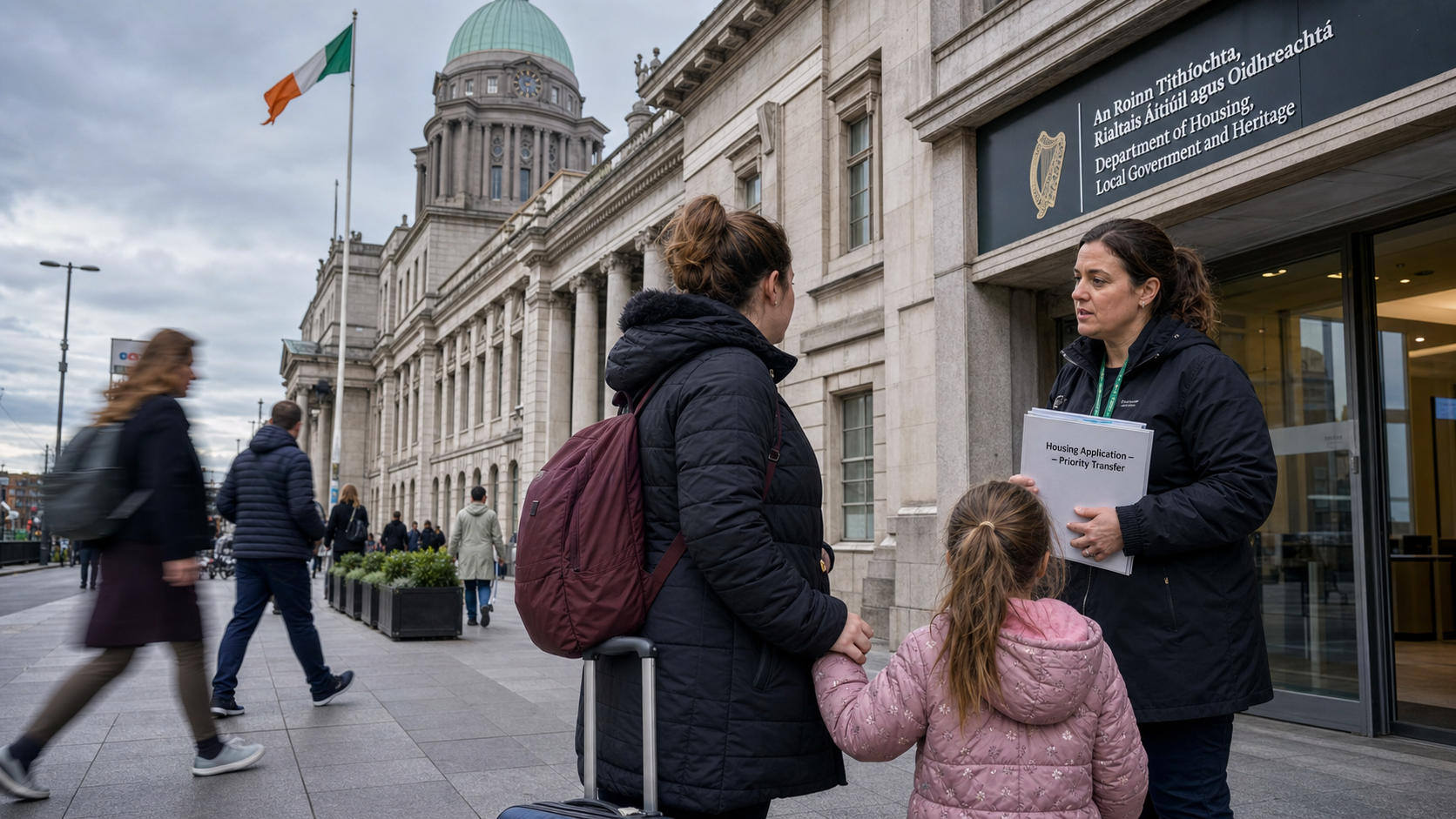
New Protocol Allows Domestic Abuse Survivors to Transfer Social Housing Priority When Fleeing Violence
A significant new government protocol has come into effect allowing survivors of domestic abuse to transfer their accrued time on a social housing waiting list when they are forced to relocate to a new local authority area to escape violence — a reform that advocates have described as one of the most practical and meaningful changes to housing policy for vulnerable people in years, removing a systemic barrier that previously forced victims to choose between their safety and their place on a years-long housing list.
Background
The intersection of domestic violence and housing insecurity has been one of the most persistent and damaging features of Ireland's social housing crisis. For years, advocates working with survivors of domestic abuse identified a cruel paradox at the heart of the system: the very act of fleeing violence — of moving to a new county or local authority area to escape an abuser — could result in the loss of years of accumulated priority on a social housing waiting list. A survivor who had spent five years on a waiting list in Dublin, for example, and who needed to move to Cork to escape a violent partner, would typically have to start their application from scratch in the new area.
The consequences of this policy were severe. Many survivors chose to remain in dangerous situations rather than lose their housing priority. Others moved but found themselves at the back of a new waiting list, facing years of uncertainty in temporary or emergency accommodation. The policy was not designed to trap people in abusive relationships, but that was its practical effect for a significant number of vulnerable women and their children.
Safe Ireland, the national network of domestic violence services, has been documenting the scale of this problem for years. A "One Day Census" conducted by the organisation on January 28, 2026, found that 1,872 women were turned away from domestic violence services in the previous six months, with housing shortages identified as the "single greatest barrier" to safety. The new protocol is a direct response to this evidence.
Key Developments
The new protocol, announced by Minister for Housing James Browne on July 1, 2026, and now in effect, allows individuals who can provide evidence of domestic, sexual, or gender-based violence to transfer their accrued time on a social housing waiting list when they move to a new local authority area. The receiving local authority is granted the discretion to waive "local connection" requirements — the rules that typically tie housing eligibility to a specific county or area — for survivors who need to relocate for safety reasons.
The protocol was developed in consultation with local authorities and Cuan, the state agency established to tackle domestic, sexual, and gender-based violence. It forms part of the broader Delivering Homes, Building Communities 2025–2030 plan, which sets out the government's housing strategy for the coming years. The inclusion of a specific measure for domestic abuse survivors in the national housing plan is itself significant, reflecting a recognition that housing policy cannot be separated from the broader challenge of protecting vulnerable people.
Advocacy organisations including Safe Ireland and Wexford Women's Refuge have welcomed the protocol as a long-overdue reform. Safe Ireland's chief executive described it as "a vital, practical measure that gives survivors greater freedom and support to escape abusive environments" and called on local authorities to implement it consistently and compassionately.
Why It Matters
The new protocol matters because it addresses a real and documented harm. The previous system was not merely inconvenient — it was actively dangerous, creating a financial and practical disincentive for survivors to leave abusive relationships. By removing that disincentive, the protocol has the potential to save lives. It is a recognition that housing policy has consequences that extend far beyond the allocation of bricks and mortar, and that the design of housing systems can either protect or endanger vulnerable people.
The protocol also matters as a model of evidence-based policymaking. The decision to introduce it was driven by the documented evidence of harm gathered by organisations like Safe Ireland, and the involvement of Cuan — the specialist state agency — in its development ensures that it reflects the practical realities of survivors' experiences. This is the kind of policy development that advocates have been calling for, and its implementation is a vindication of the value of sustained, evidence-based campaigning.
There is also a broader point about the relationship between housing policy and social policy. Ireland's housing crisis affects everyone, but it affects vulnerable people most severely. The new protocol is a reminder that housing policy is not a technical exercise in supply and demand but a social policy with profound implications for the safety and wellbeing of the most vulnerable members of society.
Local Impact
The practical impact of the new protocol will be felt most immediately by survivors of domestic abuse who are currently on social housing waiting lists and who need to relocate for safety reasons. Local authorities across Ireland — from Dublin City Council and Cork County Council to smaller authorities in Leitrim, Longford, and Roscommon — will be required to implement the protocol consistently and to train their housing staff in its application.
Domestic violence support organisations in each county will play a crucial role in helping survivors to navigate the protocol, including the process of providing evidence of violence and making the case for the transfer of their housing priority. Organisations such as Women's Aid, Adapt Kerry, Sonas, and the network of Safe Ireland member services have been briefed on the new protocol and are preparing to support their clients in accessing it.
In Dublin, where the social housing waiting list is longest and where the pressure on domestic violence services is most acute, the protocol is expected to have a significant impact. Dublin City Council has confirmed that it will implement the protocol in full and has committed to training its housing staff to handle applications from survivors with sensitivity and urgency.
What's Next
The Department of Housing has committed to monitoring the implementation of the new protocol and to publishing data on its use within six months of its introduction. This data will include the number of applications received, the number approved, and the average time taken to process applications — information that will allow advocates and policymakers to assess whether the protocol is working as intended and to identify any barriers to its effective implementation. A review of the protocol is planned for 2027, at which point the government will consider whether any amendments are needed in light of the experience of its first year of operation.