Government Unveils Biggest Overhaul of Rural Housing Rules in 20 Years, Scrapping Blanket Bans and Easing Planning Criteria
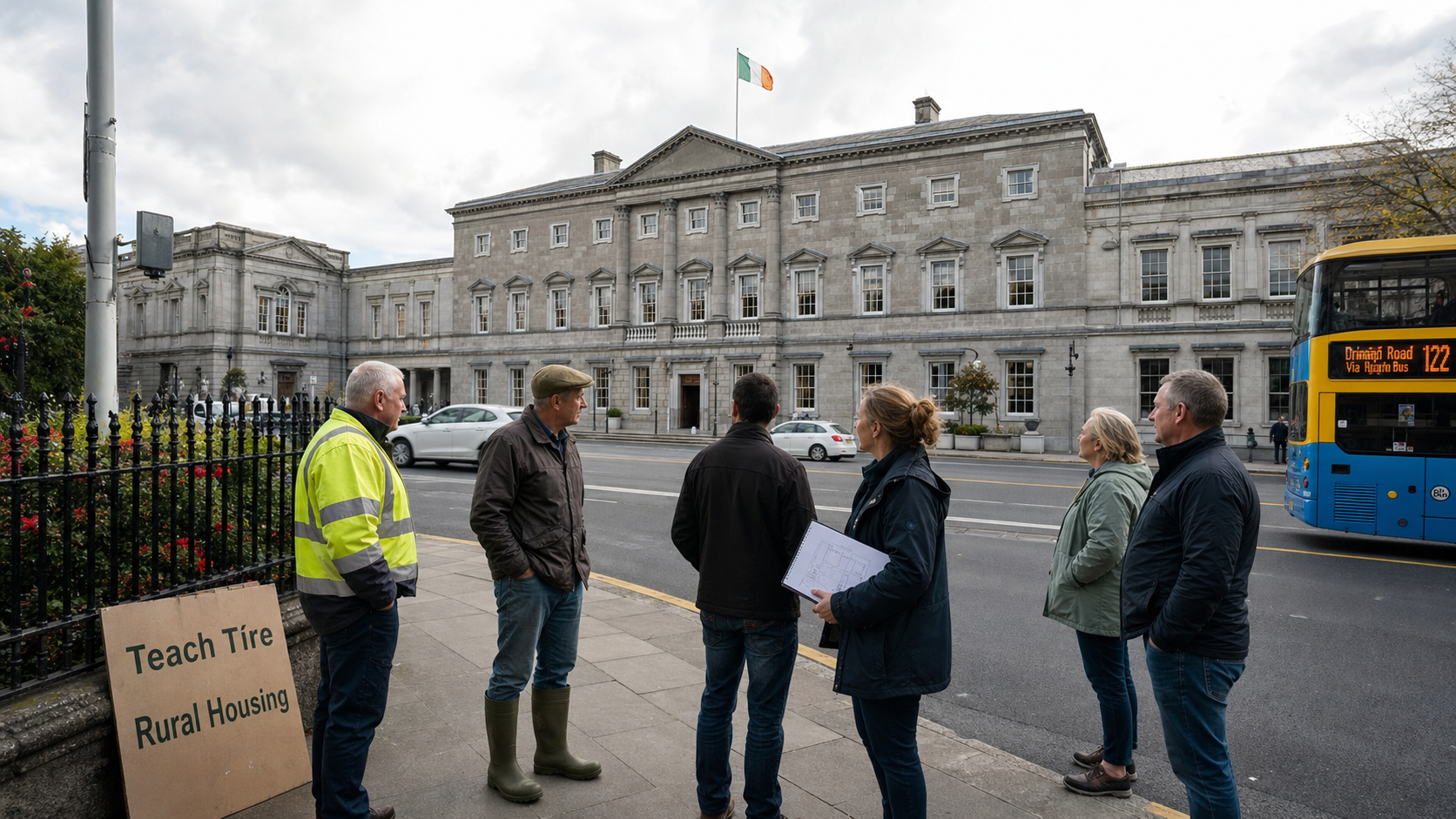
The Irish government has introduced the most significant reform of rural housing planning policy in two decades, removing blanket bans on ribbon development, scrapping minimum site size and road frontage requirements, and broadening the criteria for demonstrating social or economic need to live in a rural area — changes that supporters say will reverse rural depopulation but that critics warn could accelerate unsustainable sprawl and car dependency.
Background
Rural housing policy has been one of the most contentious areas of Irish planning law for decades. The tension between the desire of people with rural roots to build homes in their communities and the planning system's obligation to prevent unsustainable development has generated enormous political heat, particularly in constituencies where rural identity and the right to build on family land are deeply held values.
The previous policy framework, which dated from the early 2000s, gave local authorities significant discretion to restrict one-off rural housing through local development plans. Many councils used this discretion to impose blanket bans on ribbon development — the practice of building houses in a line along rural roads — and to set minimum requirements for site size and road frontage that effectively excluded many applicants. The result was a patchwork of inconsistent rules that varied enormously from one county to the next and that many rural residents experienced as arbitrary and unfair.
The new framework, the Draft Sustainable Rural and Gaeltacht Housing National Planning Statement, represents an attempt to standardise the rules nationally while also making them more permissive. It has been developed by the Department of Housing under Minister James Browne and reflects a political commitment to addressing rural depopulation and supporting the viability of rural communities.
Key Developments
The key changes introduced by the new framework are substantial. Blanket bans on ribbon development are no longer permitted — each application must be assessed on its individual merits rather than being automatically refused because of its location along a rural road. Minimum requirements for road frontage and site size have been scrapped, removing barriers that prevented many applicants from building on family land that did not meet the previous technical specifications.
The criteria for demonstrating social or economic need to live in a rural area have been significantly broadened. Previously, the economic need criterion was primarily restricted to those working in agriculture or farming. Under the new rules, it extends to people running local businesses or providing essential local services — teachers, healthcare workers, tradespeople, and others whose work is rooted in the rural community. Applicants must demonstrate either a social need (having lived in the area for at least seven years) or an economic need (being employed in local services or agriculture).
A particularly notable innovation is the provision allowing rural homeowners to build a second, smaller home of up to 90 square metres on their existing land to facilitate downsizing. This measure is designed to free up larger family homes for the next generation while allowing older residents to remain in their communities. New builds under the framework must be the applicant's primary residence for at least ten years and cannot be used for short-term holiday lets during that period.
Why It Matters
The rural housing overhaul matters because it addresses a genuine tension at the heart of Irish society: the desire of people with deep roots in rural communities to remain in those communities, and the planning system's obligation to prevent development that is environmentally unsustainable or that places undue burdens on public infrastructure. The previous framework was widely perceived as having tilted too far towards restriction, contributing to the depopulation of rural areas and the erosion of the social fabric of rural communities.
The new rules are not without risk. Environmental organisations have raised concerns that the removal of blanket bans on ribbon development could lead to a significant increase in one-off housing in the countryside, with associated impacts on biodiversity, water quality, and the visual character of the landscape. The prohibition on short-term lets for ten years is a welcome safeguard, but critics argue that it will be difficult to enforce in practice.
The Gaeltacht dimension of the new framework is also significant. Irish language communities in Connemara, Donegal, Kerry, and other Gaeltacht areas have long argued that the planning system was contributing to the decline of Irish-speaking communities by making it difficult for young people with local roots to build homes. The new rules explicitly recognise the social and cultural importance of maintaining the population of Gaeltacht areas.
Local Impact
The impact of the new rules will be felt most immediately in counties with large rural populations and significant demand for one-off housing — Galway, Mayo, Donegal, Kerry, Cork, and Tipperary among them. In Connemara, where the Gaeltacht communities of south Galway have been campaigning for more permissive rural housing rules for years, the announcement has been welcomed as a long-overdue recognition of the area's particular needs.
In Donegal, where rural depopulation has been a persistent concern and where the county council has historically been one of the more restrictive in its approach to one-off housing, the new national framework will require a significant revision of the county development plan. Local councillors have broadly welcomed the changes, though some have expressed concern about the implications for infrastructure — roads, water, and wastewater — in areas that may see increased development.
What's Next
The Draft Sustainable Rural and Gaeltacht Housing National Planning Statement is currently in a public consultation phase, with submissions invited from local authorities, planning bodies, environmental organisations, and members of the public. The final version of the statement is expected to be published in the autumn of 2026, after which local authorities will be required to update their development plans to reflect the new national policy. Planning applications submitted under the new framework are expected to begin flowing through the system from early 2027.