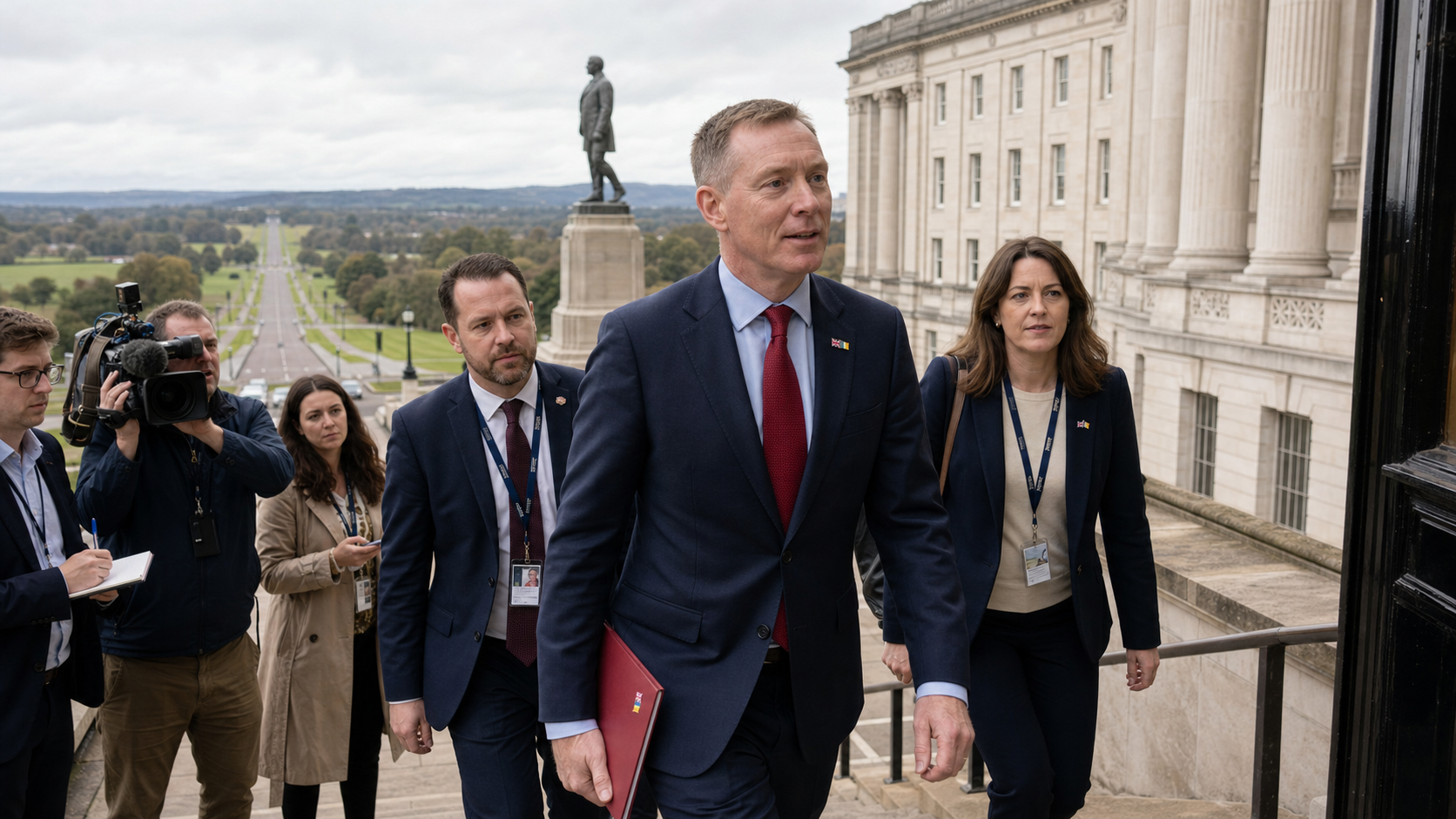
New NI Secretary Chris Bryant Arrives at Stormont with Pledge to Keep 'Door Open' to All Communities
Sir Chris Bryant has arrived at Stormont as the new Secretary of State for Northern Ireland, pledging to keep his door open to all communities and political parties as he takes on one of the most complex and sensitive briefs in British politics, succeeding Hilary Benn following the cabinet reshuffle that accompanied Andy Burnham's elevation to the office of Prime Minister.
Background
The role of Secretary of State for Northern Ireland has always carried a weight that goes beyond the conventional demands of ministerial office. It requires an individual capable of navigating the competing sensitivities of unionist and nationalist communities, maintaining productive relationships with the Irish government, managing the complex constitutional arrangements that flow from the Good Friday Agreement and its successor agreements, and representing Northern Ireland's interests within the UK government — all while remaining alert to the ever-present possibility that the political settlement could come under strain.
Sir Chris Bryant, a Labour MP for Rhondda and Ogmore since 2001, brings to the role a background that is in some respects unconventional for a Northern Ireland Secretary. A former Anglican priest and a committed pro-European, he served as Minister of State for Trade between 2025 and 2026 and held various ministerial roles in the Department for Science, Innovation and Technology and the Department for Culture, Media and Sport. His appointment by Prime Minister Andy Burnham — himself a figure with strong connections to the north of England rather than the traditional Labour heartlands — reflects the new administration's determination to bring fresh perspectives to established briefs.
Bryant's predecessor, Hilary Benn, had developed a reputation for careful, methodical engagement with Northern Ireland's political parties and a deep understanding of the constitutional complexities of the role. The transition to Bryant comes at a moment when the Windsor Framework — the post-Brexit arrangement governing Northern Ireland's relationship with both the UK internal market and the EU single market — continues to generate political controversy, and when the question of a border poll remains a live, if not immediately pressing, issue.
Key Developments
Bryant described the role as "daunting" and acknowledged the "heavy responsibility" it carries upon his arrival in Belfast. He outlined his primary focus areas as maintaining political stability, promoting economic growth, ensuring that devolved government effectively delivers services for the public, and creating economic opportunities for young people in Northern Ireland. He stated explicitly that a border poll is not currently on his list of priorities, a position that will be welcomed by unionist parties but noted carefully by Sinn Féin and the SDLP.
The reaction from Northern Ireland's political parties has been predictably varied. Sinn Féin leadership, including First Minister Michelle O'Neill and party president Mary Lou McDonald, urged a "change of approach" from the Labour government, specifically regarding funding for the Executive, political reform, and the constitutional position of Ireland. DUP leader Gavin Robinson acknowledged Bryant's pro-European stance and expressed the need for arrangements that ensure Northern Ireland is not disadvantaged relative to the rest of the United Kingdom. SDLP leader Claire Hanna described her initial discussion with Bryant as "constructive," emphasising the need for momentum on institutional reform and sustainable public finances. TUV leader Jim Allister publicly criticised Bryant as an "EU fanatic," a characterisation Bryant deflected with a statement of his interest in working with Allister for a "strong Northern Ireland in a strong United Kingdom."
Why It Matters
The appointment of a new Secretary of State always represents a moment of recalibration in Northern Ireland's political relationships. Bryant arrives at a time when the Executive is functioning — a significant achievement given the periods of collapse that have characterised Stormont's history — but when the underlying tensions between unionism and nationalism remain unresolved and the economic challenges facing Northern Ireland are acute. His pro-European background is a double-edged sword: it may facilitate productive engagement with the Irish government and with EU institutions on matters relating to the Windsor Framework, but it will require careful management of unionist sensitivities about the constitutional implications of Northern Ireland's unique post-Brexit position. His stated commitment to keeping his door open to all communities is the right starting point; the test will be whether that commitment translates into substantive engagement on the issues that matter most to each community.
Local Impact
In practical terms, Bryant's arrival at Stormont will be felt most immediately in the ongoing negotiations about the Executive's budget and the funding arrangements between Westminster and Belfast. The Executive has been operating under significant financial pressure, with public services — including health, education, and infrastructure — facing real-terms cuts that have generated considerable public frustration. Bryant's ability to secure additional funding from the Treasury, or to facilitate a more sustainable long-term financial settlement for Northern Ireland, will be a key test of his effectiveness in the role. His engagement with the Windsor Framework implementation process will also be closely watched by business groups and trade bodies who have a direct interest in the practical operation of the arrangements.
What's Next
Bryant is expected to meet with the First Minister, Deputy First Minister, and leaders of all the main parties at Stormont in the coming days. He will also travel to Dublin for early meetings with Taoiseach Micheál Martin and Minister for Foreign Affairs Micheál Martin, as part of the established practice of close bilateral engagement between the British and Irish governments on Northern Ireland matters. A formal review of the Windsor Framework implementation is scheduled for later in the year, and Bryant's approach to that process will be an early indicator of his priorities and style in the role.