New IRA Suspected After Car Bomb Explodes Outside Dunmurry Police Station in Belfast
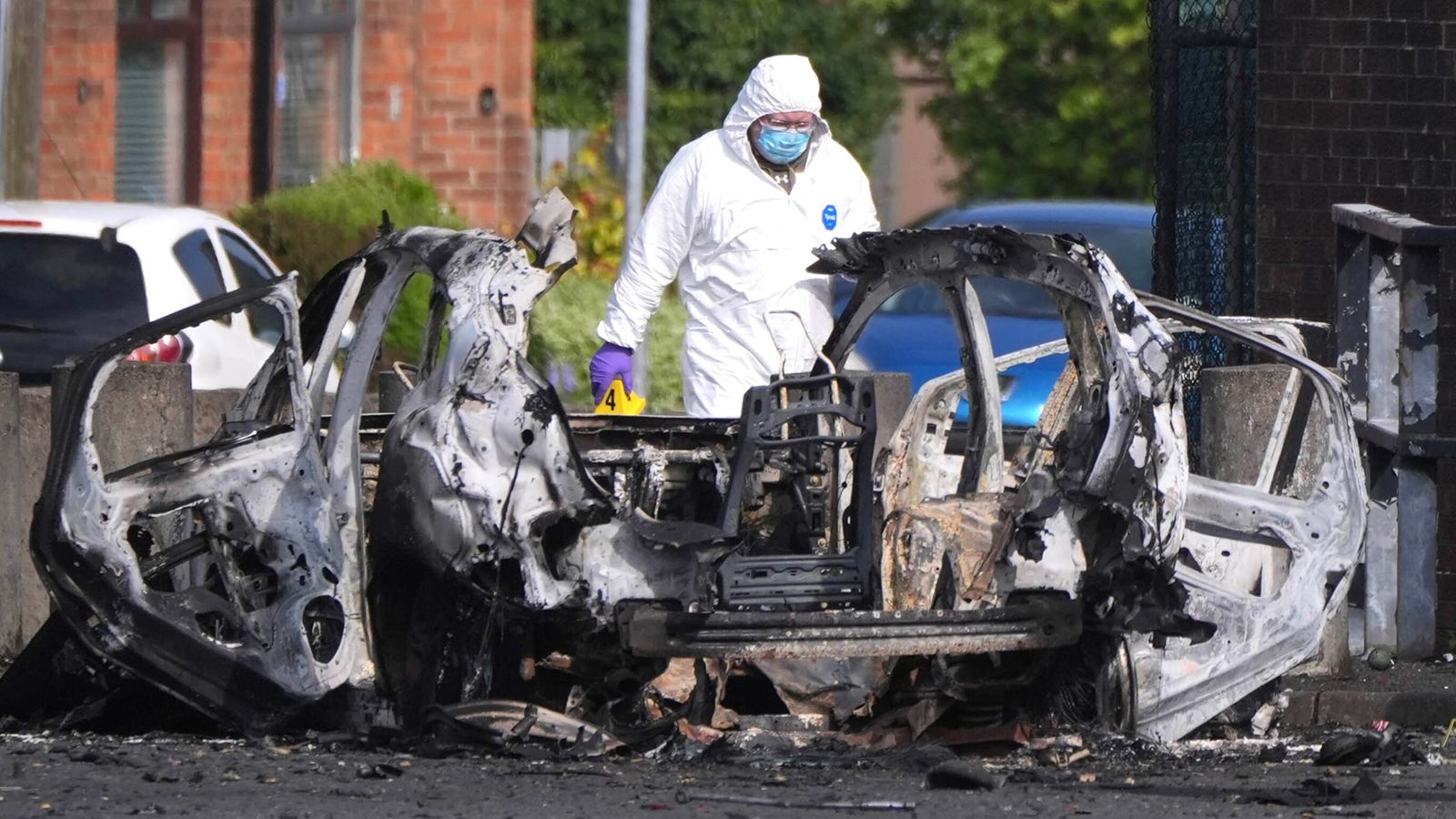
A car bomb exploded outside Dunmurry police station on the outskirts of Belfast in the early hours of Sunday, 26 April, with the PSNI suspecting the New IRA is responsible for an attack that saw two babies among the residents evacuated by officers moments before the device detonated — in a reckless act of violence that drew universal condemnation from political leaders across Northern Ireland and beyond.
The device, a gas cylinder bomb, was delivered to the station by a hijacked delivery driver who had been forced to transport it from the Twinbrook area of west Belfast. PSNI officers activated an attack alarm and began evacuating nearby homes, carrying two babies to safety as the explosion engulfed the vehicle in flames and scattered debris across the area. Some residents were temporarily sheltered in the police station itself before being moved to the Brook Leisure Centre for the night.
Background
The New IRA is a dissident republican paramilitary group formed in 2012 through a merger of the Real IRA, Republican Action Against Drugs (RAAD), and other smaller factions. The group rejects the 1998 Good Friday Agreement and continues to pursue the goal of a united Ireland through violent means, primarily targeting British security forces in Northern Ireland. It is considered the largest and most active of the dissident republican groups, with an estimated membership of a few hundred activists.
As of April 2026, the terrorist threat level in Northern Ireland is rated as "substantial," meaning an attack is likely. The Dunmurry bombing follows a similar attempt in Lurgan in March 2026, in which a delivery driver was also forced to transport a bomb to a police station — a device that failed to detonate. The New IRA claimed responsibility for the Lurgan attack, and the PSNI has cited the strong similarities between the two incidents as the basis for their "early working hypothesis" that the same group is responsible for Dunmurry.
Key Developments
PSNI Deputy Chief Constable Bobby Singleton confirmed that the "early working hypothesis is that this may well be the work of the New IRA," and praised the courageous actions of officers who ran into danger to evacuate residents. Chief Constable Jon Boutcher described the perpetrators as "mindless idiots" and urged the public to come forward with any information to help bring them to justice. An extensive police operation was launched in the Twinbrook area, where the delivery driver's vehicle was hijacked.
The attack caused significant disruption and fear within the Dunmurry community, a heavily residential area with many elderly residents. Local politicians reported "panic and concern" in the area following what they described as a "shocking and dangerous attack." The incident was widely condemned by community leaders and residents, who expressed revulsion at the reckless endangerment of life, particularly of children and babies.
Political condemnation was swift and unanimous. First Minister Michelle O'Neill stated that those behind the attack "speak for absolutely no one" and described the perpetrators as having "no vision, no support, and nothing to offer our society." Prime Minister Keir Starmer echoed this condemnation, while DUP leader Gavin Robinson described the attackers as "neanderthals with nothing to offer society except destruction and division."
Why It Matters
The Dunmurry bombing is a stark reminder that dissident republican violence remains a live threat to the peace and stability of Northern Ireland, nearly three decades after the Good Friday Agreement. The New IRA's use of "human bombs" — forcing civilians to deliver devices — is a particularly callous tactic designed to maximise fear and disruption while placing innocent people in grave danger. The fact that two babies were being carried to safety as the bomb exploded illustrates just how close this attack came to causing a catastrophic loss of life.
The broader pattern of attacks — Lurgan in March, Dunmurry in April — suggests a sustained campaign rather than isolated incidents. Security analysts have noted that the New IRA, while described as a "brittle organisation, riven with factions," has demonstrated improved bomb-making skills and a persistent willingness to target police officers and the communities they serve. The group's attacks are seen as attempts to demonstrate relevance and capability, particularly during significant anniversaries, and to draw security forces into a more confrontational posture.
Local Impact
For the Dunmurry community, the attack was deeply traumatic — a distressing throwback to the violence of the Troubles that the vast majority of residents have worked hard to leave behind. The evacuation of families, including babies, in the middle of the night, and the sight of a car engulfed in flames outside the local police station, will have left lasting psychological scars on those who witnessed it.
The attack also places renewed pressure on the Northern Ireland Executive and the UK government to ensure adequate resources for the PSNI to counter the ongoing dissident threat. Chief Constable Boutcher has previously highlighted what he describes as a lack of financial and political support for the PSNI compared to other UK police forces — a concern that the Dunmurry bombing will bring back into sharp focus.
What's Next
The PSNI's Terrorism Investigation Unit is pursuing an active investigation, and police have appealed for anyone with information about the hijacking or the attack to come forward. As BBC News reports, the attack has prompted renewed calls for a coordinated response to the dissident republican threat. Further details of the investigation and community response are available from the Belfast Telegraph.