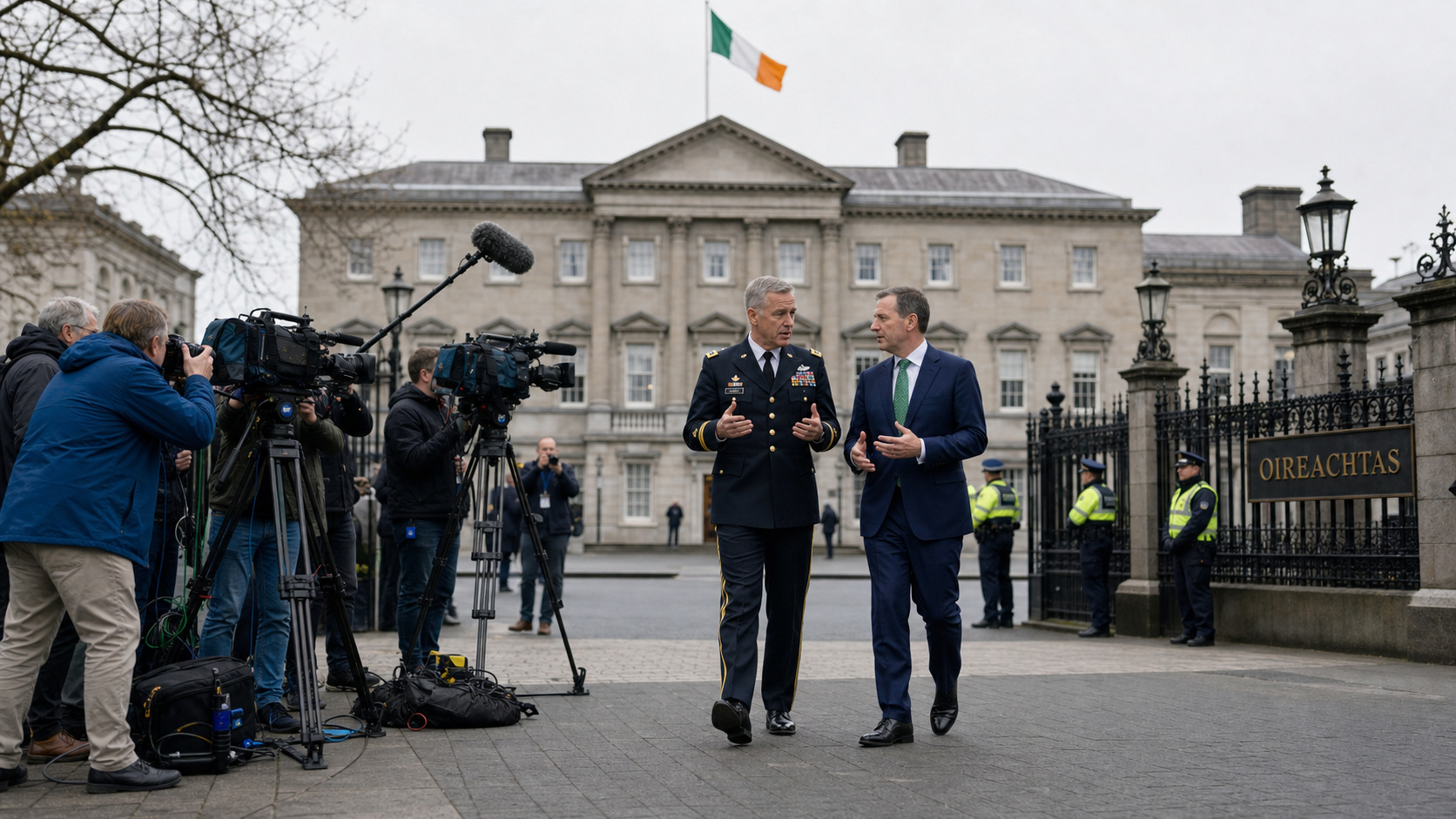
NATO Chief Calls for Irish Debate on Neutrality as Government Reaffirms Non-Alignment Policy
General Alexus Grynkewich, Supreme Allied Commander Europe, has visited Dublin and stated publicly that Ireland needs to have a conversation about its defence policy and its long-standing policy of military neutrality, prompting the Irish government to reaffirm its commitment to non-alignment while acknowledging the evolving security environment and the need for enhanced defence capabilities.
Background
Ireland's policy of military neutrality has been a cornerstone of its independent foreign policy since the foundation of the state, and it enjoys broad public support that has consistently been reflected in opinion polls and in the political positions of all major parties. The policy dictates that Ireland does not participate in military alliances or common defence arrangements, though it has been a member of NATO's Partnership for Peace programme since 1999 and joined the alliance's Individually Tailored Partnership Programme in 2024 to enhance its capabilities in protecting critical undersea infrastructure.
The European security environment has changed dramatically since Russia's full-scale invasion of Ukraine in 2022, and Ireland has not been immune to the pressures that have led other traditionally neutral European states — Finland, Sweden — to seek NATO membership. The Irish government has responded to the changed environment by committing to record-high defence budgets, with a stated goal of reaching €1.5 billion annually by 2028, and by focusing investment on the protection of the undersea data cables that transit through or near Irish waters and that are vital to global internet traffic.
General Grynkewich's visit to Dublin is part of a broader NATO effort to engage with partner countries and to encourage a public debate about the role of military alliances in the current security environment. His public statement that Ireland needs to have a conversation about its defence policy is consistent with the alliance's approach to other neutral and non-aligned European states, though it carries particular resonance in Ireland given the depth of public attachment to the neutrality tradition.
Key Developments
General Grynkewich met with senior Irish government officials and military leaders during his Dublin visit, discussing the security challenges facing Europe and Ireland's role in the broader European security architecture. His public statement calling for an Irish debate on neutrality was carefully worded — he did not call for Ireland to join NATO, but rather for a public conversation about what neutrality means in the current security environment and whether Ireland's current defence posture is adequate to protect its interests and meet its international obligations.
The Irish government's response was measured. Taoiseach Micheál Martin reaffirmed Ireland's commitment to military non-alignment, emphasising that the policy does not equate to political neutrality and that Ireland remains an active participant in international conflict resolution, peacebuilding, and humanitarian missions under the auspices of the United Nations and the European Union. The Minister for Defence, however, acknowledged that the security environment has changed and that Ireland's defence capabilities need to be enhanced to meet modern threats, particularly in the areas of cyber security, maritime surveillance, and the protection of critical infrastructure.
The debate about Irish neutrality has been simmering for several years, with a Commission on the Defence Forces recommending in 2022 that Ireland significantly increase its defence spending and capabilities. The government has accepted the broad thrust of those recommendations, but has been careful to frame the investment as enhancing Ireland's ability to fulfil its existing commitments — UN peacekeeping, EU missions, maritime patrol — rather than as a step toward NATO membership.
Why It Matters
The neutrality debate touches on some of the deepest questions about Irish identity and Ireland's place in the world. For a country that achieved independence through a struggle against British imperialism and that has defined itself in part through its non-participation in the military alliances of the great powers, the question of whether to maintain, modify, or abandon neutrality is not merely a strategic calculation but a matter of national self-understanding. The public's attachment to neutrality is genuine and deep, and any government that sought to move toward NATO membership without a referendum would face significant political consequences. At the same time, the changed security environment in Europe — with Russia's aggression in Ukraine demonstrating that the post-Cold War peace cannot be taken for granted — has created space for a more nuanced public debate about what neutrality means and what it requires in practice.
Local Impact
The neutrality debate has practical implications for communities across Ireland, from the Defence Forces personnel who serve on UN peacekeeping missions to the coastal communities that depend on the Naval Service for maritime patrol and search and rescue. The planned increase in defence spending will create employment in the Defence Forces and in the defence industry, and the focus on protecting undersea infrastructure has particular relevance for communities along the west coast, where the landing stations for transatlantic data cables are located. The debate also has implications for Ireland's relationship with the European Union, where the development of a common defence policy under the Strategic Compass framework is creating new expectations of member states' defence contributions.
What's Next
The government is expected to publish a White Paper on Defence in the autumn of 2026, setting out its long-term vision for the Defence Forces and Ireland's security policy. The document will address the neutrality question directly, though it is unlikely to recommend a fundamental change in policy without a prior public debate and, potentially, a referendum. The Dáil's Joint Committee on Foreign Affairs and Defence is expected to hold hearings on the neutrality question in the coming months, providing a forum for a structured public debate. General Grynkewich's visit has ensured that the issue will remain on the political agenda for the foreseeable future.