More Than 200 NI Hospitality Firms Have Closed in 2026 as VAT Gap with Republic Reaches Breaking Point
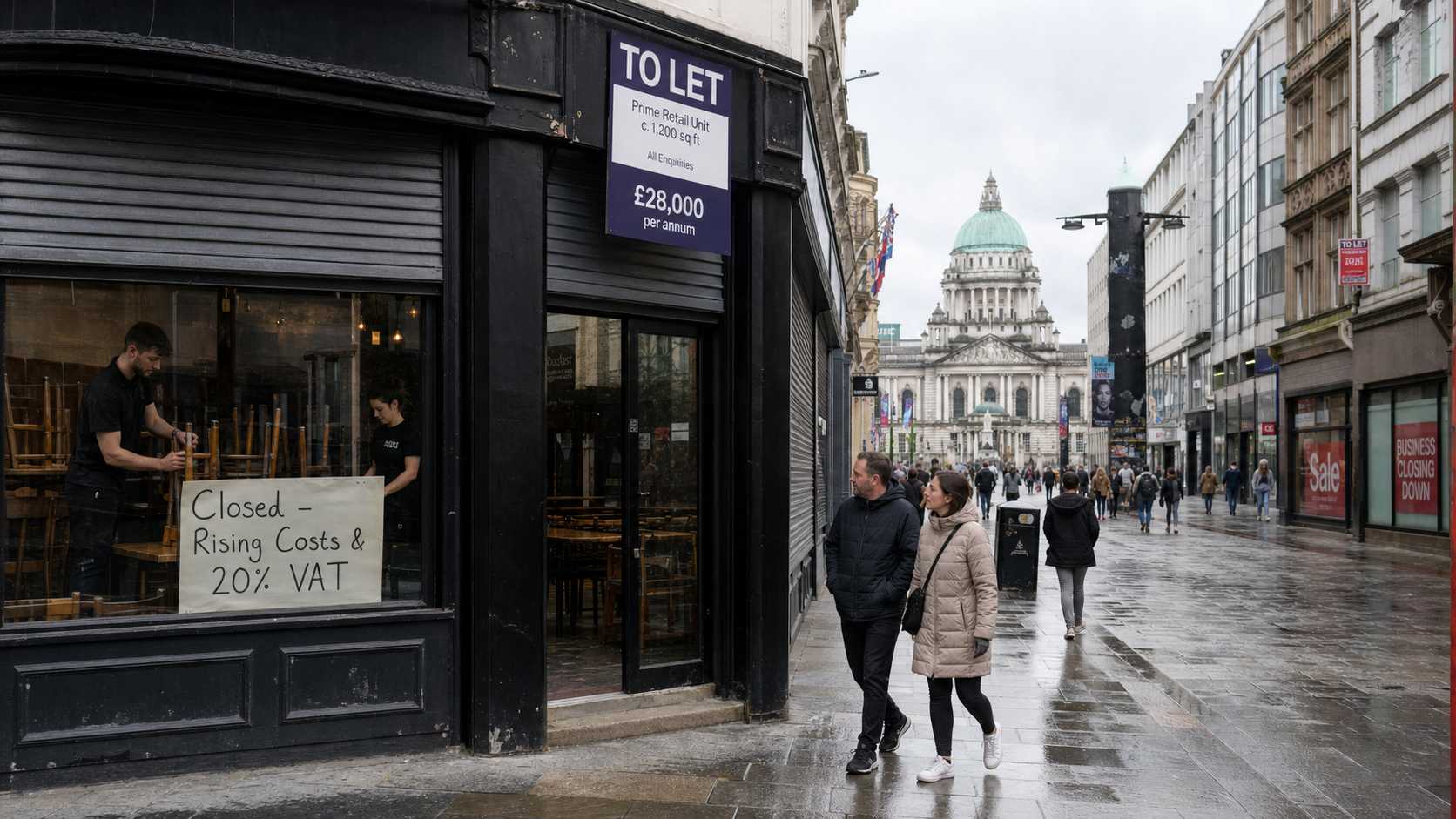
Northern Ireland's hospitality industry is haemorrhaging businesses at a rate that trade leaders describe as unsustainable, with Hospitality Ulster confirming this week that more than 200 pubs, restaurants, hotels, and cafés have closed their doors in 2026 — an average of 40 closures every month. The sector is pointing to a toxic combination of soaring costs and a widening VAT gap with the Republic of Ireland as the primary drivers of a crisis that threatens to fundamentally reshape the region's food and drink landscape.
Background
Northern Ireland's hospitality sector has been under pressure since the pandemic, but the pace of closures in 2026 has alarmed even those who have been tracking the industry's difficulties for years. The sector employs tens of thousands of people across the region and is a cornerstone of the tourism economy, which the Northern Ireland Tourist Board has been working to grow towards a target of £1 billion in annual visitor spending.
The challenges facing the sector are multiple and interconnected. Energy costs, which spiked dramatically in 2022 and 2023, have remained elevated. Labour costs have risen significantly following increases in the National Living Wage. Food and drink input costs have been pushed higher by supply chain disruptions and the lingering effects of Brexit on import arrangements. And the consumer, squeezed by the cost of living crisis, has been eating and drinking out less frequently.
But the issue that Hospitality Ulster has identified as the most structurally damaging is the VAT differential between Northern Ireland and the Republic. In the Republic, the government reduced the hospitality VAT rate to 9% during the pandemic and, after a brief return to 13.5%, has now confirmed it will be set at 9% from July 2026. In Northern Ireland, which operates under UK tax rules, the standard VAT rate of 20% applies to hospitality. This creates a competitive disadvantage that operators on the border — and increasingly those across the region — describe as impossible to overcome.
Key Developments
Colin Neill, chief executive of Hospitality Ulster, presented the closure figures to media this week alongside a stark assessment of the sector's prospects. "We are losing businesses at a rate that should alarm everyone," he said. "These are not just statistics — they are families, they are communities, they are the social fabric of towns and villages across Northern Ireland. When the local pub closes, something irreplaceable is lost."
Neill called for urgent action on VAT, arguing that the UK government must either reduce the rate for Northern Ireland's hospitality sector or introduce a specific mechanism to address the competitive disadvantage. "We need a level playing field for Northern Ireland hospitality," he said. "We are competing with businesses in the Republic who are paying less than half the VAT we pay. That is not a market — that is a structural injustice."
The Irish News reported that the closure rate is particularly acute in border areas, where consumers can easily cross into the Republic to eat and drink at lower prices. In Newry, Armagh, and Fermanagh, operators have reported a significant shift in consumer behaviour, with local residents increasingly choosing to travel south for meals and social occasions. One Newry restaurateur told the paper: "I cannot compete with a restaurant in Dundalk that is paying 9% VAT when I am paying 20%. It is as simple as that."
Why It Matters
The hospitality crisis matters because it is not simply an economic story — it is a social one. Pubs, restaurants, and cafés are the spaces where communities gather, where friendships are maintained, where local identity is expressed and reinforced. Their closure leaves gaps that are not easily filled. In rural areas of Northern Ireland, the local pub is often the only social venue for miles; its loss can accelerate the isolation and decline of entire communities.
The VAT issue also illustrates a broader structural challenge facing Northern Ireland's economy. As a region that is part of the United Kingdom but shares a land border and a single market in goods with the Republic of Ireland, Northern Ireland occupies a unique and often uncomfortable position. The Windsor Framework has addressed some of the trade frictions created by Brexit, but it has done nothing to address the tax differentials that are now driving businesses to the wall.
The contrast with the Republic's approach is instructive. Dublin's decision to maintain a reduced hospitality VAT rate was explicitly justified as a measure to support a sector that is vital to the tourism economy and to employment in communities across the country. Northern Ireland's operators are making exactly the same argument — and getting exactly the opposite response from Westminster.
Local Impact
The impact of the closures is being felt most acutely in smaller towns and rural areas. In Fermanagh, where tourism is a significant part of the local economy, several well-established hospitality businesses have closed in recent months. In Tyrone, the closure of a number of rural pubs has left communities without a social hub. In Derry/Londonderry, the city's restaurant scene — which had been growing strongly in recent years — has seen several high-profile closures. Even in Belfast, where the hospitality market is more resilient, operators are reporting that margins have been squeezed to the point where any further cost increase could tip them into closure.
What's Next
Hospitality Ulster is planning a lobbying campaign targeting both Westminster and Stormont, with a formal submission to the UK Treasury expected in the coming weeks. The organisation is also seeking a meeting with the Secretary of State for Northern Ireland to make the case for a specific VAT intervention. At Stormont, the Economy Committee is expected to hold a hearing on the hospitality crisis in July. Tourism Ireland, meanwhile, is pressing ahead with its strategy to attract visitors from India, China, and Canada, with a target of pushing total tourism spending in Northern Ireland above £1 billion annually — a target that will be significantly harder to achieve if the hospitality infrastructure continues to contract at its current rate.