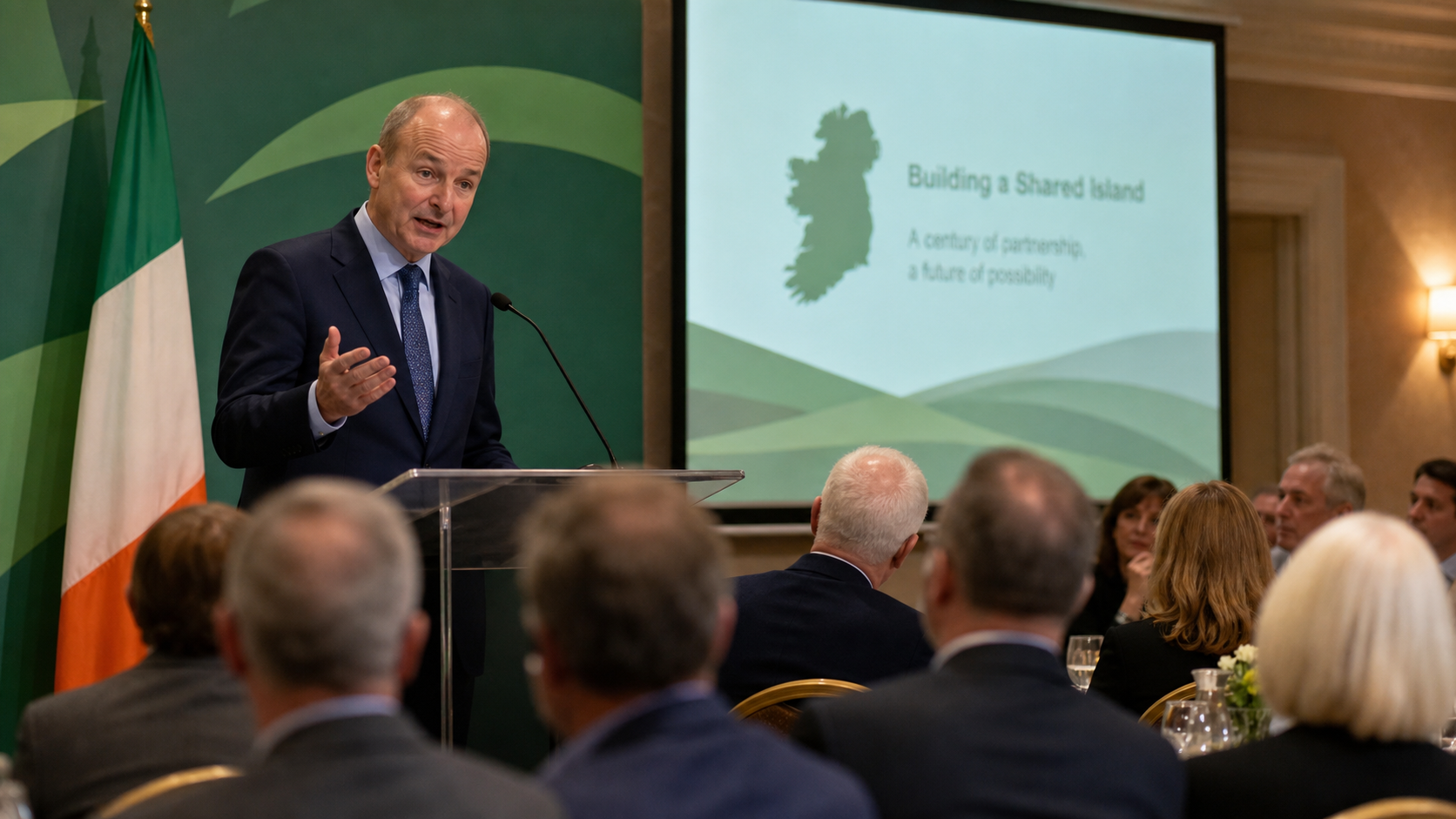
Micheál Martin Says Talk of Border Poll Makes Him 'Go Bananas' as He Prioritises Shared Island
Taoiseach Micheál Martin has expressed pointed frustration with the persistent political focus on a border poll, declaring that such discussions make him "go bananas" and insisting that his government's priority is the practical work of the Shared Island initiative rather than what he characterised as superficial constitutional rhetoric — remarks that have drawn both support and criticism from across the political spectrum.
Background
The question of a border poll — a referendum on Irish unity that could, under the terms of the Good Friday Agreement, be called by the Secretary of State for Northern Ireland if it appears likely that a majority would vote for a united Ireland — has been a recurring feature of political debate in both jurisdictions since the Brexit referendum of 2016. The prospect of Northern Ireland leaving the European Union against the wishes of a majority of its voters, combined with Sinn Féin's historic electoral performances in both the 2022 Assembly election and the 2024 Dáil election, gave the issue a new urgency that it had not previously possessed.
Micheál Martin has consistently sought to manage expectations about the timeline for a border poll, arguing that the conditions for a successful referendum — including a genuine majority in favour of unity and a credible plan for what a united Ireland would look like — are not yet in place. His position has put him at odds with Sinn Féin, which has argued that the government should be actively preparing for a poll, and with some within his own party who believe that Fianna Fáil's traditional commitment to Irish unity requires a more proactive approach.
The Shared Island initiative, which Martin has championed since his first term as Taoiseach, commits €2 billion to cross-border projects through 2035 and focuses on practical cooperation in areas including infrastructure, health, education, and economic development. Martin has argued that this kind of tangible, community-level cooperation is more likely to build the conditions for eventual unity than a premature referendum that could entrench division.
Key Developments
Speaking at a Fianna Fáil centenary event in Tipperary, Martin was characteristically direct in his frustration with the border poll question. "I go bananas when fellows talk to me and say, 'What about a Border poll?'" he told the gathering, arguing that such talk prioritises political rhetoric over the substantive work of reconciliation and practical cooperation. He reiterated his view that a border poll is not imminent and that the government's focus should be on the Shared Island initiative and on building genuine relationships between communities on both sides of the border.
The remarks have drawn criticism from Sinn Féin, which has accused Martin of creating an "artificial barrier" to a border poll by insisting on conditions that may never be fully met. Former Taoiseach Leo Varadkar has previously made a similar argument, suggesting that the requirement for "total reconciliation" as a prerequisite for a poll is an unrealistic standard. Sinn Féin's Finance Minister John O'Dowd has described Martin's approach as a "disservice" to those who view partition as a historical injustice that should be addressed urgently.
Martin has maintained that his position is one of honesty rather than obstruction, arguing that it would be irresponsible to raise expectations about a border poll that he does not believe will happen within the next five years. He has pointed to the Shared Island initiative's concrete achievements — including cross-border health cooperation, infrastructure investment, and educational exchange programmes — as evidence that his approach is producing real results.
Why It Matters
The border poll debate cuts to the heart of some of the most fundamental questions in Irish politics: what does Irish unity mean, how should it be pursued, and what is the relationship between constitutional aspiration and practical governance? Martin's position — that reconciliation must precede a referendum — reflects a particular reading of the Good Friday Agreement's provisions and a particular assessment of the political risks of a premature poll. His critics argue that this reading is too conservative and that the conditions for a poll are closer than he acknowledges.
The debate also reflects a generational shift in Irish politics. For many younger voters in both jurisdictions, the question of Irish unity is not the abstract constitutional aspiration it was for their parents' generation — it is a live political question with practical implications for their lives, their careers, and their sense of identity. The political parties that are seen as most credibly engaging with that question are likely to benefit electorally, which is why the border poll debate is unlikely to go away regardless of Martin's personal frustrations.
Local Impact
In border communities across counties Donegal, Cavan, Monaghan, Louth, and Armagh, the border poll debate has a particular resonance. These are communities that live with the practical consequences of partition every day — in the form of different health systems, different educational structures, different currencies, and different regulatory frameworks. The Shared Island initiative has delivered tangible benefits in some of these areas, including investment in cross-border road infrastructure and health cooperation projects. But many residents of border communities argue that the practical benefits of the initiative, while welcome, do not address the fundamental question of whether partition serves their interests.
What's Next
Martin is expected to continue to resist calls for a more proactive approach to border poll preparation, at least for the remainder of the current Dáil term. The Shared Island Unit in the Department of the Taoiseach is expected to publish a new report on cross-border cooperation in the autumn, which will be used to demonstrate the initiative's achievements. Sinn Féin is expected to continue to press the government on border poll preparation, and the issue is likely to feature prominently in the next general election campaign. The Secretary of State for Northern Ireland has indicated that the UK government has no current plans to call a border poll.