Live Register Climbs to 191,880 in July as New Benefit Scheme Reshapes Unemployment Landscape
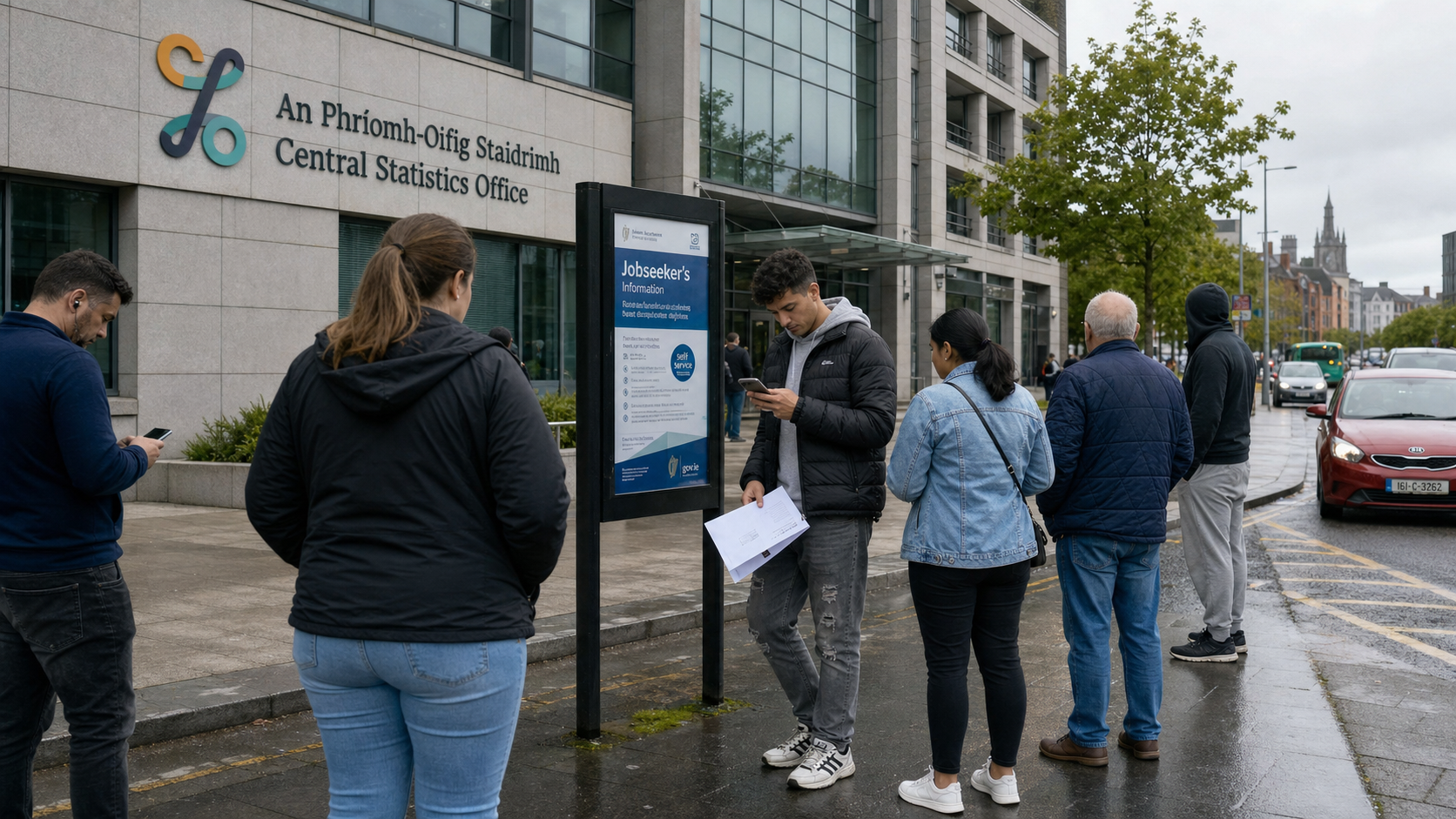
The Central Statistics Office has reported that the unadjusted Live Register figure reached 191,880 in July 2026, representing a 3.4% increase of 6,253 individuals compared to July 2025, with the seasonally adjusted total rising by 1,200 from June to reach 174,500 — figures that reflect both the underlying state of the Irish labour market and the significant structural changes introduced by the Jobseeker's Pay-Related Benefit scheme that came into effect in March 2025.
Background
The Live Register is Ireland's primary measure of the number of people claiming unemployment-related benefits, and its monthly publication by the Central Statistics Office is one of the most closely watched economic indicators in the country. The register includes recipients of Jobseeker's Benefit, Jobseeker's Allowance, and a range of other payments, and its movements are taken as a broad indicator of labour market conditions, though it is not a precise measure of unemployment in the technical sense used by international statistical agencies.
The introduction of the Jobseeker's Pay-Related Benefit scheme in March 2025 represented the most significant reform of Ireland's unemployment benefit system in decades. The scheme, which links the level of benefit to a claimant's previous earnings, was designed to provide a more adequate income replacement for workers who lose their jobs and to bring Ireland's unemployment support system closer to the model used in most other EU member states. The reform has had a significant impact on the composition of the Live Register, with claims under the new scheme rising sharply while traditional Jobseeker's Benefit claims have declined.
The July 2026 figures are the latest in a series of monthly releases that have shown a gradual upward trend in the register over the course of the year, reflecting a labour market that, while still relatively strong by historical standards, is showing signs of softening as the global economic environment becomes more challenging.
Key Developments
The CSO's July 2026 release showed that of the 191,880 unadjusted claimants, 52.2% were male and 73.4% were Irish nationals. Non-Irish EU nationals accounted for 10.7% of the total, while approximately 3% were from the United Kingdom and nearly 13% were from other countries. The age group of 25-34 represented the largest segment on the register, comprising 24.5% — or 47,045 people — of the total.
The impact of the Jobseeker's Pay-Related Benefit scheme is clearly visible in the data. Claims under the new scheme rose by 71.9% year-on-year, while traditional Jobseeker's Benefit claims declined by 33.5% — a pattern that reflects the migration of claimants from the old system to the new one rather than a genuine increase in unemployment. The figures also included 11,488 individuals benefiting from the EU's Temporary Protection Directive, a decrease of 2.2% compared to the previous month and 6.4% lower than the previous year.
Regional variations in the data showed that Wexford experienced the highest year-on-year increase in claimants at 7.2%, followed by Longford at 6.2%. Conversely, Monaghan and Clare recorded the largest decreases, falling by 4.1% and 4.0% respectively — a pattern that reflects the uneven distribution of economic activity across the country.
Why It Matters
The Live Register figures are a lagging indicator of labour market conditions, and the July 2026 data should be interpreted with caution. The 3.4% year-on-year increase is partly a statistical artefact of the Jobseeker's Pay-Related Benefit reform, which has brought more workers into the formal benefit system than were previously captured by the register. The underlying labour market remains relatively healthy by historical standards, with employment levels near record highs and unemployment well below the peaks seen during the financial crisis of the 2010s.
However, the gradual upward trend in the seasonally adjusted register — which has risen for several consecutive months — is a signal that the labour market is cooling, and economists have noted that the trend is consistent with a broader slowdown in economic activity that is being felt across the EU. The government will be watching the data closely as it prepares Budget 2027, with the Live Register figures feeding into projections for social welfare expenditure and the overall fiscal position.
Local Impact
The regional breakdown of the July figures highlights the continuing divergence between the labour market performance of different parts of Ireland. The high year-on-year increases in Wexford and Longford suggest that those counties are experiencing particular difficulties, while the decreases in Monaghan and Clare indicate that some areas are continuing to see employment growth. The figures will inform the allocation of employment support resources by the Department of Social Protection and the regional offices of the Department of Enterprise, and they will be used by local enterprise offices and SOLAS to target training and activation programmes at the areas of greatest need.
What's Next
The August Live Register figures will be published by the CSO in September 2026, and economists will be watching closely for any further movement in the seasonally adjusted total. The government's Budget 2027 preparations are expected to include a review of the Jobseeker's Pay-Related Benefit scheme's impact on the Live Register and on the overall cost of unemployment supports. The Department of Social Protection has indicated that it will publish a review of the scheme's first year of operation in the autumn, which will provide a more detailed assessment of its impact on claimants and on the labour market.