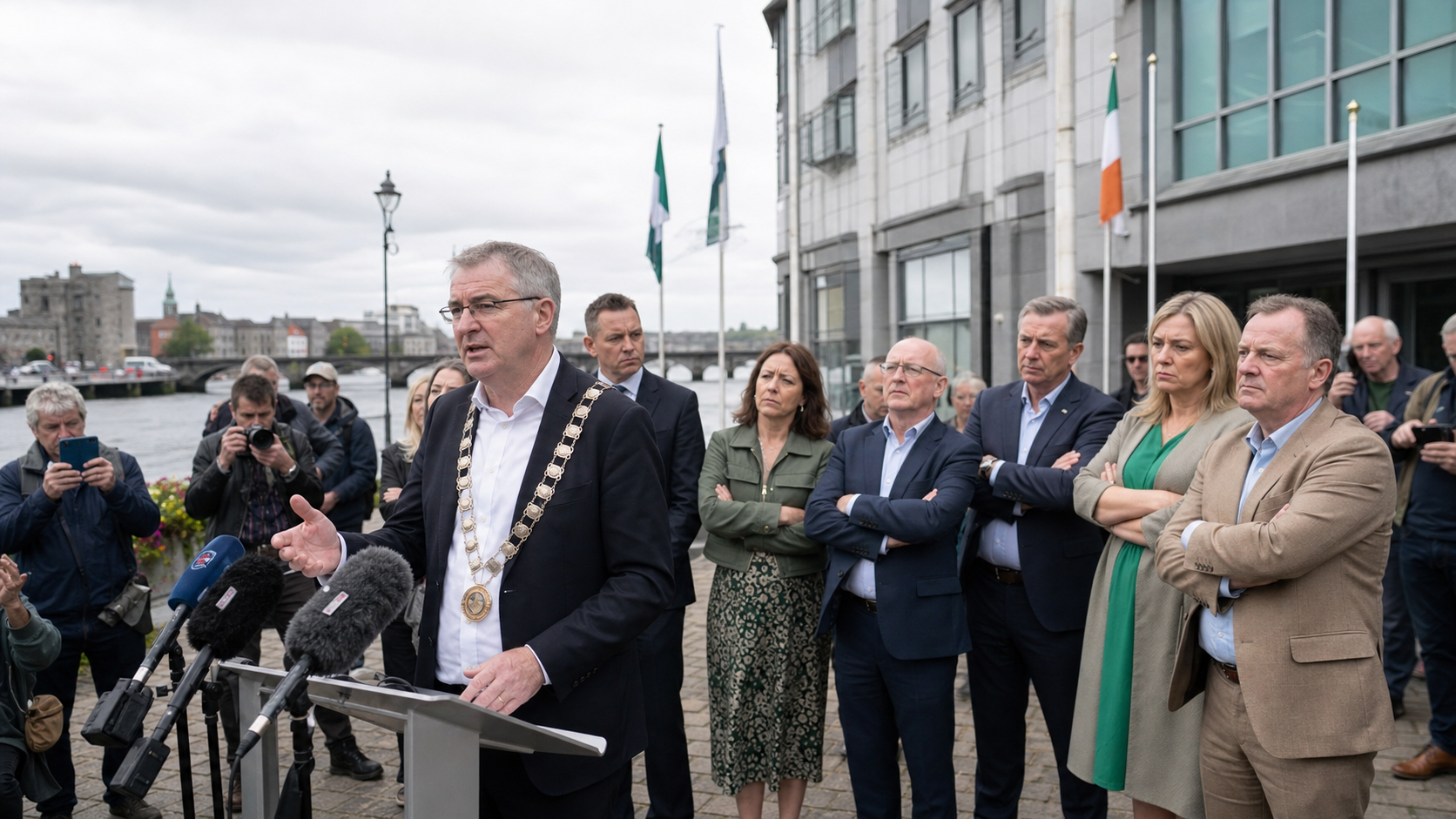
Limerick Mayor John Moran Defiant as Councillor Rows Intensify: 'I Will Run Again'
Limerick's first directly elected mayor, John Moran, has declared his intention to seek re-election despite a period of sustained political turbulence that has seen him clash repeatedly with Fianna Fáil and Fine Gael councillors over road closures, the passage of the council's corporate plan, and the fundamental question of how executive power is divided between the directly elected mayor and the elected council.
Background
John Moran was elected as Limerick's first directly elected mayor in June 2024, a historic moment for Irish local government and the culmination of years of campaigning by Limerick civic leaders for a stronger executive model of city governance. The directly elected mayor model, which gives the mayor significant executive powers over the city and county council, was seen as a potential template for other Irish cities and as a way of driving more decisive and accountable local leadership.
Moran, a former Secretary General of the Department of Finance, came to the role with a reputation as a technocratic reformer with ambitious plans for Limerick's economic and urban development. His first two years in office have been marked by genuine achievements — including progress on major infrastructure projects and a series of city centre activation initiatives — but also by persistent friction with a group of Fianna Fáil and Fine Gael councillors who have challenged his authority on multiple fronts.
The tensions came to a head in February 2026, when the council passed its corporate plan for 2025-2029 during a meeting from which Moran had departed due to a health concern. The mayor subsequently wrote to Taoiseach Micheál Martin and Tánaiste Simon Harris to express "serious concerns" about the conduct of the meeting, a move that was described as "pathetic" by Fianna Fáil councillor Catherine Slattery.
Key Developments
The most recent flashpoint involved the "Summer in the City" programme, a month-long series of city centre events that required road closures in parts of Limerick city. A group of Fianna Fáil councillors attempted to invoke Section 140 of the Local Government Act 2001 to stop the planned closures, citing concerns from local traders. Moran challenged the legality of the move and accused the councillors of attempting to "hijack" his programme while he was abroad.
Despite the ongoing tensions, Moran has been unequivocal about his intention to seek re-election when his term expires. He has accused a "small minority" of councillors of pursuing a deliberate strategy to ensure his term is unsuccessful, while acknowledging that the majority of councillors continue to work constructively with his office.
The Irish Examiner has reported that Moran has acknowledged he may have been "ahead of the thought process of councillors" on some issues, a rare concession that suggests some awareness of the political dynamics at play.
Why It Matters
The Limerick mayoral experiment is being watched closely by advocates for local government reform across Ireland. If the directly elected mayor model is seen to be dysfunctional — characterised by constant conflict between the mayor and the council rather than by effective executive leadership — it will be much harder to make the case for extending the model to Dublin, Cork, and other cities. The current difficulties in Limerick reflect a genuine ambiguity in the legislation about the division of powers between the mayor and the council, an ambiguity that was perhaps inevitable given that the model was new and untested. The question is whether those ambiguities can be resolved through political accommodation or whether they require legislative clarification.
Local Impact
For Limerick city and county, the political turbulence at the top of local government has had real consequences. Several significant decisions have been delayed or complicated by the ongoing disputes, and the energy that might have been devoted to delivering on the mayor's ambitious agenda has been consumed by political conflict. Business groups in the city have expressed frustration at the instability, while community organisations have called for a period of political calm to allow the council to focus on the practical challenges facing the city. The "Summer in the City" programme, despite the controversy over the road closures, has been well received by the public, suggesting that Moran's instincts about city centre activation are broadly correct even if his political management has sometimes been less sure-footed.
What's Next
Moran's term as mayor runs until June 2028. The next mayoral election will be held alongside the local elections in that year. The government has indicated it is considering legislative clarification of the powers of directly elected mayors, which could resolve some of the ambiguities that have fuelled the current disputes. A mediation process between the mayor and the council has been suggested by some observers, though neither side has publicly endorsed that approach. The Irish Examiner has reported that Moran is planning a series of major announcements in the autumn that he hopes will reset the political narrative around his mayoralty.