Keir Starmer Resigns as UK Prime Minister; Irish Government Eyes Andy Burnham as Successor
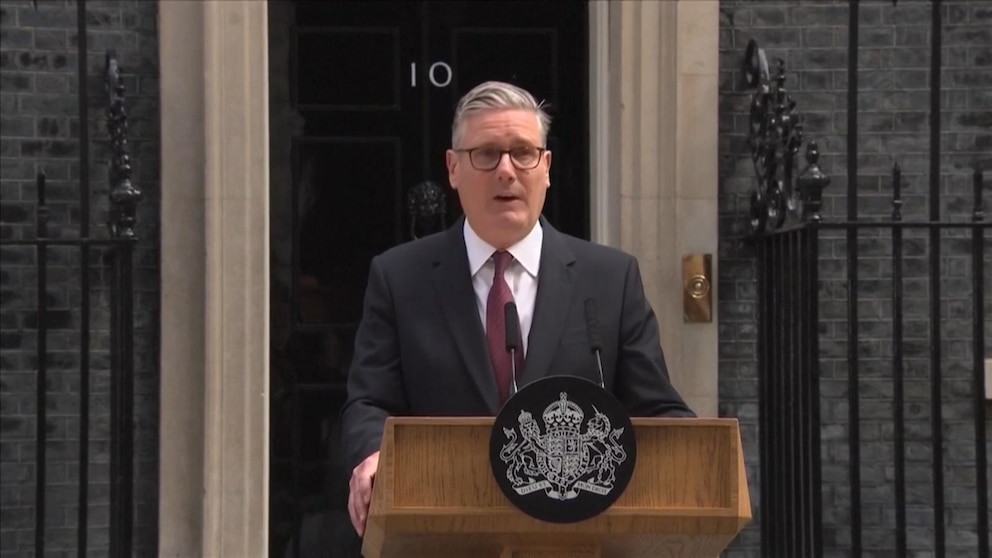
Keir Starmer has resigned as British Prime Minister, delivering a resignation speech from Downing Street on Monday that confirmed his departure from office after less than two years in power — continuing a pattern of premature exits from Number 10 that has defined British politics for the better part of a decade. Greater Manchester Mayor Andy Burnham has emerged as the leading contender to succeed him, with Irish government sources describing the prospect of a Burnham premiership as "business as usual," a phrase that signals Dublin's expectation of continuity on the issues that matter most to Ireland: the Windsor Framework, cross-border cooperation, and the stability of the Northern Ireland institutions.
Background
Keir Starmer came to power in July 2024 with a landslide majority, ending fourteen years of Conservative government and raising hopes in Dublin and Belfast that a new era of stable, constructive Anglo-Irish relations was beginning. Those hopes were not entirely misplaced. Starmer's government maintained the Windsor Framework, engaged constructively with the Irish government on a range of issues, and avoided the confrontational approach to Northern Ireland that had characterised some of his Conservative predecessors. But his tenure was marked by persistent political difficulties at home, and his resignation on Monday brings to an end a premiership that never quite fulfilled its early promise.
The circumstances of Starmer's resignation have not been fully disclosed at the time of writing, but the pattern is familiar. British politics has been characterised by extraordinary instability at the top since the Brexit referendum of 2016, with five Prime Ministers in eight years before Starmer took office. His departure adds to that record, and raises questions about the structural factors — the nature of the British media, the internal dynamics of the Labour Party, the pressures of governing in a post-Brexit environment — that have made it so difficult for any Prime Minister to sustain their position.
For Ireland, the instability of British politics is not merely an interesting spectacle but a genuine concern. The relationship between the two governments is central to the functioning of the Good Friday Agreement and the Northern Ireland institutions, and the quality of that relationship depends significantly on the personal and political chemistry between the leaders involved. Every change of Prime Minister in London requires a period of relationship-building in Dublin, and the uncertainty of the transition period is itself a source of risk.
Key Developments
Andy Burnham's emergence as the leading contender to succeed Starmer is significant for Ireland for several reasons. Burnham, who has served as Mayor of Greater Manchester since 2017, is a senior Labour figure with a long track record in national politics, having served as Health Secretary and Home Secretary under Gordon Brown. He is seen within the Labour Party as a pragmatic, centrist figure with strong communication skills and a genuine connection to working-class communities — qualities that are seen as essential for Labour's electoral prospects.
Irish government sources' description of a potential Burnham premiership as "business as usual" reflects a judgement that he is unlikely to seek to renegotiate the Windsor Framework or to take a confrontational approach to Northern Ireland. Burnham has not been a prominent voice on Northern Ireland issues during his time as Mayor of Manchester, but his general political positioning — pro-European in instinct, supportive of devolution, pragmatic on constitutional questions — is seen as compatible with a constructive approach to Anglo-Irish relations.
The Taoiseach's office has indicated that it will seek an early meeting with whoever succeeds Starmer, to reaffirm the importance of the bilateral relationship and to discuss the range of issues — from the Windsor Framework to cross-border infrastructure investment — that require ongoing engagement between the two governments. The Irish Ambassador in London has been in contact with senior Labour figures in the days since Starmer's resignation, seeking to understand the likely direction of the leadership contest.
Why It Matters
The change of UK Prime Minister matters for Ireland in ways that are both immediate and long-term. In the immediate term, the transition creates uncertainty about the pace and direction of UK-Ireland engagement on a range of issues, from the implementation of the Windsor Framework to the progress of cross-border infrastructure projects. Decisions that were in the pipeline under Starmer may be delayed or reconsidered as a new Prime Minister establishes their priorities.
In the longer term, the identity and approach of the new Prime Minister will shape the context in which the Northern Ireland institutions operate for years to come. The Windsor Framework, which resolved the most acute tensions created by Brexit in relation to Northern Ireland, remains a fragile settlement that depends on the goodwill of both governments to function effectively. A UK Prime Minister who is committed to making it work — as Starmer was — is a very different proposition from one who is sceptical of its value or who sees it as a political liability.
The broader pattern of British political instability is also a concern for Ireland. The Good Friday Agreement was negotiated and implemented in a context of relatively stable British politics, with governments that had the capacity and the will to engage seriously with the complex issues involved. The current environment — in which Prime Ministers come and go with alarming frequency — is a much more challenging one for sustaining the kind of long-term, relationship-based diplomacy that the Irish question requires.
Local Impact
In Northern Ireland, the reaction to Starmer's resignation has been mixed. Unionist parties, which had a generally constructive relationship with the Starmer government on issues including the Windsor Framework and the Stormont budget, have expressed concern about the uncertainty created by the transition. Nationalist and republican parties have been more sanguine, noting that the fundamental architecture of the Good Friday Agreement is not dependent on any individual Prime Minister.
For the business community in Northern Ireland, which has benefited significantly from the dual market access provided by the Windsor Framework, the change of Prime Minister is a source of anxiety. The framework has been a significant competitive advantage for Northern Ireland businesses, and any suggestion that a new Prime Minister might seek to renegotiate or undermine it would be deeply unwelcome. Business organisations including the CBI Northern Ireland and the Northern Ireland Chamber of Commerce have called for continuity on the Windsor Framework regardless of who leads the UK government.
What's Next
The Labour Party leadership contest is expected to begin in the coming days, with Andy Burnham the early frontrunner but by no means the certain winner. Other potential candidates include senior Cabinet ministers and Labour MPs who may seek to position themselves as alternatives. The contest is expected to last several weeks, during which the UK will be governed by a caretaker administration. The Irish government has indicated that it will maintain normal diplomatic engagement with the UK during the transition period and will seek to establish a strong working relationship with whoever emerges as the new Prime Minister as quickly as possible.