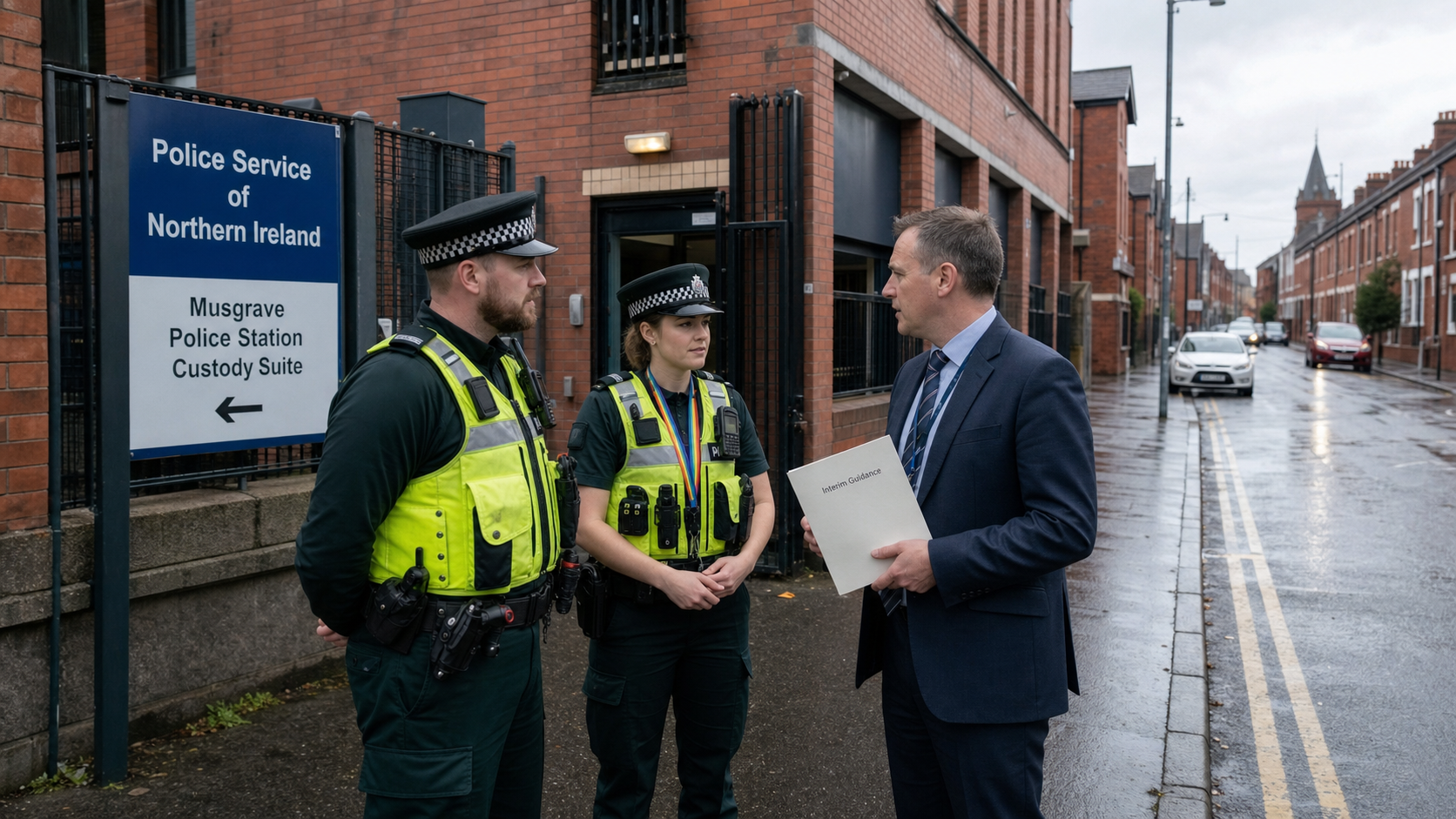
Justice Department Issues Controversial Interim Guidance on Searching Transgender Detainees in PSNI Custody
Northern Ireland's Department of Justice has introduced new interim guidance for the Police Service of Northern Ireland governing the searching of transgender individuals held in custody, a policy that has immediately attracted controversy, with critics arguing it creates an unworkable operational framework for officers and raises serious concerns about the rights and safety of female police personnel — while supporters contend it is a necessary step towards treating transgender detainees with dignity and respect.
Background
The question of how police forces should handle the searching and detention of transgender individuals has become one of the most contested policy areas in British and Irish policing in recent years. The issue sits at the intersection of competing rights frameworks — the rights of transgender individuals to be treated in accordance with their gender identity, and the rights of other detainees and police officers to privacy and safety during search procedures. Different police forces across the UK have adopted varying approaches, and the absence of a consistent national framework has led to a patchwork of local policies that have been criticised from multiple directions.
In Northern Ireland, the issue has been particularly sensitive given the PSNI's complex relationship with different communities and the heightened political scrutiny that attaches to any policy decision that touches on identity, rights, and equality. The Department of Justice has been working on guidance in this area for some time, consulting with a range of stakeholders including PSNI leadership, the Police Federation for Northern Ireland, transgender advocacy organisations, and women's rights groups. The interim guidance published on 2 July represents the outcome of that process, though it is explicitly described as a temporary measure pending a fuller review.
The guidance comes in the context of a broader UK-wide debate about transgender rights and the application of the Equality Act 2010, which has been the subject of significant legal and political controversy. The UK Supreme Court's ruling in April 2025 that the term 'woman' in the Equality Act refers to biological sex has added a further layer of complexity to the policy landscape, and the Department of Justice has had to navigate these competing legal frameworks in developing its guidance for the PSNI.
Key Developments
The interim guidance requires PSNI officers to attempt to find an officer of the same sex as the detainee's 'predominant lifestyle' if the detainee requests it during a search procedure. If it is operationally unfeasible to locate such an officer — for example, in a custody suite where no officer of the requested sex is available — the search would revert to being conducted by an officer of the detainee's biological sex. The guidance also sets out requirements for the recording of such requests and the documentation of the operational decisions made in response.
The policy has drawn immediate and sharp criticism from the Ulster Unionist Party leader, who described it as placing officers in an 'invidious position' and argued that it creates confusion and potential legal liability for individual officers trying to comply with competing obligations. Critics of the guidance have also raised concerns about the implications for female police officers, with one commentator warning that the policy 'risks the dignity and safety of female police officers' by potentially requiring them to conduct searches of individuals who are biologically male.
The Department of Justice has defended the guidance as a proportionate and carefully considered response to a genuinely complex policy challenge, noting that it is explicitly interim in nature and will be subject to review in light of operational experience and any further legal developments. The PSNI has said it will implement the guidance and provide appropriate training to officers to ensure they understand their obligations under the new policy.
Why It Matters
This policy debate matters because it reflects the genuine difficulty of translating competing rights frameworks into workable operational guidance for frontline police officers. The PSNI operates in a jurisdiction where the Human Rights Act 1998, the Equality Act 2010, and the Gender Recognition Act 2004 all apply, and where the courts have not yet provided definitive guidance on how these frameworks interact in the specific context of police searches. The interim nature of the guidance acknowledges this uncertainty, but it also means that officers are being asked to implement a policy that may be subject to further change, which creates its own operational challenges. The controversy also reflects the broader polarisation of public debate on transgender issues in Northern Ireland and the UK, with strongly held views on all sides making it difficult for policymakers to find approaches that command broad acceptance.
Local Impact
The guidance will apply to all PSNI custody suites across Northern Ireland, from the major facilities at Musgrave Street in Belfast and Strand Road in Derry/Londonderry to smaller custody suites in Antrim, Newry, Omagh, and Enniskillen. The practical implications will vary depending on the staffing levels and gender composition of the officer cohort at each facility. The Police Federation for Northern Ireland, which represents rank-and-file officers, has indicated that it will be seeking urgent clarification from the Department of Justice on a number of operational questions raised by the guidance, including how 'predominant lifestyle' is to be assessed and what documentation officers are required to complete when a request is made. Training on the new guidance is expected to be rolled out to custody officers across the PSNI in the coming weeks.
What's Next
The Department of Justice has committed to reviewing the interim guidance within six months of its implementation, taking into account operational feedback from the PSNI, representations from stakeholder groups, and any relevant legal developments. The review will also consider the approaches adopted by other police forces across the UK and Ireland. The Police Federation has indicated it will submit a formal response to the review, and transgender advocacy organisations have said they will engage constructively with the process. The matter is also expected to be raised in the Northern Ireland Assembly, where members from across the political spectrum have indicated they wish to scrutinise the policy and its implications.