Irish Manufacturing Employment Hits Four-Year High as PMI Reaches 55.1 Despite Global Headwinds
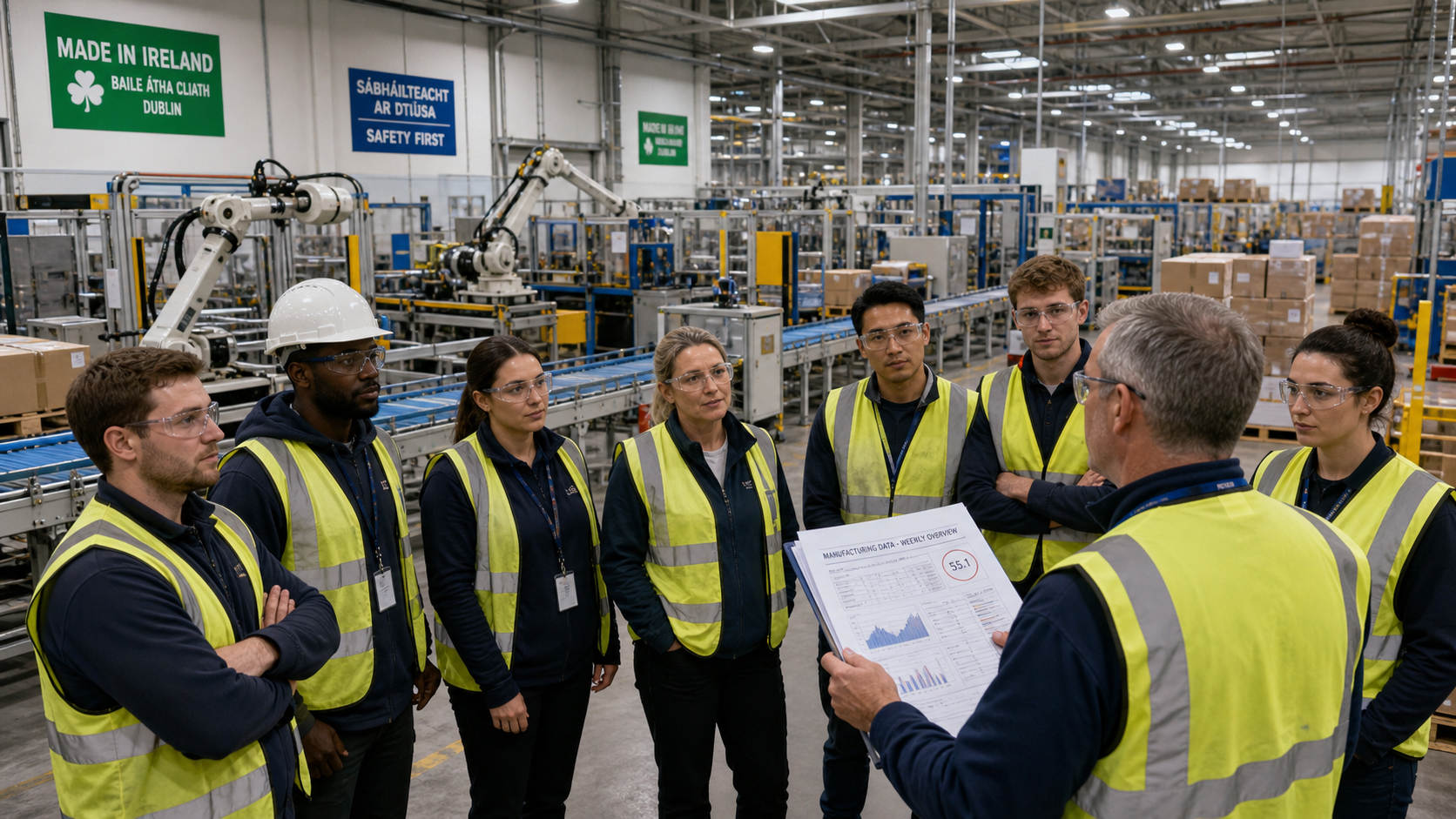
Employment growth in Ireland's manufacturing sector has reached its highest level in more than four years, according to the AIB Ireland Manufacturing Purchasing Managers' Index for July 2026, with the headline index rising to 55.1 — its second-highest reading since May 2022 — as businesses accelerate hiring on the back of robust order books and improved confidence about future demand, even as geopolitical uncertainty and supply chain disruption continue to weigh on export performance.
Background
Ireland's manufacturing sector occupies a distinctive position in the national economy. The presence of a large number of multinational corporations — particularly in pharmaceuticals, medical devices, and technology — means that Ireland's manufacturing output figures are heavily influenced by the activities of a relatively small number of very large companies, creating a statistical picture that can diverge significantly from the experience of the broader domestic manufacturing base. The PMI survey, which captures the sentiment and activity of purchasing managers across a wide range of manufacturing businesses, provides a more granular and timely picture of conditions in the sector than the official output statistics.
The Irish manufacturing sector has demonstrated considerable resilience in the face of the global economic headwinds that have characterised the first half of 2026. The imposition of new US tariffs on 59 countries and the EU — currently the subject of legal challenges from a coalition of 25 US states — has created uncertainty for Irish exporters, particularly those in sectors with significant exposure to the American market. Supply chain disruptions linked to tensions in the Gulf have added further complexity, with transportation delays and reduced availability of certain raw materials affecting production schedules.
Against this backdrop, the July PMI reading of 55.1 — any reading above 50 indicates expansion — represents a genuinely positive signal about the underlying health of the sector. The acceleration in employment growth, in particular, suggests that businesses are sufficiently confident about the medium-term outlook to commit to expanding their workforces.
Key Developments
The July PMI report identified employment growth as the standout feature of the month's data, with the rate of job creation reaching its highest level since May 2022. This marked the third consecutive month in which the pace of employment expansion had accelerated, a trend that businesses attributed to robust order books, improved expectations regarding future demand, and long-term strategic initiatives to increase production capacity. Nearly half of the survey respondents — 46% — indicated an expectation for increased production activity over the coming 12 months, the highest level of optimism recorded in six months.
The sector's performance continues to outpace that of many comparable economies. Irish manufacturers have consistently outperformed their counterparts in the wider eurozone, the United Kingdom, and the United States in recent months, a relative strength that reflects both the specific characteristics of Ireland's manufacturing base and the effectiveness of the government's industrial policy in attracting and retaining high-value manufacturing investment.
However, the report also flagged ongoing challenges. Geopolitical uncertainty — particularly the US tariff situation and the Gulf tensions — continues to place a ceiling on export gains, and some businesses reported difficulties in securing raw materials and managing transportation costs. The Central Statistics Office's estimate that the Irish economy contracted by 1.6% over the 12-month period ending in June 2026 — a figure heavily influenced by the volatile modified domestic demand measure — has added to concerns about the broader economic outlook, though most economists regard the underlying domestic economy as more resilient than the headline figure suggests.
Why It Matters
The manufacturing PMI data matters because it provides a real-time indicator of economic conditions that is not subject to the statistical distortions that affect Ireland's headline GDP figures. The acceleration in employment growth is particularly significant: it suggests that manufacturing businesses are not merely maintaining their existing workforces but are actively expanding them, a sign of genuine confidence in the sector's prospects. For a government that has made job creation and economic resilience central to its policy agenda, the PMI data provides welcome evidence that the manufacturing sector — which employs hundreds of thousands of people directly and indirectly across Ireland — is in good health. The challenge is to sustain that performance in the face of the global headwinds that show no sign of abating.
Local Impact
The manufacturing employment growth captured in the PMI data is distributed across Ireland's regions, with significant concentrations in the midlands, the west, and the south-west, where pharmaceutical and medical device manufacturing is particularly strong. Counties such as Cork, Galway, Limerick, and Sligo have significant manufacturing employment bases that benefit directly from the sector's expansion. IDA Ireland, the agency responsible for attracting foreign direct investment, has reported continued strong interest from international companies in establishing or expanding manufacturing operations in Ireland, and the PMI data provides supporting evidence for the agency's pitch to potential investors. Enterprise Ireland, which supports indigenous manufacturing businesses, has also noted increased activity among its client companies in the sector.
What's Next
The August PMI data will be published in early September and will provide an early indication of whether the July momentum has been sustained. The government's Budget 2027, expected in October, will be closely watched for measures affecting the manufacturing sector, including any changes to the corporate tax regime, research and development tax credits, and capital investment incentives. The ongoing US tariff situation — and the outcome of the legal challenges being mounted by the coalition of US states — will be a key variable in the sector's performance over the remainder of 2026 and into 2027.