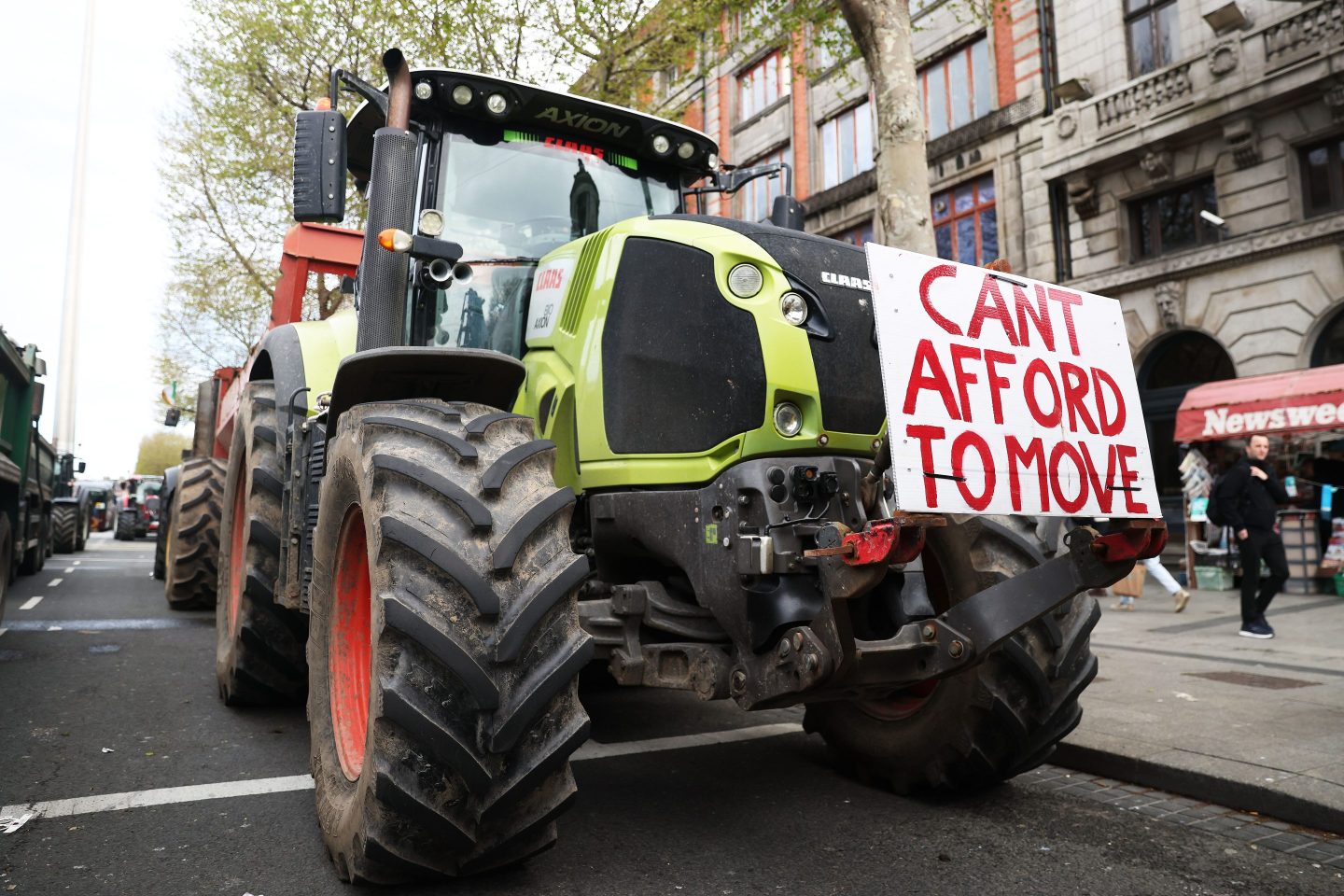
Irish Business Leaders Sound Alarm as Fuel Protests Threaten Empty Shelves and Production Shutdowns
Ireland’s top business and retail organisations have issued a stark warning that ongoing fuel protests have escalated from a logistical headache into an imminent threat to the national economy, with critical supply chains on the verge of collapse, production lines grinding to a halt, and essential goods disappearing from shelves. The warnings from Ibec and Retail Ireland paint a grim picture of a country teetering on the edge of severe disruption, directly impacting everything from food and medicine to construction and employment.
Background
The current wave of protests stems from deep-seated public anger over the rising cost of living, with the price of petrol and diesel serving as a lightning rod for broader frustrations. Protesters, a loose coalition of hauliers, farmers, and rural dwellers, have been demanding government action to mitigate soaring fuel costs, including a reduction in excise duties and carbon taxes. For weeks, they have engaged in a campaign of disruption, using tactics such as slow-moving convoys on motorways and, more recently, the strategic blockading of key distribution hubs and fuel depots. This escalation has moved the protest from a visible demonstration of discontent to a direct chokehold on the arteries of Irish commerce.
The Irish economy, like many modern developed nations, operates on a 'just-in-time' logistics model. This highly efficient system minimises the need for extensive warehousing by ensuring goods are delivered to retailers and manufacturers precisely when they are needed. While this model is cost-effective under normal circumstances, its inherent lack of redundancy makes it extremely vulnerable to the kind of sustained disruption now being witnessed. With distribution centres blocked, the flow of goods has been severed, and the downstream consequences are now rippling through the entire economy with alarming speed.
Key Developments
The gravity of the situation was underscored by Fergal O’Brien, Director of Lobbying and Influence at Ibec, the group representing Irish business. As reported in the Irish Times, O'Brien stated that the protests pose "imminent threats to critical supply chains and business operations," confirming that some member companies, particularly in the food sector, have already been forced to cease production due to a lack of raw materials or the inability to ship finished products. He highlighted growing risks for the supply of medicines and critical construction materials, while noting that absenteeism rates had soared to as high as 50% in some firms as employees found it impossible to get to work.
This sentiment was echoed by Arnold Dillon, director of Retail Ireland, who noted the situation had transitioned from a "logistical inconvenience" into a "direct threat to the availability of essential goods." Retailers, particularly in city centre locations, are reporting significant gaps on their shelves as daily deliveries fail to arrive. The blockades of major grocery distribution hubs mean that fresh produce, bread, and milk are becoming scarce, with the prospect of more widespread shortages looming if the situation is not resolved. The combined warnings from these two influential bodies represent a clear and urgent alarm bell for the Government.
Why It Matters
This crisis exposes the profound fragility of modern supply chains and serves as a case study in how targeted disruption by a relatively small group can have a disproportionately massive impact on a national scale. The protest's effectiveness in grinding the economy to a halt presents a complex dilemma for the Government. It must balance the democratic right to protest against its fundamental duty to ensure the free movement of goods and the continued functioning of essential services. The situation is politically perilous; a heavy-handed response could inflame tensions and be seen as an attack on ordinary citizens struggling with the cost of living, while inaction risks catastrophic economic consequences and public anger over empty shelves.
The scenario in Ireland draws parallels with the 'Gilets Jaunes' (Yellow Vests) movement in France, which also began as a protest against fuel taxes before morphing into a wider anti-government movement that caused huge economic damage. The key challenge for the Irish Government is to de-escalate the situation before it becomes similarly entrenched, addressing the legitimate concerns of protesters without capitulating to tactics that threaten the wellbeing of the entire population.
Local Impact
For people across Ireland, the impact is becoming increasingly tangible. In Dublin, Cork, and Galway, shoppers are being met with empty sections in their local supermarkets, creating a sense of anxiety and prompting fears of panic buying. Small business owners who rely on daily deliveries are facing the prospect of being unable to serve their customers. For workers in the affected industries, the threat of temporary layoffs looms as production lines fall silent. The blockades are not just an abstract economic issue; they are causing real stress and hardship in local communities throughout the country.
What's Next
A crucial development is the agreement of protest negotiators to attend a significant meeting with Government officials. This meeting represents the most promising path to a resolution. Protesters will be looking for concrete proposals on tax relief and other measures to alleviate their financial burden. The Government, in turn, will be demanding an immediate end to the blockades. The coming days are critical. If a deal can be struck, the flow of goods could be restored relatively quickly. If not, the Government will face mounting pressure to intervene more forcefully to clear the blockades and prevent a full-blown national crisis.