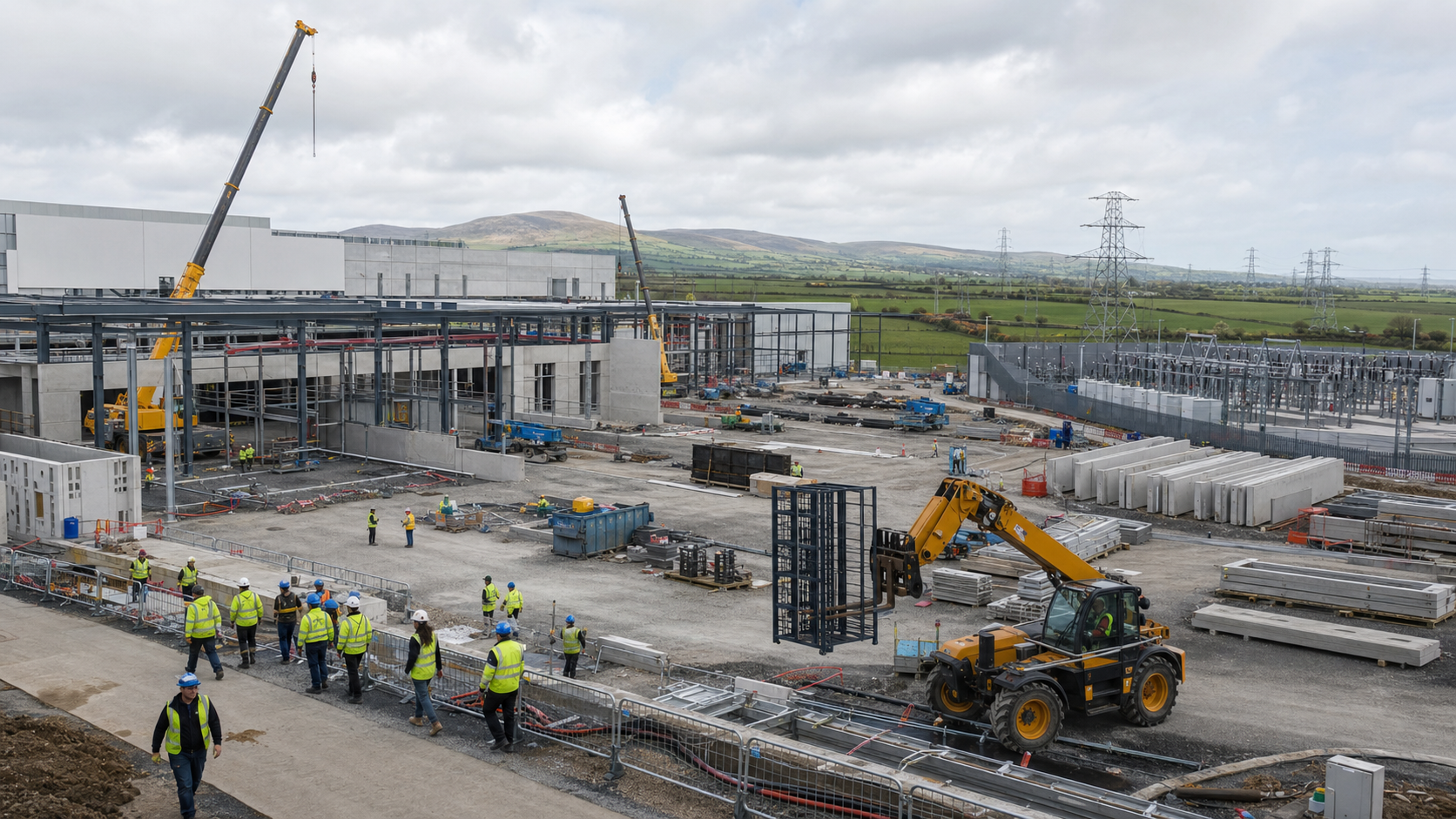
Irish Builders at Heart of Europe's Data Centre Boom as €8 Billion Surge Transforms Construction Sector
Irish construction firms have emerged as the primary beneficiaries of Europe's data centre building boom, with the sector generating an €8 billion surge for the country's top contractors and creating a newly-minted elite of Irish business owners who have capitalised on the extraordinary demand for digital infrastructure — but the rapid expansion is placing severe pressure on Ireland's electricity grid and raising serious questions about the country's ability to meet its climate commitments.
Background
Ireland's emergence as Europe's leading data centre hub is one of the most significant economic developments of the past decade. The combination of a cool climate, reliable power supply, EU single market access, and the presence of major US technology companies has made Ireland the preferred location for hyperscale data centre development across the continent, with 16 of the world's 20 largest technology companies maintaining data infrastructure or European headquarters in the country.
The construction of data centres — massive, highly engineered facilities that require specialist expertise in electrical systems, cooling infrastructure, and structural engineering — has created enormous opportunities for Irish contractors. A small number of firms have developed world-class capabilities in this sector, winning contracts not just in Ireland but across Europe, and the revenues generated have transformed the scale and ambition of the Irish construction industry.
The moratorium on new data centre connections in the Dublin and Greater Dublin area, which has been in effect since 2022 and is expected to remain in place until 2028, has pushed development to other parts of Ireland and to other European countries, where Irish contractors have followed the work. This geographic diversification has further expanded the sector's economic footprint.
Key Developments
The Business Post has reported that the data centre sector has generated an €8 billion surge for Ireland's top construction companies, with a small number of specialist firms accounting for the majority of this activity. The scale of the opportunity has attracted significant private equity investment into the sector, with several Irish data centre contractors having completed management buyouts or received external investment in recent years.
Data centres accounted for 21 per cent of Ireland's total electricity consumption in 2023, a figure projected to climb to 32 per cent by 2026. This surge has created supply-demand tensions on the national grid, leading to concerns about capacity and potential blackouts during periods of peak demand. The Commission for Regulation of Utilities introduced a new connection policy in December 2025 that mandates new data centres to source 80 per cent of their power from new renewable energy sources and install on-site dispatchable generation or energy storage facilities.
Critics have argued that data centres are "cannibalising" renewable energy capacity that could otherwise be used for broader public electrification, slowing down the transition to clean energy for the general population. Reports indicate that data centre growth has contributed to rising household electricity bills, with projections suggesting that bill payers could face an additional €1.43 billion to €1.6 billion in costs between 2025 and 2034 due to grid reliance on expensive fossil gas during peak demand.
Why It Matters
The data centre boom illustrates the tensions at the heart of Ireland's economic model. The sector generates enormous revenues for Irish contractors, significant corporation tax from the technology companies that operate the facilities, and high-quality employment for engineers and technicians. At the same time, it places severe pressure on the electricity grid, raises household energy costs, and threatens Ireland's ability to meet its legally binding carbon budgets. The government's response — the moratorium in Dublin, the new connection policy, the push for renewable energy — represents an attempt to manage these tensions, but the fundamental question of whether Ireland can continue to attract data centre investment at the current scale while also meeting its climate commitments remains unresolved. This is not a problem unique to Ireland, but Ireland's concentration of data centre activity makes it more acute here than in most other European countries.
Local Impact
The data centre boom has had a significant impact on communities across Ireland, both positive and negative. In counties such as Meath, Kildare, and Wicklow, where many of the largest data centre campuses are located, the construction activity has generated employment and economic activity. However, local residents have also raised concerns about the visual impact of large industrial facilities in rural landscapes, the pressure on local roads and infrastructure, and the noise generated by cooling systems. In Dublin, the moratorium has shifted development pressure to other areas, with planning applications for data centres now being submitted in counties as far afield as Cork, Galway, and Donegal.
What's Next
The Commission for Regulation of Utilities is expected to publish a review of the new data centre connection policy in the autumn, assessing its effectiveness in managing grid pressure and promoting renewable energy development. The government is also expected to publish a revised National Data Centre Strategy, which will set out the framework for data centre development in Ireland over the next decade. The moratorium on new connections in the Dublin area is expected to remain in place until 2028, when a new grid connection process is expected to be introduced.