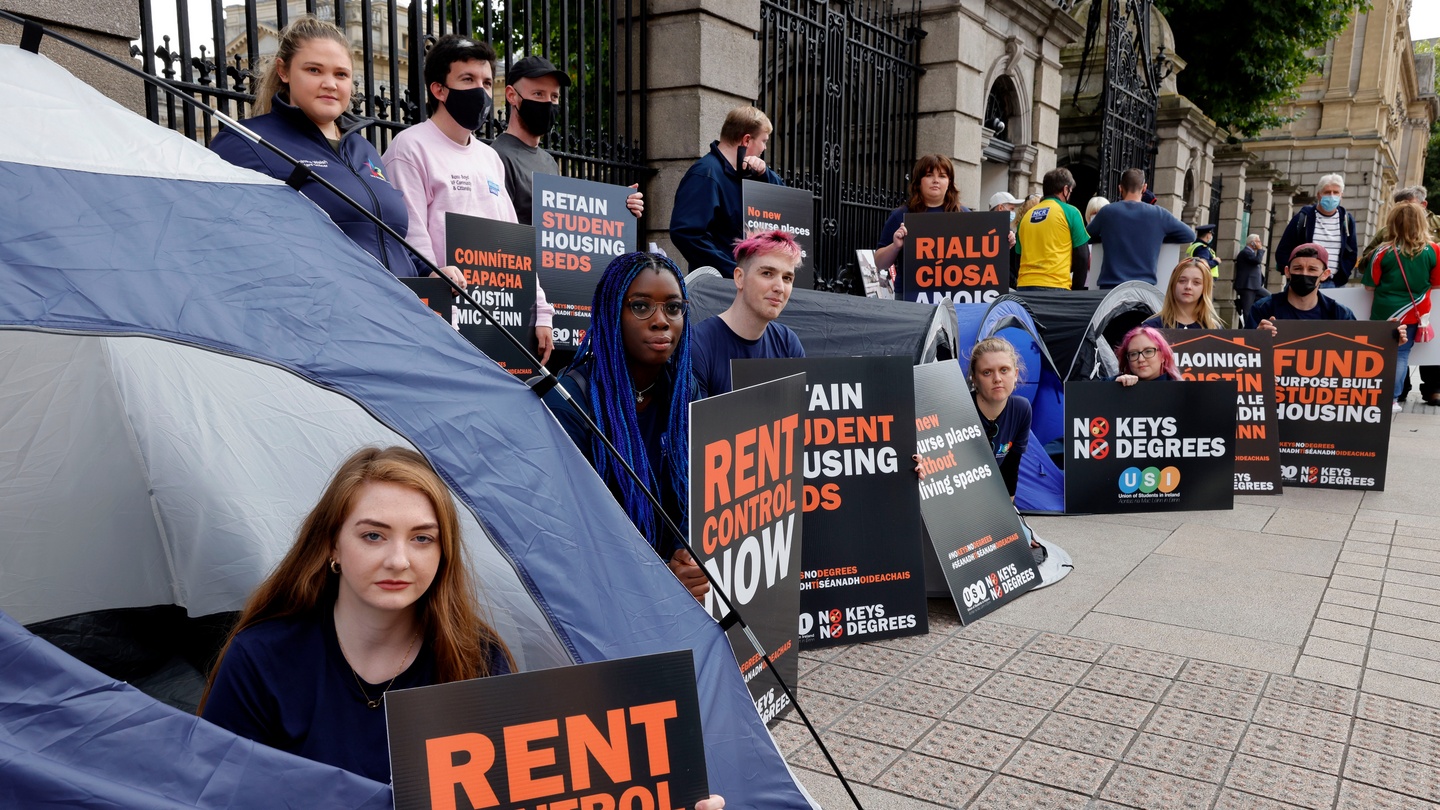
Joint Committee on Housing Meets as High Rents and Limited Supply Threaten Access to Higher Education
Ireland's Joint Committee on Housing, Local Government and Heritage met on Tuesday to address the country's deepening student accommodation crisis, with committee chair Deputy Micheál Carrigy warning that student rental housing is under "severe pressure" from high rents and limited supply — a situation that is threatening access to higher education and student well-being across the island.
Background
Ireland's housing crisis has been building for over a decade, driven by chronic undersupply, rising construction costs, and a regulatory environment that has struggled to keep pace with demand. The crisis has been most acute in Dublin, where the median property price stands at €495,000 — approximately 30% above the national median of €381,000 — but it has spread to cities and towns across the country as population growth and urbanisation have outpaced the construction of new homes.
For students, the housing crisis has a particular character. Student-specific accommodation (SSA) — purpose-built halls of residence and managed student housing — has been chronically undersupplied in Ireland, leaving many students dependent on the private rental market. In Dublin, Cork, Galway, and Limerick, competition for rental properties between students and working adults has driven rents to levels that many students simply cannot afford, even with parental support and part-time work.
The government's Residential Tenancies (Miscellaneous Provisions) Bill 2026, which came into effect for new tenancies from 1 March 2026, introduced minimum six-year tenancies and rent controls linked to the Consumer Price Index with a 2% annual cap. However, a significant caveat — allowing rents to reset to market rates when new tenants are sought — has drawn criticism from opposition parties, with Sinn Féin leader Mary Lou McDonald citing a major landlord's prediction of a "25% potential rental income uplift" from the reforms.
Key Developments
Tuesday's committee meeting featured two sessions. The first, at 3 PM, involved officials from the Department of Further and Higher Education, Research, Innovation and Science, and representatives from the Residential Tenancies Board. The second, at 6 PM, heard from Aontas na Mac Léinn in Éirinn (the Union of Students in Ireland), PBSA Council Ireland, and TUS Midlands Midwest Student Union.
Deputy Carrigy highlighted that the student accommodation crisis is recognised as a key part of the wider housing crisis, affecting access to education, student well-being, and regional participation in higher education. The committee is expected to examine the pipeline of new student-specific accommodation, the effectiveness of existing planning and funding mechanisms, and the impact of the new tenancy legislation on the student rental market.
For student-specific accommodation, the new legislation allows providers to reset rents to market levels at the end of each three-year cycle from 1 March 2029 — a provision that acknowledges the higher turnover in student housing while providing rent certainty for students for a fixed period. Critics argue this will simply defer rather than resolve the affordability problem.
Why It Matters
The student accommodation crisis is not simply a housing issue — it is an education access issue. When students cannot find affordable accommodation near their universities and colleges, they face a stark choice: commute long distances at significant cost and time, defer or abandon their studies, or take on unsustainable levels of debt. The consequences fall disproportionately on students from lower-income backgrounds and from rural areas, who are least able to absorb the costs of the Dublin rental market.
Ireland's higher education system has been a significant driver of economic growth, producing the skilled graduates that have attracted major technology and pharmaceutical companies to the country. If the accommodation crisis begins to deter students from pursuing higher education — or from choosing Irish universities over those in the UK or elsewhere — the long-term economic consequences could be significant. Unlike the UK, where student loans cover maintenance costs as well as tuition fees, Ireland's student support system is less comprehensive, making the accommodation crisis more acute for Irish students.
Local Impact
The student accommodation crisis affects students across the island of Ireland, including those from Northern Ireland who choose to study in the Republic. For students at Queen's University Belfast and Ulster University, the housing market in Belfast — while less extreme than Dublin — has also tightened significantly in recent years, with rents in the Holylands and other student areas rising sharply. The committee's findings and recommendations will be relevant to policymakers on both sides of the border, as the island's higher education system increasingly operates as an integrated whole, with students moving freely between institutions in Belfast, Dublin, Cork, and Galway.
What's Next
The committee is expected to publish its report on student accommodation in the coming months, with recommendations for government action. Watch for any response from the Minister for Further and Higher Education, Patrick O'Donovan, to the committee's findings. The Residential Tenancies Board will also publish its quarterly rental market report in May, which will provide updated data on rent levels and supply across the country. Any further government measures to address the student accommodation crisis are likely to be announced in the context of Budget 2027, which will be prepared over the summer.
Sources: Oireachtas, University Times