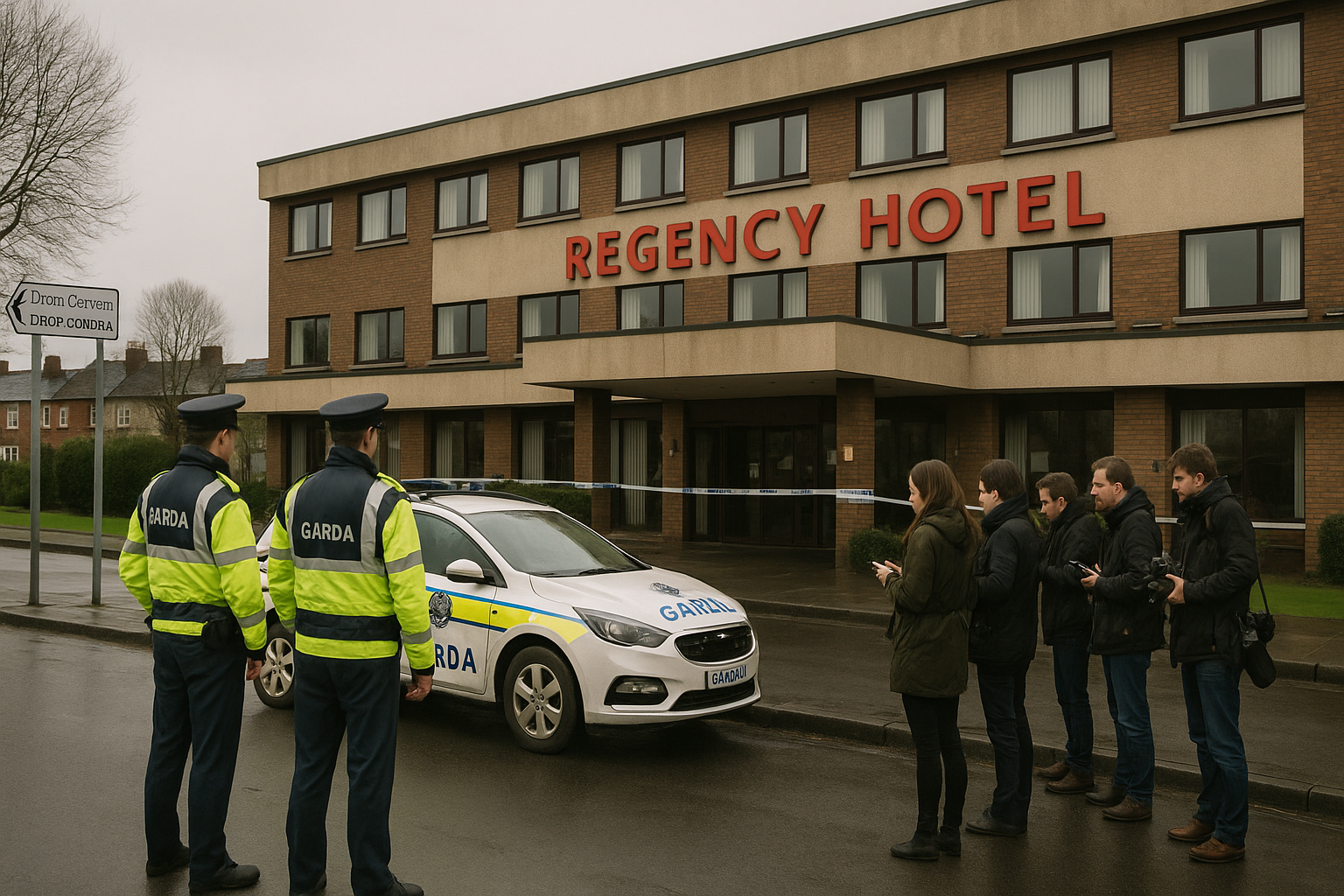
Regency Hotel Shooting Trial Hears Chilling Testimony About Accused's Oath
The trial of the man accused in connection with the murder of David Byrne at the Regency Hotel in February 2016 has heard chilling testimony that the accused took an "oath" to kill the victim. The prosecution, presenting its case before the Special Criminal Court in Dublin, has alleged that the accused was a key member of the Hutch organised crime group and that he participated in the attack as part of the bloody feud with the rival Kinahan cartel — a conflict that has claimed at least 18 lives over the past decade.
Background
The murder of David Byrne at the Regency Hotel on 5 February 2016 was one of the most audacious and shocking crimes in the history of the Irish state. A gang of armed men, some disguised as members of An Garda Síochána and carrying AK-47 assault rifles, stormed a boxing weigh-in event at the north Dublin hotel. Their primary target was Daniel Kinahan, a senior figure in the Kinahan cartel, but he escaped unharmed. Byrne, a Kinahan associate, was shot and killed in the hotel lobby, while two others were injured in the attack.
The assault was a dramatic escalation of the Hutch-Kinahan feud, which had begun around 2015 with the murder of Gary Hutch — nephew of Gerry Hutch — in Spain. The feud plunged Dublin into a prolonged period of gangland violence, with retaliatory killings carried out on both sides. In total, the conflict has claimed at least 18 lives, devastating communities across the city and prompting one of the largest Garda investigations in the history of the state.
The Special Criminal Court, a non-jury tribunal established to try cases of terrorism and organised crime, has been central to the state's efforts to bring those responsible to justice. In April 2023, Gerard 'The Monk' Hutch was acquitted of Byrne's murder after the court found insufficient evidence to prove he was one of the gunmen, though two other men — Paul Murphy and Jason Bonney — were convicted of facilitating the attack by providing vehicles for the hit team.
Key Developments
The current trial has heard from a number of witnesses, including a former associate of the accused who has turned state's evidence. The witness, who cannot be named for legal reasons, has given a detailed account of the planning and execution of the murder, telling the court that the accused was a key member of the hit team and that he took an "oath" to kill David Byrne. The testimony has provided a rare and disturbing insight into the inner workings of the Hutch gang and the cold-blooded calculation that underpinned the attack.
The prosecution has also presented a substantial body of forensic evidence, including DNA and ballistics material, which they contend links the accused directly to the murder. The defence has challenged the credibility of the state's witness and contested the forensic evidence, arguing that it falls short of the standard required for a conviction. The proceedings are being heard by a panel of three judges, as is standard practice at the Special Criminal Court.
Why It Matters
The Regency Hotel murder trial is one of the most significant criminal proceedings in recent Irish history, and its outcome will have far-reaching implications for the state's ongoing efforts to dismantle the networks that drove the Hutch-Kinahan feud. The case is also part of a broader legal reckoning: senior Kinahan cartel member Seán McGovern, who was wounded in the 2016 attack, was extradited from Dubai and is set for sentencing in 2026 after pleading guilty to directing a criminal organisation. The trial is a reminder that, a decade on from the Regency attack, the hunt for those responsible continues — and that the Irish state remains committed to pursuing justice through the courts.
Local Impact
For people in Northern Ireland, the Regency Hotel trial resonates deeply. Communities across Belfast and beyond have their own painful experience of paramilitary feuds and the devastating human cost of organised violence. The parallels between the Hutch-Kinahan conflict and the sectarian feuds that scarred Northern Ireland during the Troubles are not lost on observers here. The trial is a reminder of the destructive power of criminal organisations and the importance of robust legal institutions in holding them to account. It is also a story about the courage of witnesses who come forward in the face of very real personal risk — a theme that will be familiar to many in this part of the world.
What's Next
The trial is expected to continue for several more weeks, with the prosecution still presenting its evidence before the defence has an opportunity to make its case. The three judges of the Special Criminal Court will then retire to consider their verdict. Whatever the outcome, the Regency Hotel murder will remain one of the defining criminal events in modern Irish history — a moment that exposed the brutal reality of gangland violence and set in motion a decade of legal proceedings that are still working their way through the courts.
Sources: RTÉ — Ten Years On: Hunt for Regency Attackers Continues, The Irish Times — Case Against Daniel Kinahan