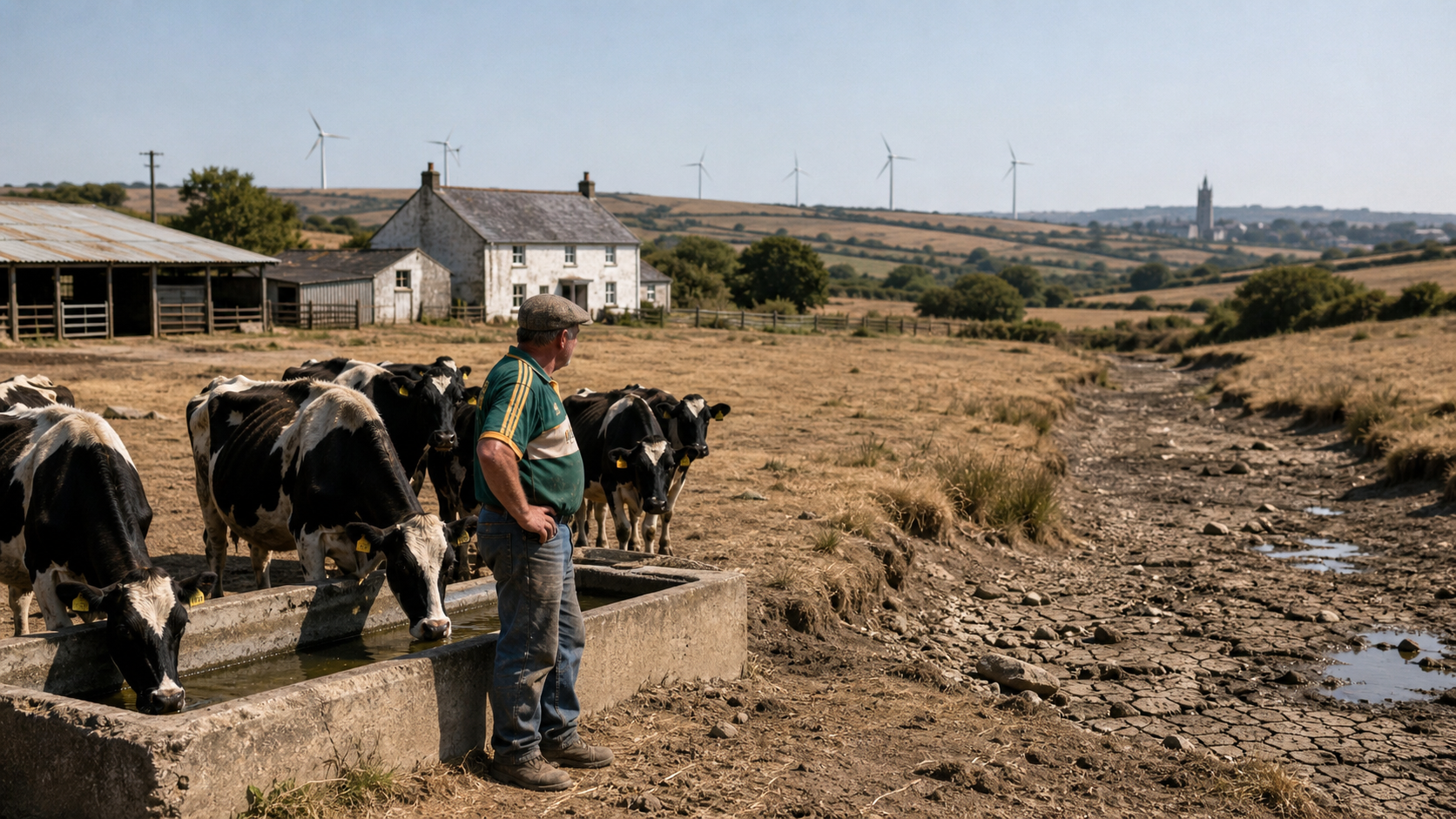
Ireland's Driest July on Record Signals Accelerating Climate Shift with Major Economic Consequences
July 2026 was Ireland's driest July on record and the third-hottest month ever measured in the country, with Met Éireann confirming that the extreme weather conditions represent a significant departure from historical norms and have had substantial implications for agriculture, water supply, tourism, and the broader Irish economy — implications that are likely to intensify as climate patterns continue to shift.
The record-breaking conditions, which saw parts of the country go more than three weeks without meaningful rainfall, have prompted warnings from agricultural organisations about the impact on grass growth, livestock welfare, and crop yields, while water utilities have reported increased demand and reduced reservoir levels in several regions. The tourism sector, by contrast, has benefited from the prolonged warm weather, with visitor numbers and spending at record levels.
Background
Ireland's climate has historically been characterised by mild temperatures, high rainfall, and relatively limited seasonal variation — a pattern shaped by the country's position on the western edge of Europe and the moderating influence of the Atlantic Ocean. However, climate scientists have been warning for years that this pattern is changing, with rising temperatures, more frequent extreme weather events, and shifts in precipitation patterns all consistent with the broader trends of global climate change.
The summer of 2026 has provided a vivid illustration of those changes. Following a wet and cool spring, July brought an extended period of high pressure that produced temperatures well above the seasonal average and rainfall totals that were a fraction of the historical norm. The combination of heat and drought has stressed ecosystems, agricultural systems, and water infrastructure in ways that are becoming increasingly familiar but no less challenging.
The economic implications of these changes are significant and multifaceted. Agriculture, which remains a major sector of the Irish economy and a cornerstone of rural communities, is particularly vulnerable to the kind of weather extremes that July 2026 has brought. Grass growth, which is the foundation of Ireland's predominantly pastoral farming system, is highly sensitive to both temperature and rainfall, and the combination of heat and drought has severely reduced grass yields in many parts of the country.
Key Developments
Met Éireann confirmed that July 2026 was the driest July on record for Ireland as a whole, with national average rainfall totals significantly below the long-term average. Several weather stations recorded their lowest July rainfall totals since records began, and the prolonged dry spell has led to the development of drought conditions in parts of Leinster and Munster.
The Irish Farmers' Association has warned that the drought conditions are having a serious impact on grass growth and silage production, with many farmers reporting that they have been forced to feed supplementary fodder to livestock earlier than usual. The IFA has called on the government to activate emergency support measures for affected farmers and to expedite the processing of agri-environment scheme payments to ease cash flow pressures.
Water utilities, including Irish Water and several local authorities, have issued conservation notices in areas where reservoir levels have fallen below normal seasonal levels. The notices, which ask households and businesses to reduce water consumption, reflect the pressure that the prolonged dry spell has placed on water supply infrastructure that was not designed to cope with extended periods of low rainfall.
Why It Matters
The record-breaking conditions of July 2026 are not an isolated event but part of a pattern of increasingly extreme weather that is consistent with the projections of climate scientists. Ireland's climate is changing, and the economic and social consequences of that change are becoming more visible and more costly with each passing year. The challenge for policymakers is to accelerate the adaptation of Ireland's infrastructure, agriculture, and communities to a climate that is fundamentally different from the one in which they were designed to operate.
The agricultural sector faces particularly difficult choices. Ireland's farming system is built around grass-based production, which is highly efficient in a wet, mild climate but increasingly vulnerable to the kind of heat and drought that July 2026 has brought. The transition to more climate-resilient farming systems will require significant investment, changes in practice, and support from government and the agri-food industry.
The water supply challenge is equally pressing. Ireland's water infrastructure was designed for a climate with reliable and relatively evenly distributed rainfall, and it is not well-suited to the extended dry periods that are becoming more frequent. Investment in water storage, demand management, and infrastructure resilience will be essential to ensure that water supply remains secure as the climate continues to change.
Local Impact
The impact of the July drought has been felt most acutely in the midlands and south-east of Ireland, where rainfall totals were lowest and where agricultural land is most dependent on summer grass growth. Counties including Tipperary, Kilkenny, Carlow, and Wexford have been particularly affected, with farmers in these areas reporting significant reductions in grass yields and increased fodder costs. The Munster region, which is home to a large proportion of Ireland's dairy herd, has also been significantly affected, with milk production in some areas falling below seasonal norms.
What's Next
Met Éireann has indicated that the outlook for August is for a return to more typical Irish summer conditions, with a mix of sunshine and showers expected to provide some relief to drought-affected areas. However, the damage to grass growth and silage stocks from July's conditions will take time to recover, and the agricultural sector is likely to face ongoing challenges for the remainder of the grazing season. The government is expected to announce a package of support measures for affected farmers in the coming weeks.