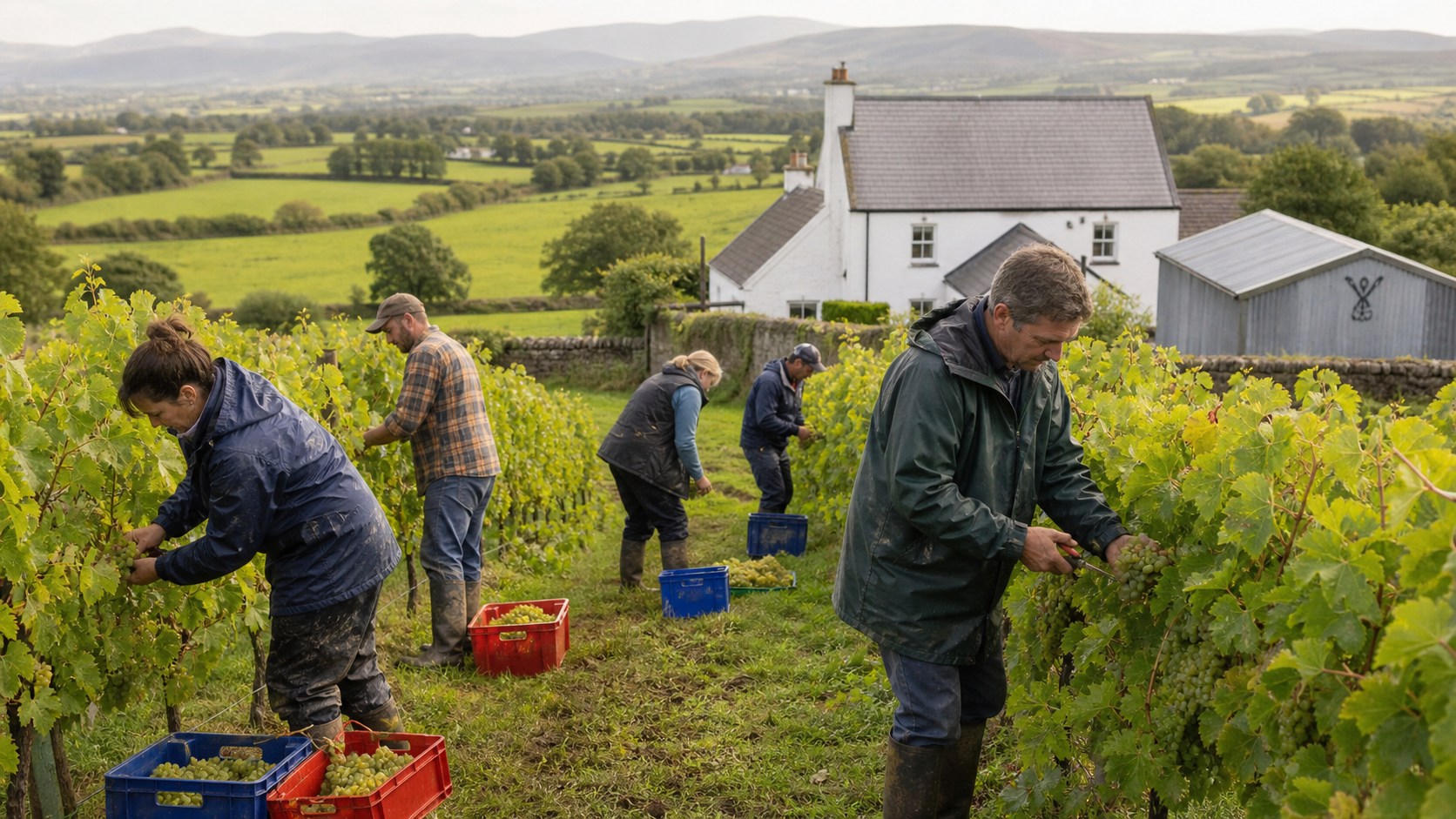
Ireland's Emerging Wine Industry Reports Bumper 2026 Harvest as Climate Change Opens New Frontier
Ireland's small but growing wine industry is reporting its best harvest in years, with the country's 42 vineyards benefiting from the same warm, dry summer that has devastated conventional agriculture — a paradox that underlines the complex and uneven ways in which climate change is reshaping Irish farming and opening new commercial possibilities alongside the more familiar catalogue of losses.
Background
The idea of Ireland as a wine-producing nation would have seemed fanciful even a decade ago. The country's cool, wet climate — the very characteristic that makes it so well suited to grass-based livestock farming — was long considered incompatible with the requirements of commercial viticulture. Grapes need warmth, sunshine, and relatively dry conditions to ripen properly, and Ireland's Atlantic climate, with its persistent cloud cover and high rainfall, seemed to offer none of these things in sufficient quantity.
That assessment is being revised. Rising temperatures driven by climate change have extended Ireland's growing season and improved the conditions for grape ripening, while the development of disease-resistant hybrid grape varieties — particularly Rondo and Solaris, which thrive in cooler, wetter conditions and are naturally resistant to the mildew and fungal rot that would devastate traditional Vitis vinifera varieties in the Irish climate — has given producers the tools they need to make commercially viable wine on the island.
The Irish wine industry is still tiny by international standards. The country's 42 vineyards range from small experimental plots of less than a hectare to larger commercial operations of five or six hectares, and total production is a fraction of what even a modest French or Italian producer would consider a normal year's output. But the trajectory is upward, and the European Commission's formal recognition of Ireland as a wine-producing nation — which came in 2023 — has given the industry a regulatory framework and a degree of credibility that it previously lacked.
Key Developments
The summer of 2026, which has been catastrophic for conventional Irish agriculture, has been a boon for the wine industry. The warm, dry conditions that have depleted grass growth and forced dairy farmers to draw on winter fodder reserves have provided ideal ripening conditions for the hybrid grape varieties grown by Irish producers. Several vineyards have reported yields comparable to those achieved in northern Italy in a good year — a comparison that would have seemed absurd just five years ago.
The Irish Winemakers Association, which represents the majority of commercial producers, has described 2026 as a "watershed year" for the industry. "We've been saying for years that Ireland can produce quality wine," said one association spokesperson. "This summer has proved it beyond any reasonable doubt. The grapes are exceptional — the sugar levels, the acidity, the flavour profiles. We're going to be producing some very exciting wines from this harvest."
The industry is also attracting growing interest from investors, both domestic and international, who see the combination of rising temperatures, available land, and Ireland's strong food and drink brand as a compelling commercial proposition. Several new vineyard projects are in the planning stages, and the Irish Wine Coop — a new initiative promoting a cooperative model for small-scale producers — has attracted significant interest from family farms looking to diversify their income.
Why It Matters
The emergence of an Irish wine industry is significant not just as a commercial story but as a symbol of the broader transformation that climate change is forcing on Irish agriculture. The same warming that is making wine production viable in Ireland is making conventional farming more challenging, and the industry's experience offers a model for how farmers might adapt to changing conditions by diversifying into new crops and new markets.
The sustainability credentials of Irish wine are also noteworthy. By using hybrid grape varieties that require minimal pesticide application and by positioning themselves as producers of low-intervention, terroir-driven wines, Irish producers are aligning themselves with the fastest-growing segment of the global wine market. Consumers in Ireland's key export markets — the United Kingdom, the United States, and Germany — are increasingly willing to pay a premium for wines that can demonstrate genuine environmental credentials.
Local Impact
The geographic spread of Ireland's vineyards reflects the diversity of the country's microclimates. The warmest and most sheltered sites — in County Wexford, County Waterford, and along the south coast of County Cork — have the longest track record of commercial production, but vineyards are now operating as far north as County Meath and County Louth. In County Wicklow, several producers have established vineyards on south-facing slopes that benefit from the shelter of the Wicklow Mountains, and the county is emerging as one of the most promising wine-producing areas in the country.
What's Next
The 2026 harvest will be processed over the coming weeks, with the resulting wines expected to be available for sale in late 2027 after a period of ageing. Several producers are planning to enter their 2026 wines in international competitions, and there is cautious optimism that the quality of this year's harvest could attract the kind of critical attention that would significantly raise the profile of Irish wine internationally. The Irish Winemakers Association is also in discussions with Bord Bia about including Irish wine in its international food and drink promotion campaigns.