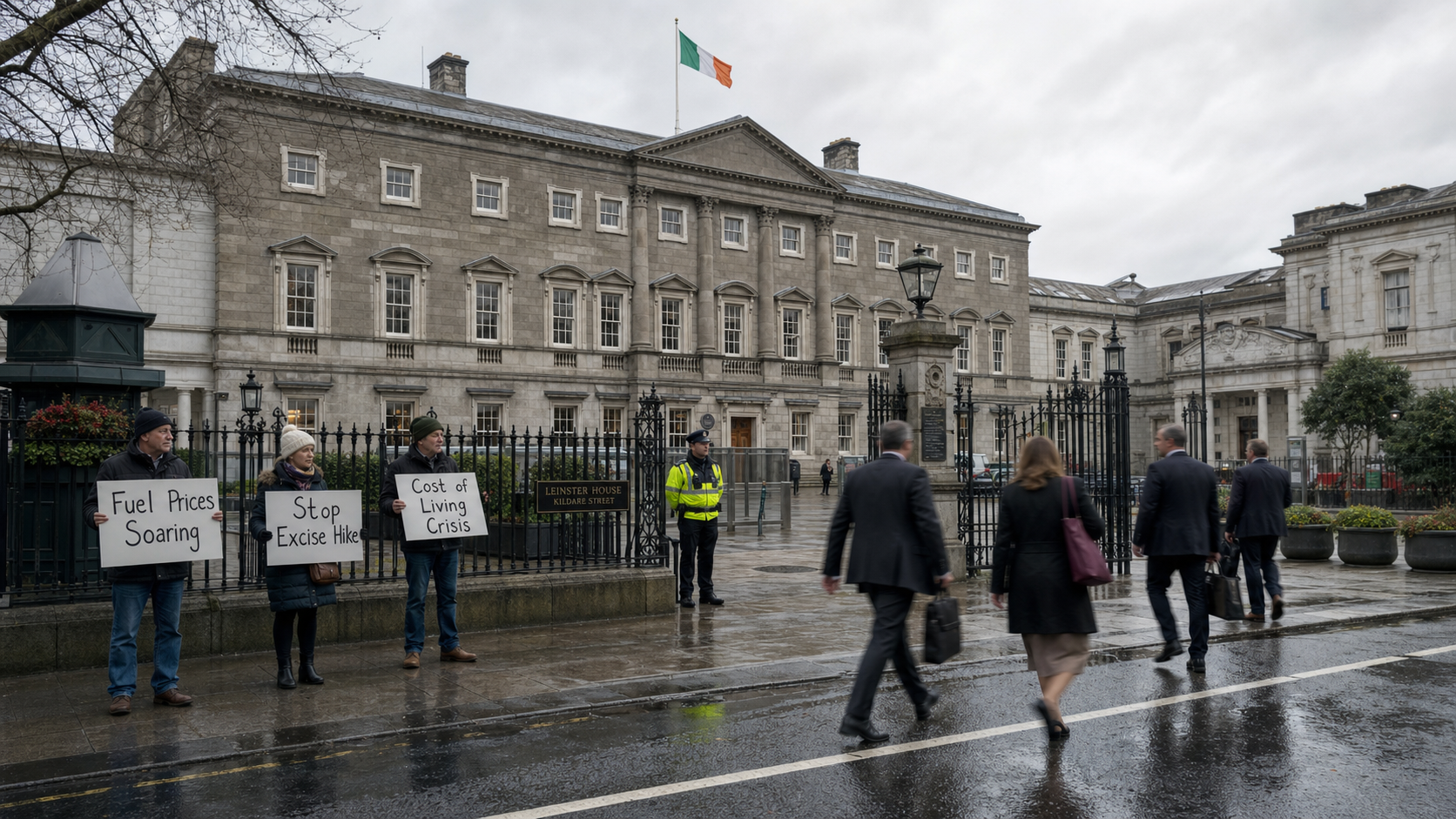
Government Faces Mounting Pressure Over Fuel Excise Restoration as Petrol Prices Near €2 Per Litre
The Irish government is facing mounting internal and external pressure over its plan to restore excise duty on fuel, with petrol prices edging closer to €2 per litre and Fine Gael and Fianna Fáil TDs privately expressing serious concern about the political consequences of proceeding with the restoration as planned — a tension that has prompted the Taoiseach to signal that the timetable may be revisited, without yet committing to a formal delay.
Background
The excise duty cuts on petrol and diesel were introduced in March 2022 as an emergency response to the surge in fuel prices that followed Russia's invasion of Ukraine. The cuts, which reduced excise on petrol by 20 cent per litre and on diesel by 15 cent per litre, were intended as a temporary measure and have been extended multiple times since their introduction. The current government committed in its Programme for Government to a phased restoration of the cuts, with the process to be completed by the end of 2026.
The restoration has proceeded in stages, with excise being partially restored in October 2025 and a further tranche due in the autumn of 2026. However, the combination of rising global oil prices — driven by tensions in the Strait of Hormuz and the ongoing conflict in the Middle East — and the weakness of the euro against the dollar has pushed pump prices to levels that are making the restoration politically toxic. Petrol prices at forecourts across Ireland have been rising steadily since June, and several outlets in Dublin and Cork have already crossed the €1.90 per litre threshold.
The political sensitivity of fuel prices in Ireland is well established. The country's dispersed population and limited public transport infrastructure outside the major cities mean that car dependency is high, and fuel costs represent a significant proportion of household budgets for many families, particularly in rural areas. Any government that is seen to be adding to those costs through tax policy does so at considerable political risk.
Key Developments
Taoiseach Micheál Martin, speaking to reporters on Friday, acknowledged the pressure and indicated that the government was "keeping the situation under review." He stopped short of committing to a delay in the restoration, but his language was notably more cautious than the government's previous position, which had been that the restoration would proceed as planned regardless of market conditions.
Fine Gael TDs from rural constituencies have been among the most vocal in expressing concern, with several telling party whips that they cannot support a further restoration if pump prices continue to rise. Fianna Fáil's parliamentary party has also discussed the issue, with a number of TDs arguing that the political cost of proceeding outweighs the fiscal benefit of the additional excise revenue.
The opposition has been quick to exploit the government's discomfort. Sinn Féin's finance spokesman Pearse Doherty has called for an immediate suspension of the restoration process, arguing that the government's commitment to a timetable drawn up in very different market conditions is "ideological stubbornness dressed up as fiscal responsibility."
Why It Matters
The fuel excise debate is a microcosm of a broader tension in Irish economic policy between the need to restore public finances to a sustainable footing and the political imperative to protect households from the cost-of-living pressures that have dominated Irish politics since 2021. The government has been relatively successful in managing this tension — the economy is growing, unemployment is low, and the public finances are in surplus — but fuel prices are one of the most visible and politically salient cost-of-living indicators, and a surge to €2 per litre would be a significant political event.
The fiscal stakes are also real. The excise cuts cost the exchequer approximately €600 million per year in foregone revenue, and the government's medium-term fiscal plan assumes that this revenue will be progressively restored. A decision to delay or abandon the restoration would require compensating savings elsewhere or a revision of the fiscal projections, neither of which is straightforward in the current political environment.
Local Impact
The impact of rising fuel prices is felt most acutely in rural Ireland, where public transport alternatives are limited and car dependency is highest. In counties like Roscommon, Leitrim, and Longford, where Bus Éireann services are sparse and Irish Rail does not reach, the car is not a luxury but a necessity, and fuel costs represent a significant proportion of household budgets. The government's rural affairs minister has been in contact with the Department of Finance about the specific impact on rural communities, and there are reports that a rural-proofing analysis of the restoration timetable is being prepared.
What's Next
A decision on whether to proceed with the autumn excise restoration is expected before the end of August, when the government will need to finalise its Budget 2027 parameters. The Taoiseach has indicated that the decision will be made in the context of the overall Budget package, suggesting that a delay in the restoration might be offset by other cost-of-living measures. The Budget is due to be presented to the Dáil on 14 October 2026.