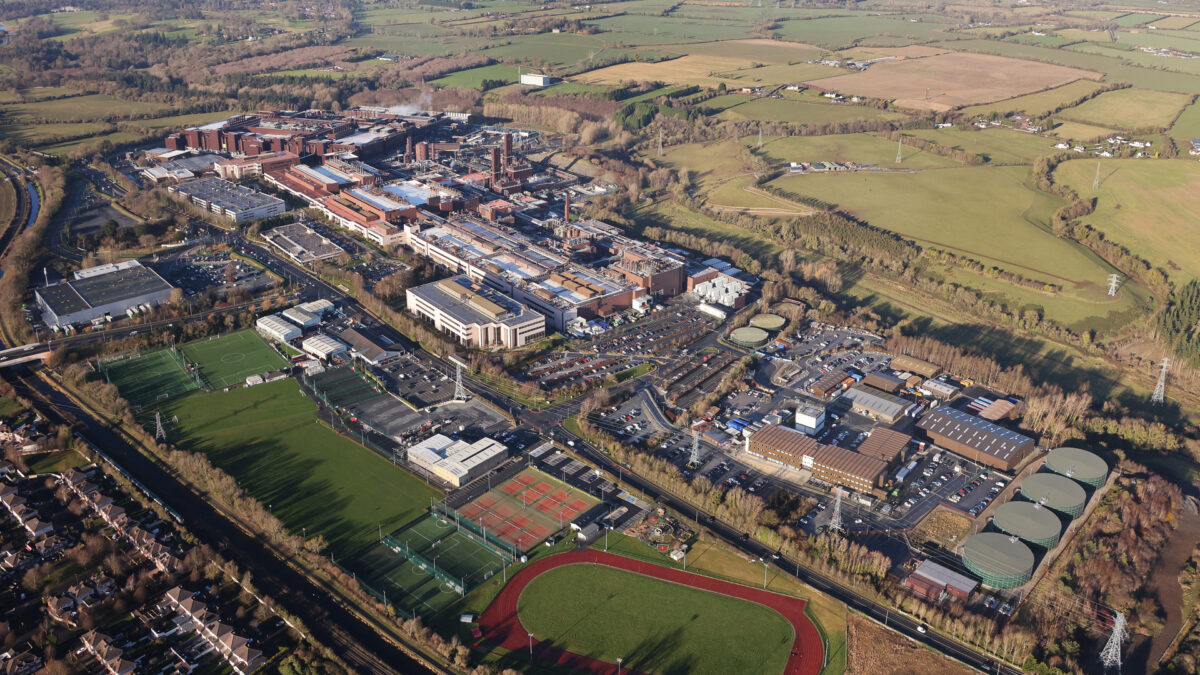
Intel Confirms €5 Billion Investment to Expand Leixlip Campus for Next-Generation AI Chip Manufacturing
Technology giant Intel has confirmed a new €5 billion investment in its Leixlip, Co. Kildare, campus — one of the largest single foreign direct investment announcements in the history of the Irish state — to upgrade fabrication facilities and expand manufacturing output for next-generation processors designed for high-performance computing applications.
Background
Intel's presence in Ireland dates to 1989, when the company opened its first European manufacturing facility at Leixlip. Over the subsequent three and a half decades, the campus has grown into one of the most significant semiconductor manufacturing sites in Europe, employing approximately 5,000 people directly and supporting tens of thousands of additional jobs in the supply chain and wider economy. The Leixlip facility produces some of Intel's most advanced processors, and its output is central to the company's global manufacturing strategy.
The announcement comes at a significant moment for Intel globally. The company experienced a difficult period in 2024 and 2025, including a round of job cuts that affected its Irish operations, as it navigated intense competition from rivals including TSMC, Samsung, and AMD. The decision to invest €5 billion in Leixlip represents a major strategic recommitment to European manufacturing and to Ireland specifically, signalling confidence in the country's skilled workforce, stable regulatory environment, and infrastructure.
The global semiconductor industry is undergoing a period of rapid transformation, driven by the explosive growth in demand for chips capable of supporting advanced computing workloads. Governments across the world — including the United States, the European Union, and Japan — have introduced substantial subsidies and incentives to attract semiconductor manufacturing investment, recognising the strategic importance of domestic chip production. Ireland's position within the EU single market makes it an attractive location for companies seeking to serve European customers.
Key Developments
The €5 billion investment will be deployed over the period to end-2027, with the primary focus on upgrading existing fabrication facilities at the Leixlip campus to enable the production of next-generation processors. The upgraded facilities will be capable of manufacturing chips using Intel's most advanced process technology, designed for applications including high-performance computing, data centre infrastructure, and advanced networking equipment.
The project is expected to create several hundred new permanent, high-skilled roles at the Leixlip campus, in addition to thousands of construction and engineering jobs during the build phase. IDA Ireland, the state agency responsible for attracting foreign direct investment, has been closely involved in securing the announcement and will work with Intel to ensure the project delivers maximum benefit to the Irish economy.
Taoiseach Micheál Martin welcomed the announcement as a powerful vote of confidence in Ireland and its skilled workforce, noting that it demonstrated the country's continued attractiveness as a location for high-value manufacturing investment. IDA Ireland CEO Michael Lohan described the project as a testament to Ireland's stable business environment and the quality of its engineering talent pipeline, which draws on graduates from universities including UCD, UCC, TCD, and the University of Limerick.
Why It Matters
A €5 billion investment is, by any measure, a transformative commitment. To put it in context, it is equivalent to approximately 1.5% of Ireland's modified gross national income — a significant injection into an economy that, despite its headline GDP figures, is heavily dependent on the decisions of a relatively small number of large multinational companies. The Intel announcement reinforces Ireland's position as a European hub for semiconductor manufacturing at a time when the EU is actively seeking to reduce its dependence on Asian chip producers.
The investment also carries symbolic weight. Intel's decision to expand at Leixlip, rather than at alternative European sites, reflects a vote of confidence in Ireland's ability to deliver the infrastructure, workforce, and regulatory stability that advanced manufacturing requires. This is not guaranteed — other European countries, including Germany, France, and Poland, have been aggressively competing for semiconductor investment — and the fact that Ireland has secured this commitment is a significant achievement for IDA Ireland and the government.
The broader question of Ireland's economic model — its dependence on a small number of large multinationals for a disproportionate share of tax revenue and employment — remains a live debate. The Intel announcement will intensify that debate, with some economists arguing that it deepens Ireland's vulnerability to corporate decisions made in California or Santa Clara, while others contend that the depth of Intel's commitment to Leixlip — now spanning 35 years — represents a qualitatively different kind of relationship than a typical FDI project.
Local Impact
For Co. Kildare and the wider Leinster region, the Intel investment is enormously significant. The Leixlip campus is the largest private sector employer in the county, and its supply chain extends across the midlands and east of Ireland. The construction phase of the project will generate substantial activity for Irish engineering and construction firms, with the project expected to draw on contractors from across the country.
The investment will also have implications for housing and infrastructure in the Leixlip and Celbridge area, which is already under significant pressure from population growth driven by its proximity to Dublin. Kildare County Council has been in discussions with Intel about the infrastructure requirements associated with the expansion, including road access, water supply, and energy connectivity. The National Roads Authority is expected to review the capacity of the M4 motorway corridor in light of the increased traffic volumes the project will generate.
What's Next
Intel is expected to submit planning applications for the expanded facilities to Kildare County Council in the coming months, with construction anticipated to begin in early 2027 subject to planning approval. IDA Ireland will publish a detailed economic impact assessment of the project in August. The Department of Enterprise, Trade and Employment is expected to announce a package of workforce development measures to support the creation of the new roles, including partnerships with higher education institutions and apprenticeship programmes. A formal signing ceremony between Intel and the Irish government is scheduled for later this month.