Ireland Takes the Helm of the EU Council Presidency Amid High-Profile Diplomatic Events and Major Security Operation
Ireland has assumed the rotating Presidency of the Council of the European Union, placing the country at the centre of European legislative and political life for the next six months in what represents one of the most significant diplomatic undertakings the state has faced since its last presidency in 2013 — a responsibility that brings both considerable prestige and substantial logistical and political challenges at a moment of significant turbulence in European affairs.
Background
The Presidency of the Council of the EU rotates among member states on a six-monthly basis, with each country taking the chair of Council meetings across all policy areas and playing a key role in brokering agreement on EU legislation. Ireland's current presidency is its seventh since joining the European Community in 1973, and it comes at a particularly consequential moment for the bloc. The EU is navigating a complex set of challenges, including the ongoing management of trade relations with the United States following the imposition of tariffs, the continued support for Ukraine, the implementation of the Green Deal, and the development of a coherent European approach to artificial intelligence regulation.
Ireland's presidency priorities, as outlined by the Taoiseach and the Minister for European Affairs in the weeks leading up to the handover, focus on competitiveness, security, and sustainability. The country has positioned itself as a bridge-builder within the EU — a small, open economy with strong ties to both the United States and the United Kingdom, and a deep commitment to the European project that has been reinforced by the experience of Brexit and its consequences for the island of Ireland.
The practical demands of holding the presidency are considerable. Ireland must chair hundreds of Council meetings across all policy areas, manage the legislative agenda, and represent the Council in negotiations with the European Parliament and the Commission. The Department of Foreign Affairs has been preparing for the presidency for over a year, recruiting additional staff, upgrading facilities, and developing detailed plans for the management of the legislative dossiers that will be active during the six-month period.
Key Developments
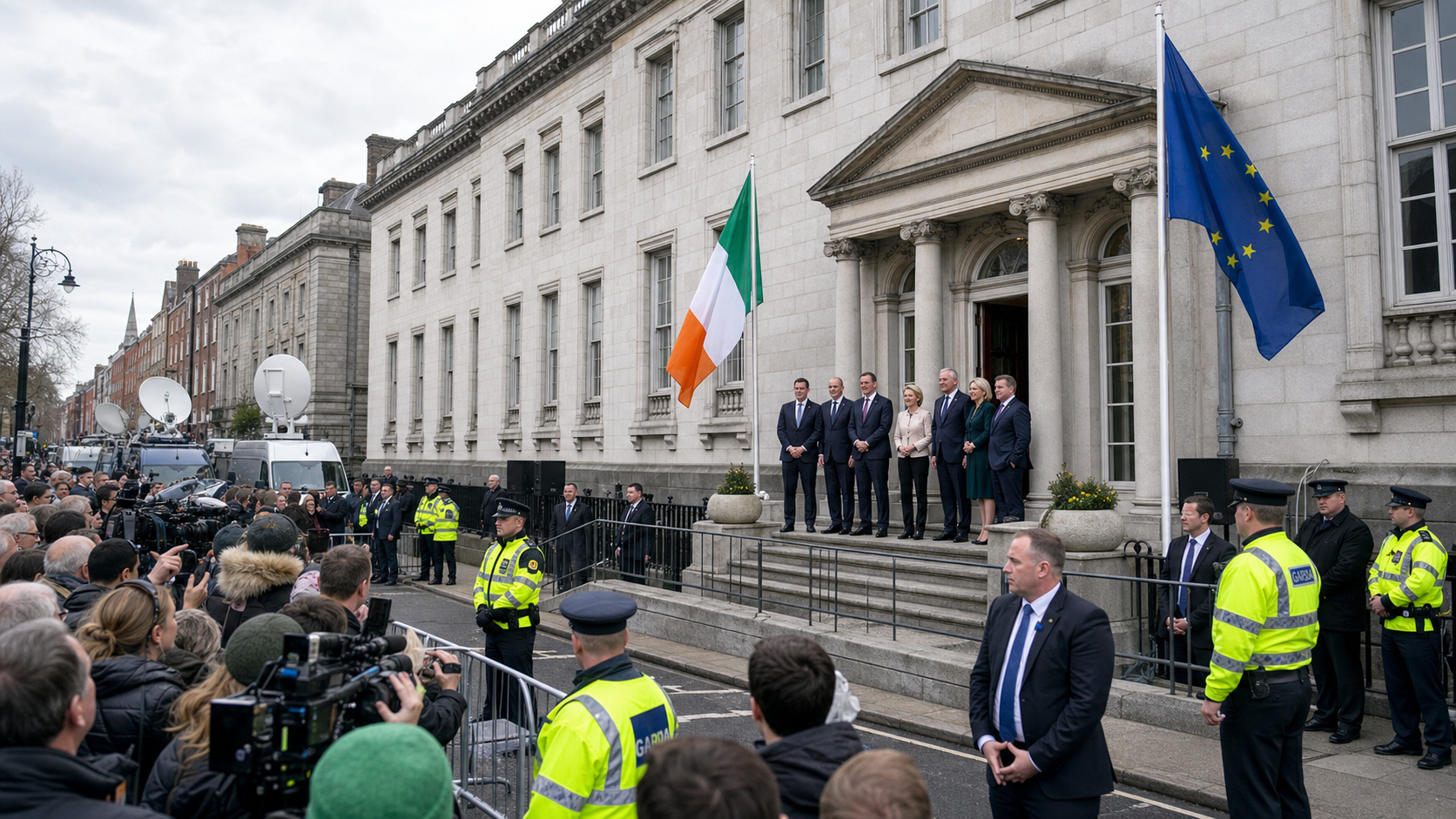
The formal commencement of Ireland's presidency was marked by a series of high-profile diplomatic events in Dublin, including a visit from European Commission President Ursula von der Leyen. The visit required a major security operation by An Garda Síochána, with significant road closures and security cordons in the city centre. The Taoiseach hosted von der Leyen for bilateral talks focused on the EU's legislative priorities for the second half of 2026 and on Ireland's specific presidency agenda.
The opening events also included a reception for EU ambassadors and a formal ceremony at Dublin Castle, which has served as the venue for significant European events during previous Irish presidencies. The Taoiseach used the occasion to outline Ireland's approach to the presidency, emphasising the country's commitment to finding consensus among member states on difficult issues and to advancing the EU's strategic agenda in a period of global uncertainty.
Among the key legislative dossiers that Ireland will be managing during its presidency are the EU's proposed framework for AI liability, revisions to the Common Agricultural Policy, and negotiations on the EU's long-term budget framework. The presidency will also oversee the implementation of the EU's new migration and asylum pact, a particularly sensitive area given the political dynamics around migration in several member states.
Why It Matters
Ireland's EU Council Presidency matters for several reasons that go beyond the procedural mechanics of EU governance. As a small member state, Ireland has historically used its presidency periods to demonstrate that size is not a barrier to effective European leadership, and to advance issues of particular importance to the country — including the peace process in Northern Ireland, the rights of small open economies in EU trade policy, and the protection of the EU's single market. The current presidency comes at a moment when Ireland's relationship with the EU is particularly important, given the ongoing implementation of the Windsor Framework and the need to maintain EU support for the arrangements that protect the Good Friday Agreement.
The presidency also has a significant economic dimension. Ireland's role as a hub for US multinational investment in Europe means it has a direct interest in the EU's approach to trade relations with the United States, and the Taoiseach is expected to use the presidency platform to advocate for a constructive transatlantic relationship. The country's tech sector, which employs tens of thousands of people and generates a significant proportion of corporate tax revenue, is directly affected by EU digital regulation, and Ireland will be in a position to shape the pace and direction of that regulation during its presidency.
Local Impact
The practical impact of the EU Council Presidency on daily life in Ireland is most visible in Dublin, where the concentration of diplomatic events, security operations, and visiting delegations creates significant disruption to traffic and public transport. Dubliners have been advised to expect road closures and delays in the city centre throughout the presidency period, particularly around Dublin Castle, Government Buildings, and the Convention Centre Dublin, which will host several major ministerial meetings. Beyond the capital, the presidency is expected to generate economic activity through tourism and hospitality, with thousands of EU officials, journalists, and lobbyists visiting Ireland over the six-month period.
What's Next
The first major test of Ireland's presidency will come at the General Affairs Council meeting scheduled for later this month, where ministers will discuss the EU's legislative priorities for the second half of 2026. A series of informal ministerial meetings — known as Gymnich meetings — are planned for the autumn, covering foreign affairs, defence, and justice. The presidency will culminate in the European Council summit in December, at which Ireland will present a summary of the legislative progress achieved during its term. The Taoiseach has indicated he hopes to secure agreement on at least three major legislative dossiers before the end of the presidency.