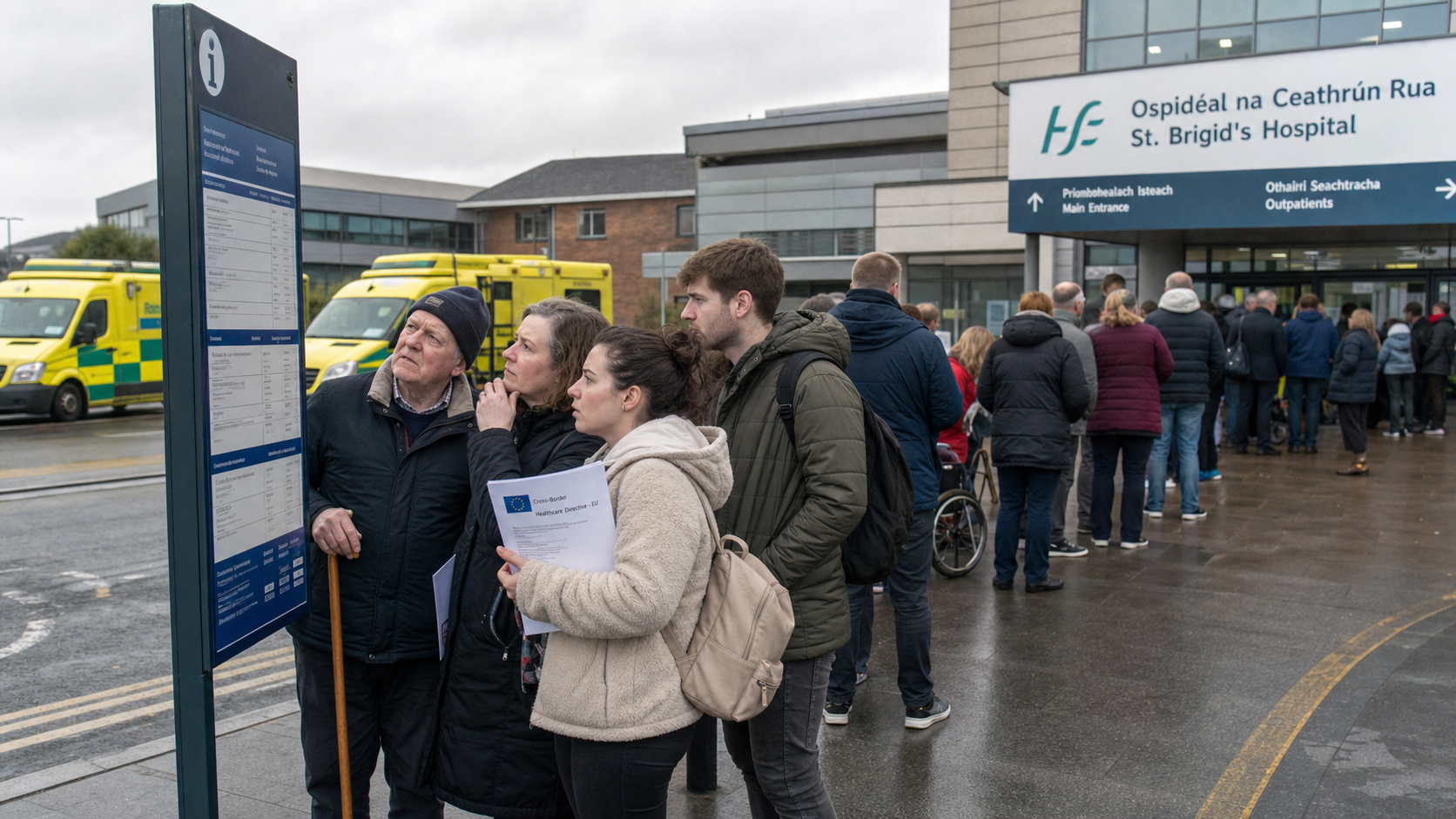
Inquiries into Cross-Border Healthcare Directive Drop 80% Despite 700,000-Strong Hospital Waiting Lists
Despite more than 700,000 people languishing on hospital waiting lists in Ireland, inquiries about the Cross-Border Healthcare Directive — which allows public patients to receive treatment in other EU countries and have the costs reimbursed by the HSE — have fallen by 80% since 2018, prompting calls for an urgent nationwide awareness campaign.
Background
The Cross-Border Healthcare Directive, formally known as Directive 2011/24/EU on the application of patients' rights in cross-border healthcare, gives citizens of EU member states the right to seek planned medical treatment in any other EU country and to have the costs reimbursed by their home country's health system, up to the amount that the treatment would have cost at home. For Irish patients, this means the HSE will reimburse the cost of treatment received in any EU country, including Northern Ireland under the Northern Ireland Planned Healthcare Scheme.
The directive was transposed into Irish law in 2014 and has been available to public patients since then. In theory, it offers a significant opportunity for patients on long waiting lists to access treatment more quickly by travelling to countries where waiting times are shorter or where specific procedures are more readily available. In practice, the scheme has been significantly underutilised, with the number of patients availing of it remaining a small fraction of those who could potentially benefit.
The barriers to uptake are multiple. Patients must typically pay for treatment upfront and then seek reimbursement from the HSE, which requires financial resources that many patients do not have. The administrative process for claiming reimbursement can be complex and time-consuming. And crucially, many patients — and indeed many GPs and hospital consultants — are simply unaware that the scheme exists or do not understand how to access it.
Key Developments
New figures reveal that inquiries about the Cross-Border Healthcare Directive to the HSE's National Contact Point have fallen by 80% since 2018, despite the fact that the number of people on hospital waiting lists has continued to grow over the same period. The decline in inquiries is particularly striking given that the waiting list crisis has intensified significantly since 2018, with the total number of patients waiting for a first outpatient appointment now exceeding 700,000.
MEP Cynthia Ní Mhurchú has emerged as a prominent advocate for greater awareness of the scheme, calling on the HSE and the Department of Health to launch a nationwide publicity campaign to inform patients of their rights under the directive. Ní Mhurchú has argued that the current situation — in which hundreds of thousands of patients are waiting for treatment that they could potentially access more quickly in another EU country — represents a significant failure of public information and patient advocacy.
The Northern Ireland Planned Healthcare Scheme, which operates under the cross-border directive framework, allows patients in the Republic to access treatment at NHS facilities in Northern Ireland and have the costs reimbursed by the HSE. This scheme has particular relevance for patients in border counties — Donegal, Cavan, Monaghan, Louth, and Leitrim — who may be geographically closer to NHS facilities in Northern Ireland than to HSE hospitals in the Republic.
Why It Matters
The 80% decline in inquiries about the cross-border directive is a striking statistic that demands explanation. It is not plausible that the decline reflects a genuine reduction in the number of patients who could benefit from the scheme — the waiting list figures make clear that demand for healthcare has increased, not decreased. The most likely explanation is a combination of reduced awareness, administrative complexity, and the financial barrier of upfront payment.
The financial barrier is particularly significant. For a patient waiting for an orthopaedic procedure or a cataract operation, the cost of treatment in another EU country — even if ultimately reimbursed — may run to several thousand euros. For patients on lower incomes, the requirement to pay upfront is effectively prohibitive, regardless of the reimbursement entitlement. This means that the cross-border directive, as currently implemented, is more accessible to patients with financial resources than to those without — a regressive outcome that sits uncomfortably with the principles of universal healthcare.
The cross-border dimension also has implications for the relationship between the Irish and Northern Irish health systems. The North-South Ministerial Council has identified cross-border health cooperation as a priority area, and the Northern Ireland Planned Healthcare Scheme is one of the most concrete expressions of that cooperation. Increasing awareness and uptake of the scheme would benefit patients on both sides of the border and strengthen the practical case for all-island health cooperation.
Local Impact
For patients in border counties, the cross-border directive offers particularly significant potential. A patient in Donegal waiting for a hip replacement, for example, might be able to access treatment at Altnagelvin Hospital in Derry/Londonderry — which is geographically closer than any HSE hospital — under the Northern Ireland Planned Healthcare Scheme. Similarly, patients in Monaghan or Cavan might access treatment at Daisy Hill Hospital in Newry or Craigavon Area Hospital in Co. Armagh.
The HSE's National Contact Point for cross-border healthcare is based in Dublin, and its capacity to process applications and provide information to patients across the country has been questioned by advocates. MEP Ní Mhurchú has called for the establishment of regional contact points in Galway, Cork, and Limerick, as well as in border counties, to make the scheme more accessible to patients outside the capital. Bus Éireann's intercity services and Irish Rail connections to border towns could facilitate access to Northern Ireland facilities for patients who are aware of the scheme.
What's Next
The Department of Health is expected to respond to MEP Ní Mhurchú's call for a publicity campaign before the end of July. The HSE's National Contact Point is due to publish its annual report on cross-border healthcare activity in August, which will provide updated figures on the number of patients who availed of the scheme in 2025. The North-South Ministerial Council's health working group is scheduled to meet in September, at which cross-border healthcare cooperation is expected to be a standing agenda item. A Dáil question on the issue has been tabled by several TDs and is expected to be addressed at the next health committee hearing.