How Ukrainian Refugees Are Breathing New Life into Cahersiveen as Kerry Town Embraces Its Newest Neighbours
In the small Kerry town of Cahersiveen, population just over 1,200, the arrival of Ukrainian refugees in the wake of Russia's full-scale invasion has produced something that the town's residents describe with quiet pride: a genuine integration, one built not on policy frameworks or official programmes but on the ordinary human instinct to welcome a neighbour in need.
Background
Cahersiveen sits at the foot of the Iveragh Peninsula, a town shaped by the Atlantic and by the rhythms of a rural economy that has contracted and expanded over generations. Like many small Irish towns, it has experienced the pressures of emigration, an ageing population, and the slow erosion of local services that follows when young people leave for cities. The arrival of Ukrainian families from 2022 onwards brought an unexpected demographic shift — new children in the local schools, new faces in the shops and on the GAA pitches, new voices in the community.
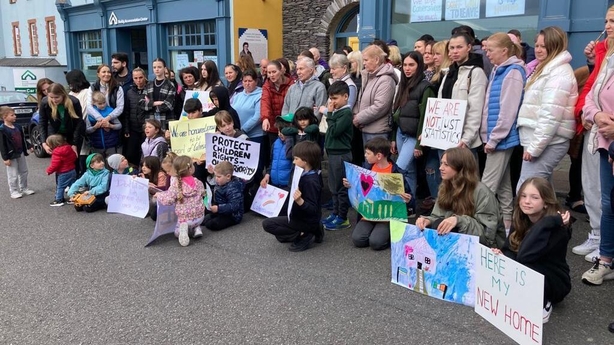
The initial response was not without complexity. In 2023, a proposal to relocate a group of Ukrainian refugees who had already integrated into Cahersiveen to a different location prompted a community campaign to keep them in the town — a campaign that succeeded. That episode illustrated both the depth of the bonds that had formed and the fragility of the arrangements that governed where refugees could live. The Irish government's subsequent introduction of a Temporary Protection Transition Scheme in May 2026, which provides a pathway for Ukrainians to remain in Ireland after the EU-wide protection directive expires in March 2027, has given those families a degree of security that was previously absent.
The scheme requires individuals to be employed and to meet a minimum salary threshold, conditions that have focused attention on the employment outcomes of Ukrainian refugees across Ireland. In Cahersiveen, the picture is broadly positive. Many of the Ukrainian adults in the town have found work in local businesses, in agriculture, and in the hospitality sector, contributing to an economy that was struggling with labour shortages before their arrival.
Key Developments
The integration of Ukrainian families into Cahersiveen has proceeded along several parallel tracks. In the schools, Ukrainian children have learned English with remarkable speed, and many are now performing at or above the level of their Irish peers. Teachers have spoken of the enrichment that comes from having children with different cultural backgrounds and life experiences in the classroom, and of the way that shared activities — sport, music, art — have broken down barriers that language alone could not.
On the GAA pitches, Ukrainian teenagers have taken to Gaelic football and camogie with enthusiasm, joining local clubs and becoming part of the social fabric that those clubs represent. The GAA has long been one of the most effective vehicles for community integration in Ireland, and Cahersiveen is no exception. Several Ukrainian players have become regulars on underage teams, and their presence has been welcomed by coaches and fellow players alike.
In the local economy, the contribution of Ukrainian workers has been tangible. Several businesses that were struggling to find staff before 2022 have been able to maintain and in some cases expand their operations thanks to the availability of willing and skilled workers from Ukraine. The town's population, which had been declining, has stabilised, and there is a sense among local business owners that the new arrivals have helped sustain services and amenities that might otherwise have been at risk.
Why It Matters
The Cahersiveen story matters because it offers a concrete, lived example of what successful refugee integration looks like — and because it stands in sharp contrast to the narrative of tension and conflict that has dominated coverage of immigration in Ireland and Northern Ireland in recent weeks. The violence in Belfast, triggered by fears about immigration and asylum, has created a climate in which it is easy to forget that the vast majority of interactions between Irish communities and newcomers are characterised by goodwill, pragmatism, and mutual benefit. Cahersiveen is a reminder that integration is not a theoretical aspiration but a practical reality that is being achieved, quietly and without fanfare, in towns and villages across the country. The town's experience also demonstrates that the benefits of integration flow in both directions — that communities which welcome newcomers tend to be strengthened by the experience, not diminished by it.
Local Impact
The impact on Cahersiveen is visible in the most ordinary ways. The primary school, which had been facing declining enrolment, now has a waiting list. The local GAA club has more players than it has had in years. Several businesses that were operating with skeleton staff are now fully staffed. The town's population has grown, and with it the demand for local services — the shops, the cafés, the pharmacy, the post office — that depend on a critical mass of residents to remain viable. For a town on the western edge of Europe, where the threat of demographic decline has been a constant background anxiety for decades, the arrival of families who want to stay and build a life is not a burden. It is, in the most straightforward sense, a gift.
What's Next
The introduction of the Temporary Protection Transition Scheme means that Ukrainian families in Cahersiveen who are employed and meet the salary threshold will be able to apply for a more secure immigration status before the EU directive expires in March 2027. For those who qualify, this represents a significant step towards permanence — the ability to plan for the future, to invest in a home, to commit to a community. Local representatives have called on the government to ensure that the transition process is as straightforward as possible and that support is available for those who face barriers to employment. The story of Cahersiveen is not finished; it is, in many ways, just beginning.