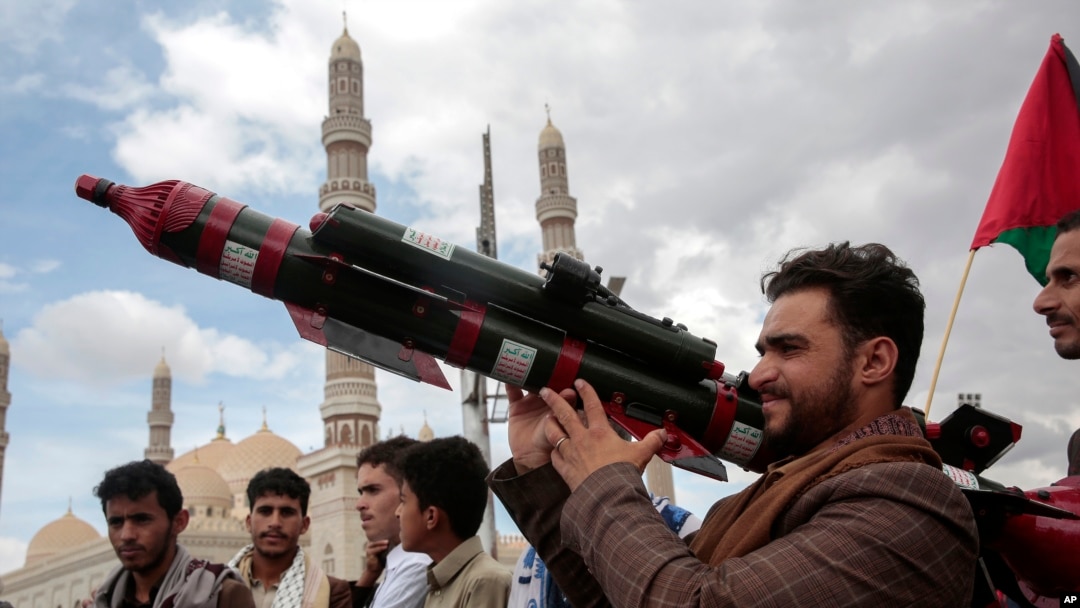
Houthis Enter Iran War with Missile Attacks on Israeli Military Sites
Yemen's Houthi forces have entered the escalating Iran conflict by launching ballistic missiles, cruise missiles, and drones at Israeli military sites, marking a significant expansion of the Middle East crisis that threatens global trade routes, energy supplies, and economic stability across the UK and beyond.
The Houthi faction, a key component of Iran's regional "Axis of Resistance," launched coordinated attacks on Israeli military installations beginning on 28 March 2026, posing a direct threat to the Bab al-Mandab strait — a critical chokepoint for global trade and energy supplies. This escalation comes as Iran maintains a near-total closure of the Strait of Hormuz, amplifying concerns about severe damage to the global economy.
Background
Yemen's Houthi movement controls much of the country's north and its strategic Red Sea coastline. Iran serves as the group's primary benefactor, providing sophisticated weaponry, training, and intelligence support. The Houthis act as a key node in Iran's "Axis of Resistance" — a network of allied militias that includes Hezbollah in Lebanon and various factions in Iraq — and their entry into the direct conflict with Israel signals a dangerous new phase in the regional war.
Houthi officials have explicitly stated their participation is in "joint coordination" with Iran, Lebanon, and Iraq, vowing to continue military operations until "aggression on all fronts of resistance ceases." Their advanced long-range missile capabilities, largely supplied by Tehran, allow them to strike targets over 1,000 miles away — a fact that has alarmed Israeli military planners preparing for what they describe as a "multifront war."
The crisis has created what analysts are calling a "double chokepoint" emergency. The Bab al-Mandab Strait — through which approximately 12% of global seaborne trade passes — has seen Suez Canal transits decline by more than 50% as major carriers like Maersk divert vessels around Africa's Cape of Good Hope, adding 10 to 14 days to journeys and over £1 million in extra fuel costs per round trip. Simultaneously, Iran's near-closure of the Strait of Hormuz — which handles a fifth of the world's oil supply — has stranded roughly 2,000 ships in the Persian Gulf.
Key Developments
The United States has responded by deploying thousands of Marines and airborne forces to the region. Reports indicate that Iranian attacks have injured US troops at a Saudi base, further complicating the security situation. Intelligence assessments suggest the US has destroyed only about a third of Iran's missile and drone arsenal, indicating the conflict could intensify further.
Air raid sirens were activated across Kuwait, Bahrain, and Israel amid reported missile threats. In Abu Dhabi, five Indians were injured after missile debris fell near KEZAD, highlighting the conflict's expanding geographic impact. Pakistan has attempted to mediate by hosting a meeting of Middle Eastern foreign ministers, though the warring parties were not included. Iran has allowed a limited number of ships to pass through the Strait of Hormuz, which Pakistan views as a "meaningful step toward peace."
President Donald Trump extended the deadline for Iran to open the Strait of Hormuz until 6 April, though tensions remain high. The conflict has already driven oil prices to $100 per barrel, with Brent crude surpassing that threshold in March 2026, and contributed to significant stock market volatility. Germany is considering restarting coal-fired power plants due to energy security concerns linked to the Middle East crisis.
Why It Matters
The combined disruption of both the Bab al-Mandab and the Strait of Hormuz puts an estimated $10 billion per day of global trade at risk, threatening to block nearly a quarter of the world's oil and gas supply from its normal routing. War-risk insurance premiums for the region have increased by over 1,000%, and freight rates on critical Asia-Europe routes have surged by nearly 300%. Analysts warn that a prolonged closure of the Strait of Hormuz would trigger a global energy crisis dwarfing previous shocks. Beyond energy, disruption to the trade of fertilisers and grain through these chokepoints poses a severe risk to food security in import-dependent nations across Africa and Asia, with potential knock-on effects for global inflation.
Local Impact
For the UK, the crisis in the Red Sea and Persian Gulf is no longer a distant problem. British firms are experiencing significant supply chain delays and a sharp rise in transportation costs, with industries reliant on parts from Asia — including automotive manufacturing — particularly vulnerable. Higher energy costs are feeding directly into inflation, putting renewed pressure on UK households and businesses. The UK government, as a leading member of Operation Prosperity Guardian, has authorised joint UK-US air and naval strikes against Houthi military targets in Yemen, with Prime Minister Sunak describing the action as "limited, necessary and proportionate." New sanctions on Houthi leaders have also been imposed.
What's Next
The diplomatic landscape remains complex. A US-Houthi ceasefire brokered by Oman in May 2025 did not include Israel, and the Houthis have made clear their attacks on Israeli targets will continue as long as the broader Iran-Israel war persists. UN Special Envoy for Yemen Hans Grundberg continues to push for de-escalation, warning that regional spillover threatens to drag Yemen back into a wider war and derail years of peace-building efforts. Analysts warn that the Houthi movement has proven resilient to military strikes, and as long as the regional conflict rages, their motivation to disrupt shipping and attack Israel will remain high.
Sources: The Guardian, House of Commons Library — UK and international response to Houthis in the Red Sea, RTÉ News