Grand Central Station Irish Language Signs Row: £145k Plan Could Cost £3m as Legal Battle Escalates
What began as a £145,000 decision by Sinn Féin Infrastructure Minister John O'Dowd to install bilingual Irish and English signage at Belfast's new Grand Central Station has escalated into a multi-million-pound legal and political saga, with figures presented in court this week suggesting the total cost of the project could reach £3 million. The dispute has become a flashpoint for unionist anger over cultural policy and public spending, and a Stormont committee has now announced it will probe the decision.
Background
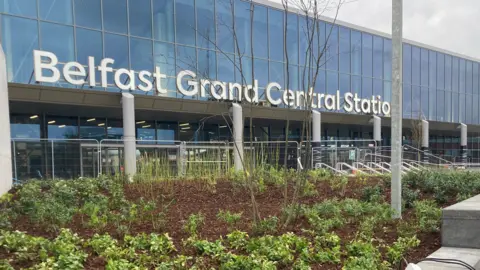
Grand Central Station, which opened in September 2024 as the largest transport hub on the island of Ireland, was built at a cost of approximately £340 million and serves as the terminus for Translink's rail and bus services in Belfast. The station was designed to be a landmark building for the city, and its signage was always going to be a politically sensitive matter in a jurisdiction where the Irish language remains a contested cultural and political symbol.
The decision by Minister O'Dowd to install bilingual signage was made under the provisions of the Identity and Language (Northern Ireland) Act 2022, which placed a duty on public bodies to promote and facilitate the use of the Irish language. The minister argued that the signage was a straightforward implementation of that statutory duty. Unionists, however, argued that the decision was politically motivated and represented an inappropriate use of public funds.
The legal challenge was brought by Jamie Bryson, a prominent unionist campaigner, who argued that the minister had exceeded his powers and that the decision was unlawful. The case has been proceeding through the courts, and it is in the context of those proceedings that the dramatically higher cost estimates have emerged.
Key Developments
Figures presented to the court this week indicated that the full cost of implementing the bilingual signage scheme — including the replacement of existing signs, the installation of new ones, and the associated legal and administrative costs — could reach as much as £3 million, a figure that is more than twenty times the original estimate of £145,000. The News Letter, which has been closely following the case, reported that the escalation in costs has been driven by the complexity of the signage system and the need to replace rather than simply supplement existing infrastructure.
The Stormont Infrastructure Committee has announced it will hold a dedicated scrutiny session on the decision, with committee members from unionist parties expressing particular concern about the cost escalation and the process by which the original decision was made. DUP members have called for the project to be suspended pending the outcome of the legal challenge and the committee's review.
Sinn Féin has defended the decision, arguing that the Irish Language Act creates a clear legal obligation and that the cost of compliance is a matter for the courts and the department to manage. The party has accused unionist parties of using the legal challenge as a political tool to undermine Irish language rights rather than as a genuine expression of concern about public spending.
Why It Matters
The Grand Central Station signage row is, on one level, a dispute about signs. But it is also a microcosm of the broader cultural and political tensions that continue to define life in Northern Ireland more than a quarter of a century after the Good Friday Agreement. The Irish language has been one of the most consistently contentious issues in post-Agreement politics, with unionists and nationalists holding fundamentally different views about its status, its promotion, and the appropriate use of public resources to support it.
The cost escalation is particularly significant. When a decision that was presented as a straightforward implementation of a statutory duty turns out to carry a potential price tag of £3 million, it raises legitimate questions about how such decisions are made and scrutinised. Northern Ireland's public finances are under severe pressure, and the prospect of spending that sum on signage — however legally justified — is difficult to defend in a context where health trusts are warning of catastrophic service cuts.
The legal challenge itself is also significant. It is the third judicial review brought by unionist campaigners against Irish language-related decisions by Sinn Féin ministers in the current mandate, suggesting a pattern of using the courts as a political arena in the absence of consensus at Stormont.
Local Impact
For commuters using Grand Central Station — which handles tens of thousands of passengers daily on Translink's Enterprise, Derry, Bangor, Larne, and Portadown services — the signage dispute is largely an abstraction. The station functions, the trains run, and the signs, for now, remain as they were. But the political temperature around the issue has been felt in the Assembly chamber, where debates about the Irish language have become increasingly heated in recent weeks.
In North Belfast, where the station is located, community reactions have been mixed. Some residents have expressed support for bilingual signage as a reflection of the city's cultural diversity; others have questioned the priority given to the issue at a time when the health service is in crisis and housing waiting lists are growing. The Belfast City Council is expected to discuss the matter at its next meeting.
What's Next
The judicial review is expected to conclude in the coming weeks, with a judgment anticipated before the end of July. The Stormont Infrastructure Committee's scrutiny session is scheduled for late June. If the court rules against the minister, the signage project will be halted and the legal costs — which are themselves likely to be substantial — will fall to the public purse. If the court upholds the decision, the project will proceed, though the question of how the escalated costs will be managed remains unresolved. Either way, the dispute is unlikely to be resolved quickly, and its political reverberations will be felt well into the autumn.