Government Defeats Sinn Féin Irish Unity Bill by 79 Votes to 69 as Coalition Labels Timelines 'Not Credible'
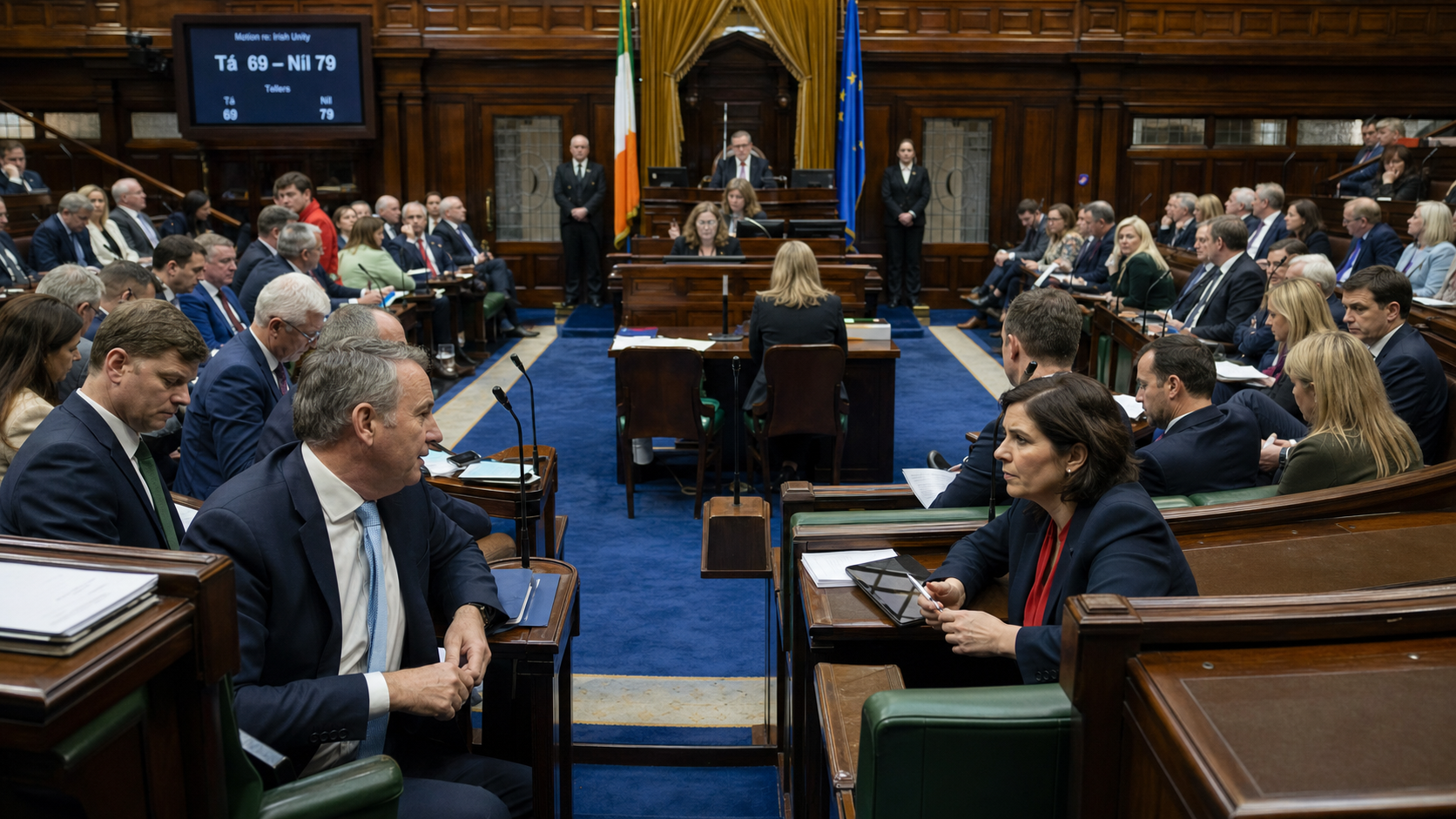
The Fianna Fáil-Fine Gael coalition government has defeated a Sinn Féin-sponsored bill in the Dáil that sought to mandate state preparation for a potential united Ireland, with the legislation falling by 79 votes to 69 after the Taoiseach described its timelines as "not credible" and the Tánaiste argued that the approach was counterproductive to the sensitive, long-term work of fostering cross-community reconciliation in Northern Ireland.
Background
The question of Irish unity has moved from the margins to the mainstream of Irish political discourse over the past decade, driven by the demographic changes in Northern Ireland, the impact of Brexit, and the growing electoral strength of Sinn Féin on both sides of the border. The 2020 Irish general election, in which Sinn Féin topped the poll, was widely interpreted as a signal that a significant portion of the Irish electorate was ready to engage seriously with the question of constitutional change.
The Good Friday Agreement provides a mechanism for a border poll — a referendum on Irish unity — to be called by the Secretary of State for Northern Ireland if it appears likely that a majority in Northern Ireland would vote for a united Ireland. The conditions under which such a poll would be called have never been precisely defined, and successive UK governments have been reluctant to engage with the question. In the Republic, successive governments have also been cautious, arguing that the priority must be building the conditions for unity rather than rushing towards a referendum.
Sinn Féin has consistently argued that this caution amounts to a failure of political will and that the state has an obligation to prepare for the possibility of unity, regardless of when a border poll might be called. The party's bill, which was debated in the Dáil on July 14 and defeated on July 15, was the latest expression of that argument.
Key Developments
The Sinn Féin bill would have required the government to produce a "Green Paper" on constitutional change within 18 months and to establish a Citizens' Assembly to discuss the issue of Irish unity. The legislation was framed as a planning measure rather than a commitment to unity, on the grounds that the state should be prepared for any constitutional outcome rather than being caught unprepared as the UK was by Brexit.
The government's opposition to the bill centred on what it described as the "arbitrary timelines" imposed by the legislation. Taoiseach Micheál Martin described the bill as "not credible" and argued that the 18-month deadline for a Green Paper was unrealistic given the complexity of the issues involved. Tánaiste Simon Harris also opposed the timelines, arguing that the approach was counterproductive to the sensitive work of building cross-community support for unity in Northern Ireland.
Sinn Féin leader Mary Lou McDonald rejected these arguments, warning that a failure to plan for unity risked "chaos" similar to that seen with Brexit, when the UK left the European Union without adequate preparation for the consequences. McDonald argued that the bill was a necessary step towards an "orderly, democratic, and peaceful" transition and that the government's opposition reflected a lack of political courage rather than a principled position.
Why It Matters
The defeat of the Sinn Féin bill matters because it clarifies the current state of play on Irish unity in the Dáil. The 79-69 vote reveals a significant minority in favour of a more proactive approach to unity planning, but a clear majority — including the government parties and most independents — opposed to the specific mechanism proposed by Sinn Féin. The vote does not settle the underlying question of Irish unity, but it does establish that the current government is not prepared to be driven by Sinn Féin's timetable.
Fine Gael's indication that it is developing its own "blueprint for a unified island" is significant. It suggests that the party recognises the political salience of the unity question and is seeking to develop a credible position that is distinct from both Sinn Féin's approach and the traditional unionist opposition to any discussion of constitutional change. The nature and content of that blueprint will be closely watched.
The vote also has implications for Northern Ireland, where the debate about Irish unity is watched with intense interest by both communities. Unionists will take some comfort from the government's rejection of the Sinn Féin bill, while nationalists and republicans will note the significant minority vote in favour and the government's acknowledgement that unity planning is a legitimate political activity.
Local Impact
The debate and vote on the Sinn Féin bill generated significant media coverage in Northern Ireland, where the question of Irish unity is not an abstract constitutional matter but a live political issue with direct implications for people's daily lives and sense of identity. Unionist politicians, including DUP leader Gavin Robinson and UUP leader Doug Beattie, welcomed the government's defeat of the bill, while Sinn Féin's northern leadership described the vote as a missed opportunity.
In the Republic, the vote has been interpreted by political analysts as a sign that the government is seeking to manage the unity question carefully, avoiding both the appearance of indifference and the risk of being seen to rush towards a referendum for which the conditions are not yet ripe. The Citizens' Assembly on Irish Unity, which was established in 2023, continues its work and is expected to publish its final report later in 2026.
What's Next
Fine Gael has indicated it will publish its blueprint for a unified island before the end of 2026. The Citizens' Assembly on Irish Unity is expected to publish its final report in the autumn, and the government has committed to responding to that report within six months. Sinn Féin has indicated it will continue to press for unity planning through the Oireachtas and has not ruled out bringing further legislation on the issue. The next scheduled review of the Good Friday Agreement's provisions on a border poll is expected to take place in 2027.