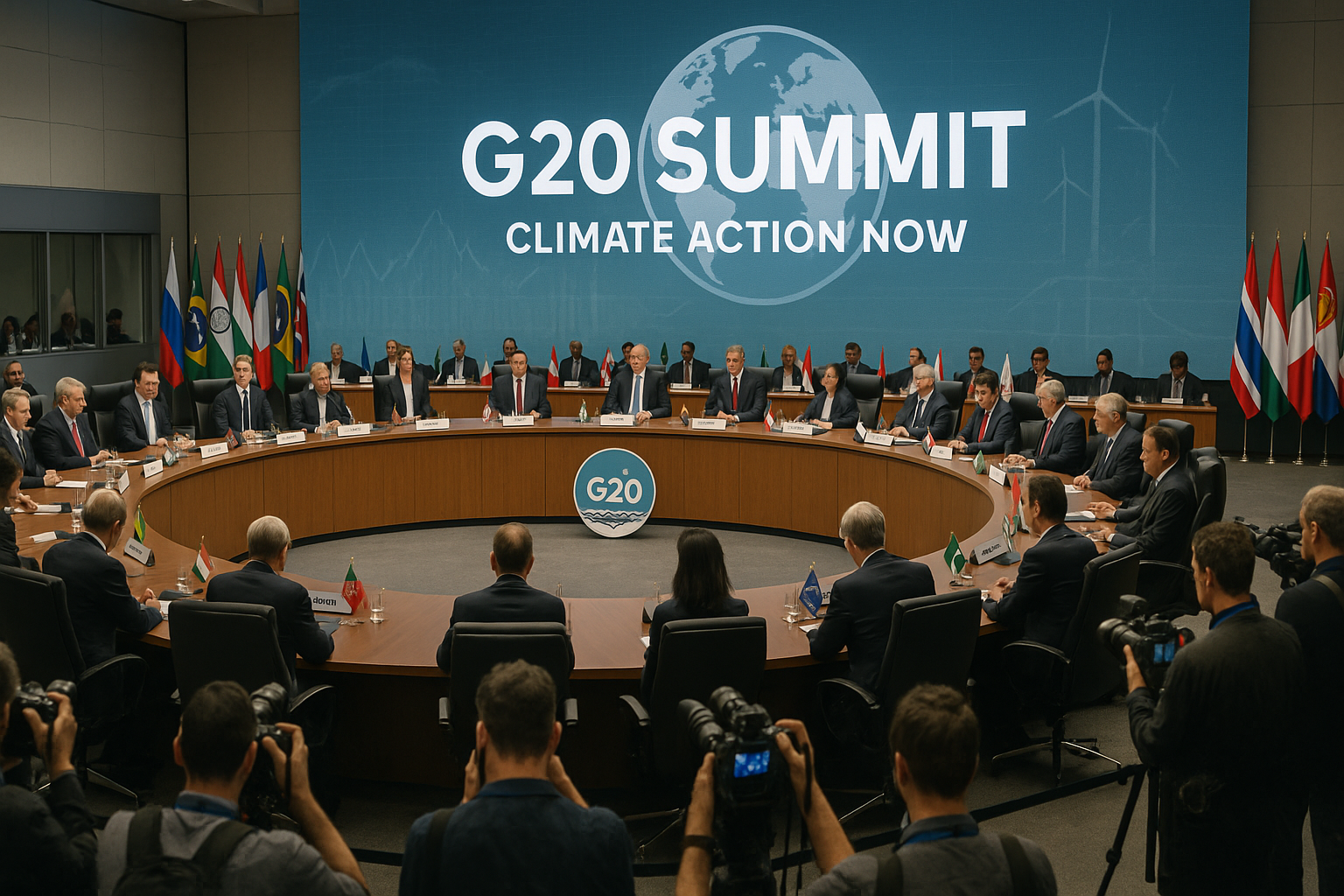
Global Leaders Convene at G20 Summit to Address Climate Crisis
World leaders from the G20 nations have convened for what many are calling the most consequential climate summit in recent memory, with the heads of the world's largest economies placing emissions reduction, clean energy transition, and climate finance squarely at the top of the agenda amid mounting evidence that global progress on climate targets is dangerously off track.
The summit, held under the theme "Vasudhaiva Kutumbakam" — One Earth, One Family, One Future — concluded with a comprehensive joint declaration that established a framework for collective action on climate change, sustainable development, and multilateral reform. A landmark decision was the permanent inclusion of the African Union as a full G20 member, widely hailed as a crucial step toward making global governance more representative and inclusive.
Background
The G20 summit comes at a critical moment for global climate action. At the midpoint to 2030, global progress on the Sustainable Development Goals is, in the words of the declaration itself, "off track with only 12% of the targets on track." Extreme weather events — from devastating floods in Pakistan and Libya to record-breaking heatwaves across Europe and North America — have underscored the urgency of the moment and increased public pressure on governments to deliver concrete, enforceable commitments rather than aspirational pledges.
The scientific consensus is unambiguous: global greenhouse gas emissions must fall by 43% by 2030 relative to 2019 levels to keep the 1.5°C temperature target within reach. The G20 nations collectively account for approximately 80% of global emissions, making their commitments central to any credible pathway to limiting warming. Previous summits have been criticised for producing declarations heavy on ambition but light on implementation mechanisms.
Key Developments
The summit's Green Development Pact represents the most detailed section of the declaration, committing leaders to "pursue and encourage efforts to triple renewable energy capacity globally" by 2030 and to accelerate the phasedown of unabated coal power. Leaders reaffirmed their commitment to the Paris Agreement's temperature goals, reiterating their resolve to "pursue efforts to limit the temperature increase to 1.5°C above pre-industrial levels."
On climate finance — historically the most contentious issue in international climate negotiations — the declaration acknowledged the immense scale of investment required: an estimated $5.8–5.9 trillion for developing countries' climate goals before 2030, and $4 trillion per year for clean energy technologies by 2030 to reach net-zero emissions by 2050. Developed countries stated they expect the long-standing goal of mobilising $100 billion per year in climate finance for developing nations to be met for the first time. A Global Biofuels Alliance was also established to promote sustainable biofuels as part of the energy transition.
Environmental organisations have cautiously welcomed the tone of the proceedings while emphasising the need for enforceable commitments. Financial markets have already begun responding to early summit signals, with clean energy stocks seeing significant gains across Asian and European exchanges as investors anticipate a surge in green infrastructure spending.
Why It Matters
The G20 summit's outcomes carry enormous weight for the trajectory of global climate action. The commitment to triple renewable energy capacity by 2030 — if implemented — would represent a fundamental shift in the global energy mix, with profound implications for fossil fuel producers, energy importers, and the millions of people in developing nations who currently lack access to reliable electricity. The inclusion of the African Union as a permanent G20 member is also significant, giving the continent a stronger voice in shaping the global rules on climate finance and technology transfer that will determine whether developing nations can pursue low-carbon growth pathways.
Critics, however, have noted that the declaration's language on coal — calling for a "phasedown" rather than a "phaseout" — represents a weakening of previous commitments, and that the $100 billion climate finance goal, while welcome, falls far short of the trillions needed. The absence of binding enforcement mechanisms remains a fundamental weakness of the G20 process.
Local Impact
For the UK, the G20's climate commitments have direct implications for energy policy, industrial strategy, and the government's own net-zero targets. The commitment to triple renewable energy capacity globally aligns with the UK government's ambitious offshore wind and solar targets, and could accelerate investment in British clean energy infrastructure. For Northern Ireland in particular, where the transition away from oil-dependent heating systems is a pressing challenge, the G20's focus on clean energy transition and climate finance could unlock new funding streams for home insulation and heat pump programmes. Community groups and local councils across the North have been calling for greater investment in energy efficiency measures that would reduce both carbon emissions and household fuel bills.
What's Next
Working groups established at the summit will draft binding resolutions on emissions targets, climate finance, and technology transfer in the months ahead. The next major milestone will be the COP climate conference, where the G20's commitments will be tested against the demands of the most climate-vulnerable nations. Read the full G20 New Delhi Leaders' Declaration and follow analysis from the G20 Research Group at the University of Toronto.