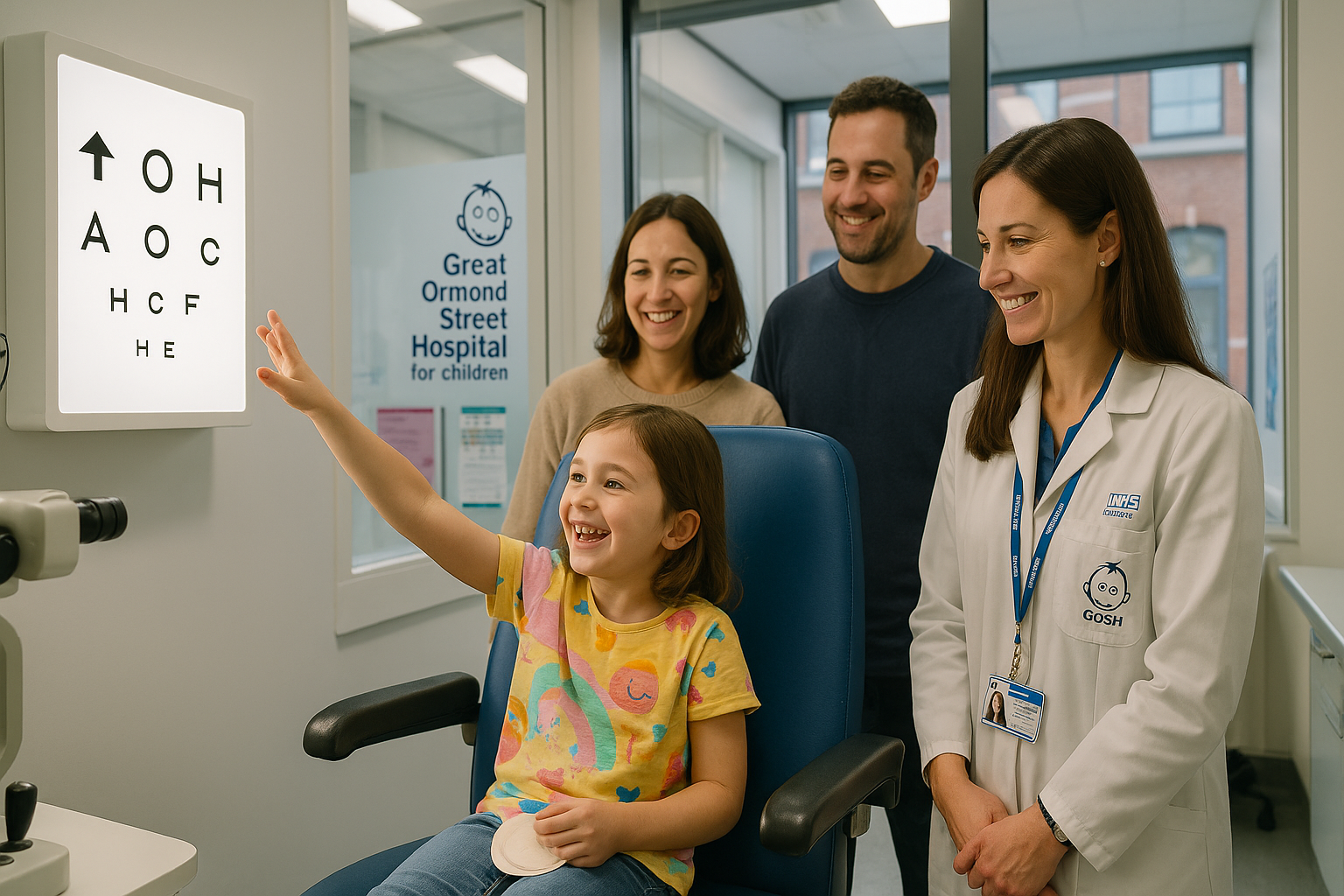
Gene Therapy Restores Sight of Six-Year-Old Girl in Landmark GOSH Study
A six-year-old girl from Hertfordshire has had her sight restored through life-changing gene therapy at Great Ormond Street Hospital, with new research published in JAMA Ophthalmology confirming that treating children at a young age can significantly strengthen visual pathways during a critical period of brain development — findings that could transform the treatment of inherited blindness across the UK and beyond.
Background
Leber's Congenital Amaurosis (LCA) is a rare inherited eye condition caused by mutations in any one of several genes responsible for the normal function of retinal cells. The RPE65 variant — the form affecting Saffie Sandford, the six-year-old at the centre of the new research — prevents eye cells from producing a protein essential for normal vision, leading to poor sight from infancy, no vision in low light, and progressive deterioration towards complete blindness in adulthood.
Saffie was diagnosed at five and a half years old after her parents noticed she was struggling to see in the dark. The diagnosis led to referral to Great Ormond Street Hospital, where she became a candidate for Luxturna — the brand name for voretigene neparvovec, the first gene therapy approved for this specific genetic cause of LCA. The treatment involves injecting a healthy copy of the RPE65 gene directly into the eye using a harmless viral vector, allowing retinal cells to produce the protein they have been unable to make.
Saffie received the treatment in her first eye in April 2025 and her second eye in September 2025. The results, described by her mother Lisa as "life-changing," have been remarkable: she can now see in the dark, participate in activities like trick-or-treating and dining out that were previously impossible, and her peripheral vision in daylight has improved sufficiently for her to detect hazards and thrive at school.
Key Developments
The new research, published in JAMA Ophthalmology in April 2026 by researchers at UCL Great Ormond Street Institute of Child Health and GOSH, provides the first objective evidence that Luxturna treatment in younger children can strengthen visual pathways during a critical period of brain development. The study — the largest of its kind in the UK — followed fifteen children treated at GOSH between 2020 and 2023, ranging in age from fifteen months to twelve years.
Because traditional vision tests are challenging for very young children, the research team used pattern visual evoked potentials (VEPs) — a non-invasive test measuring the signal travelling from the retina to the visual cortex. Seven out of ten children showed clinically significant improvements in pattern VEP testing, including stronger visual signals and faster processing. The youngest children treated during the critical visual development period showed the greatest improvement.
Dr Rob Henderson, a consultant ophthalmologist at GOSH and UCL, said the research "objectively showed gene therapy strengthening visual pathways in babies and young children with this rare eye condition," highlighting the importance of age-appropriate outcome measures and the potential of early intervention.
Why It Matters
The GOSH research matters because it provides the scientific foundation for a fundamental shift in how inherited blindness is treated. The conventional approach has been to wait until a child is old enough to participate in standard vision tests before initiating treatment; the new evidence suggests that waiting may be actively harmful, allowing visual pathways to deteriorate during the critical developmental window. This is the third major gene therapy breakthrough at GOSH in the past three years, following successful treatments for LCA4 and a separate inherited retinal condition — a pattern that reflects the hospital's position at the global frontier of paediatric gene therapy.
For context, gene therapy for inherited blindness was considered science fiction twenty years ago. The approval of Luxturna by NICE and its availability on the NHS represents a transformation in what is possible for children born with these conditions. The UK's investment in gene therapy research — through the NIHR, the Wellcome Trust, and NHS England's Genomics programme — has positioned British institutions at the forefront of a field that is likely to expand dramatically over the next decade.
Local Impact
For families across the UK and Ireland whose children have been diagnosed with inherited retinal conditions, the GOSH research offers genuine hope. In Northern Ireland, where rare disease services are provided through the Belfast Health and Social Care Trust in partnership with specialist centres in Great Britain, the findings will be of direct relevance to families navigating the diagnostic and treatment pathway. In the Republic of Ireland, where the HSE has been working to expand access to gene therapies, the GOSH study provides a model for early intervention that Irish clinicians will be watching closely.
What's Next
The GOSH team is now working to expand the evidence base for early Luxturna treatment, with a larger follow-up study planned. NICE will review the evidence as it accumulates and may update its guidance on the optimal age for treatment. Separately, GOSH and UCL are continuing their work on gene therapy for LCA4 — a different genetic variant — with results from the initial four-patient trial published in The Lancet showing significant improvements in all treated children. The next phase of that trial is expected to begin later in 2026.
Sources: UCL News, Great Ormond Street Hospital