Thousands of Cancer Patients to Benefit from New NHS Immunotherapy Jab
Thousands of cancer patients across England are set to benefit from a new immunotherapy treatment that will be made available through the National Health Service, in a development that oncologists are describing as a significant step forward in the fight against the disease — and one that builds on a remarkable clinical trial in which all 32 participants were found to be cancer-free nearly three years after treatment.
Background
Immunotherapy has transformed cancer treatment over the past decade, offering patients with certain types of cancer a treatment option that harnesses the body's own immune system to identify and destroy cancer cells. Unlike traditional chemotherapy, which attacks all rapidly dividing cells — including healthy ones — immunotherapy is more targeted, and for some patients it produces durable, long-lasting responses that conventional treatments cannot achieve.
The UK has been at the forefront of immunotherapy research and adoption, with the NHS making a series of significant investments in new treatments over recent years. The Cancer Drugs Fund, which provides access to promising new treatments while evidence of their effectiveness is gathered, has been a key mechanism for getting innovative therapies to patients more quickly than the standard approval process would allow.
The UK also passed the largest package of clinical trial reforms in over 20 years earlier this year, aimed at providing cancer patients with faster access to new treatments. Trial set-up times have already decreased as a result, and a fast-track route for less complex trials has been introduced. Publication of trial results is now a legal requirement, ensuring that the evidence base for new treatments is more transparent and accessible than before.
Key Developments
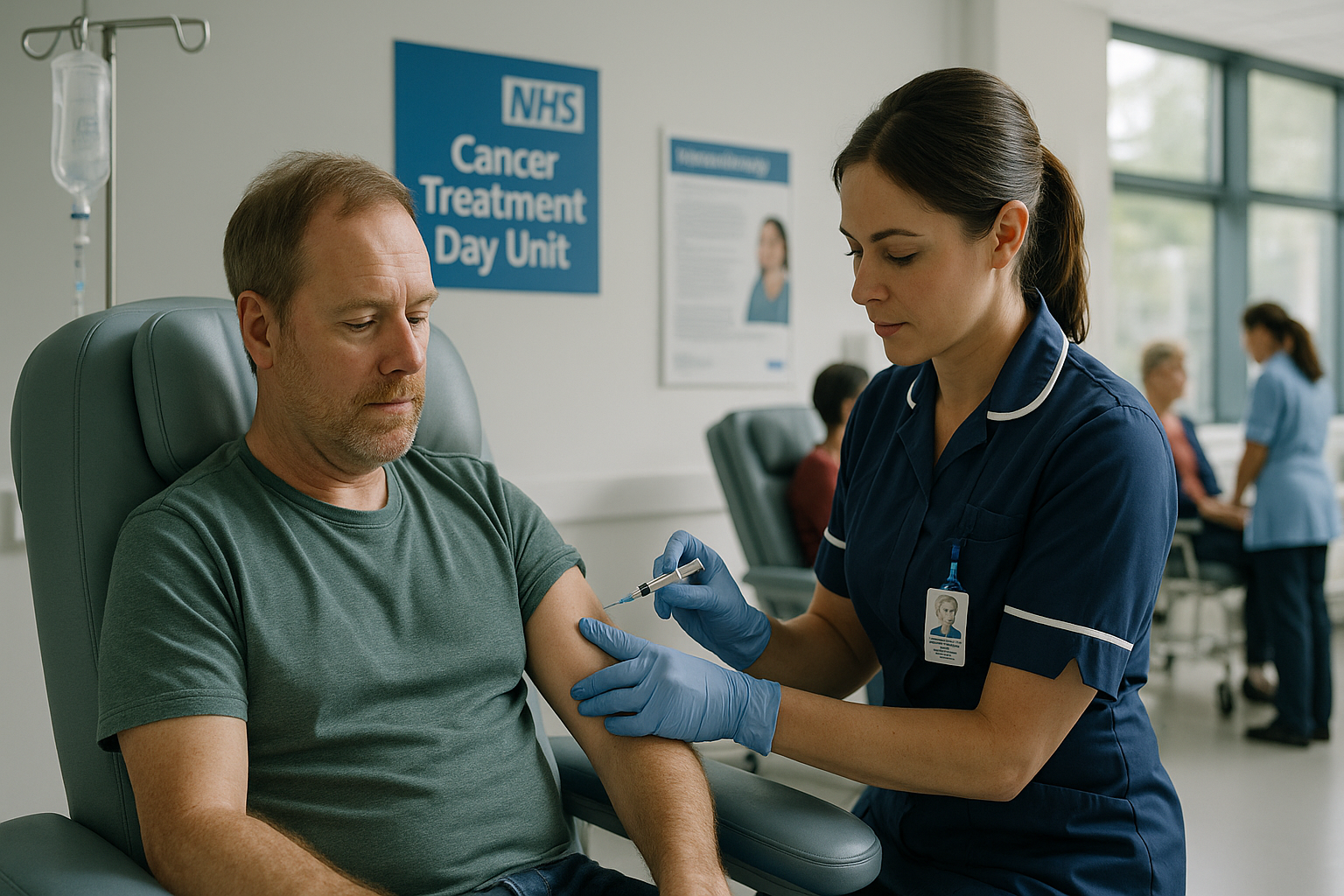
The Guardian reported on 4 May 2026 that thousands of cancer patients are set to benefit from the introduction of a new immunotherapy jab available through the NHS. The treatment represents a significant advancement in cancer care and will be made available to eligible patients across England.
The announcement comes in the context of a remarkable clinical trial result reported by Positive News: all 32 patients who participated in a UK trial for a specific type of bowel cancer — MMR deficient/MSI-high — were found to be cancer-free nearly three years after treatment. The trial used the immunotherapy drug pembrolizumab, administered before surgery, potentially replacing post-operative chemotherapy. A 100% success rate in a clinical trial is extraordinarily rare and represents a major milestone in the fight against this form of cancer.
Separately, a six-year-old girl in England had her sight restored through gene therapy (Luxturna) for Leber's congenital amaurosis at Great Ormond Street Hospital — a treatment now approved for use on the NHS that offers hope to patients with a specific type of inherited retinal dystrophy.
Why It Matters
Cancer remains the leading cause of death in the UK, with around 375,000 new cases diagnosed each year. The introduction of new immunotherapy treatments through the NHS represents a genuine improvement in the options available to patients, and the bowel cancer trial results — if they hold up in larger studies — could herald a new standard of care for a disease that kills over 16,000 people in the UK annually. For context, bowel cancer is the fourth most common cancer in the UK and the second most common cause of cancer death, making advances in its treatment of enormous public health significance.
The NHS's ability to adopt new treatments quickly is also significant. Unlike some healthcare systems, where access to innovative therapies is determined by ability to pay, the NHS provides universal access — meaning that a patient in Belfast or Bradford has the same access to new immunotherapy treatments as one in London. This principle of equity is one of the NHS's most important features, and the new immunotherapy jab reinforces it.
Local Impact
For cancer patients and their families across the UK and Ireland, the news of new NHS immunotherapy treatments is genuinely hopeful. In Northern Ireland, cancer services are provided through the Health and Social Care system, which works closely with NHS England on the adoption of new treatments. The Belfast Health and Social Care Trust, the Western Health and Social Care Trust, and other trusts across the province will be watching the rollout of the new immunotherapy jab closely, with a view to making it available to eligible patients in Northern Ireland. In the Republic of Ireland, the HSE's National Cancer Control Programme will similarly be monitoring the evidence for the new treatment, though the approval and funding process differs from the NHS.
What's Next
The NHS England rollout of the new immunotherapy jab is expected to begin in the coming weeks, with eligible patients identified through their oncology teams. The bowel cancer trial results will be submitted for peer review and publication in a major medical journal, a process that typically takes several months. If the results are confirmed in larger studies, NICE — the National Institute for Health and Care Excellence — will consider recommending the treatment for wider NHS use. The gene therapy Luxturna is already approved for NHS use and will continue to be offered to eligible patients at specialist centres including Great Ormond Street Hospital.
Sources: The Guardian — England news; Positive News — Good news stories week 17