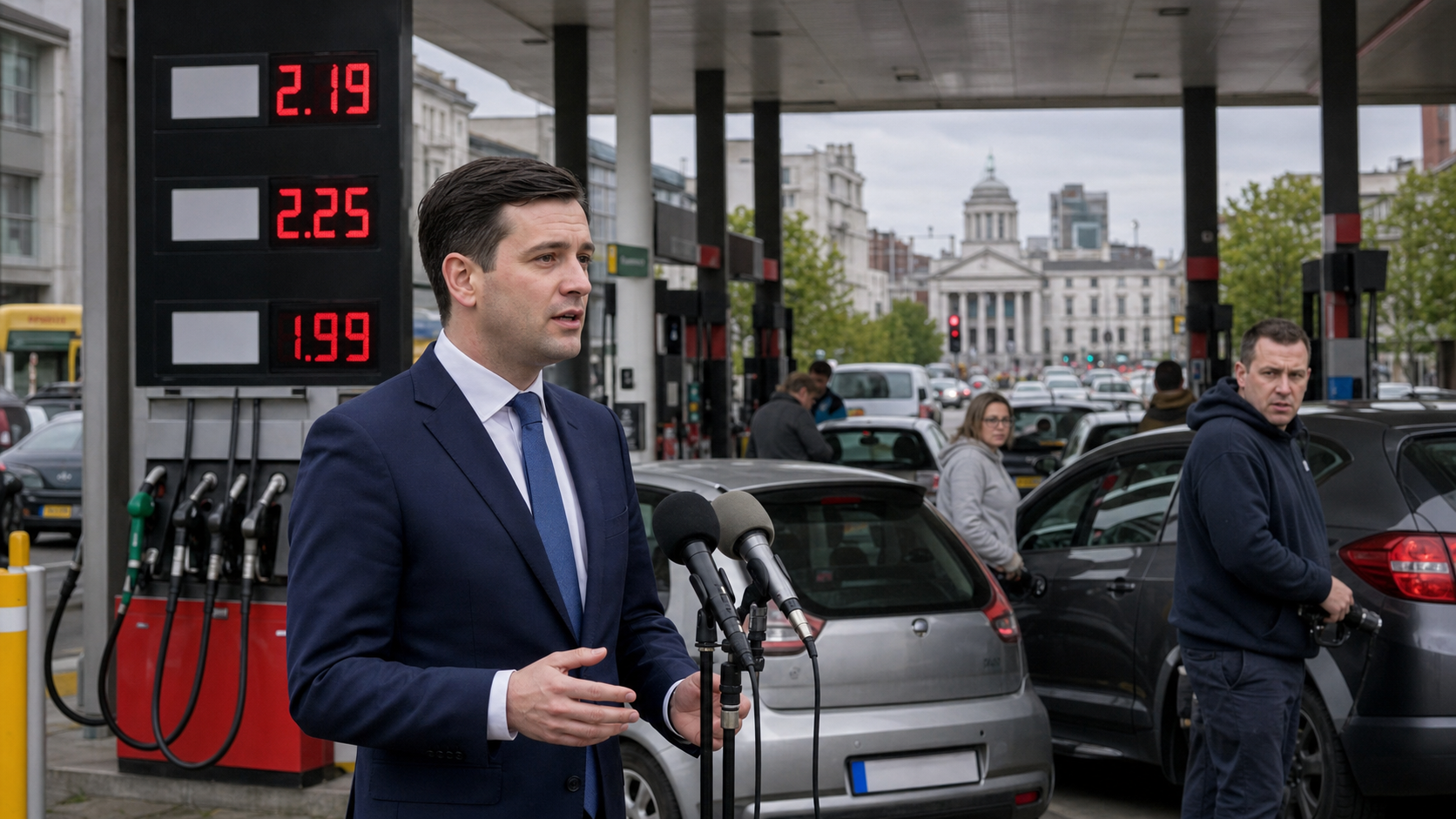
Fuel Tax Cuts May Be Extended as US-Iran Conflict Keeps Pump Prices High, Chambers Signals
Minister for Finance Jack Chambers has signalled that the government's temporary reductions in fuel excise duty could be extended beyond their current expiry date if pump prices remain at elevated levels, as the ongoing conflict between the United States and Iran continues to push oil prices higher and squeeze household budgets across Ireland.
The minister's comments, made in response to questions about the government's plans for the unwinding of fuel tax cuts introduced during the energy crisis, represent a significant shift in tone from the government's previous position, which had been that the temporary measures would be phased out as planned. The signal that an extension is possible will be welcomed by motorists and hauliers who have been warning about the impact of rising fuel costs on household and business finances.
Background
The Irish government introduced temporary reductions in fuel excise duty in 2022 in response to the surge in energy prices that followed Russia's invasion of Ukraine. The cuts, which reduced the cost of petrol and diesel at the pump by several cents per litre, were intended as a short-term measure to ease the burden on households and businesses during a period of exceptional price volatility. They have been extended on several occasions since their introduction, but the government has consistently indicated that they would eventually be phased out as energy prices normalised.
However, the normalisation of energy prices that the government anticipated has not materialised. The US-Iran conflict, which has disrupted oil supply routes through the Strait of Hormuz and pushed global oil prices higher, has kept pump prices in Ireland at levels that are significantly above the pre-crisis norm. The average price of petrol at Irish forecourts has remained above €1.80 per litre for much of 2026, and diesel prices have been similarly elevated.
The pressure on household budgets from high fuel costs has been compounded by the broader cost-of-living crisis, which has seen food prices, energy bills, and housing costs all rise significantly in recent years. For many Irish households, particularly those in rural areas where car ownership is essential, fuel costs represent a significant proportion of monthly expenditure.
Key Developments
Chambers indicated that the government was monitoring pump prices closely and would make a decision on the future of the fuel tax cuts in the context of Budget 2027, which is expected to be announced in October. "If prices remain at current levels, we will have to consider whether it is appropriate to extend the temporary measures," he said. "Our priority is to ensure that households and businesses are not unduly burdened by fuel costs that are beyond their control."
The minister also addressed the question of the planned unwinding of excise duty reductions, indicating that a significant further increase in pump prices would force a reconsideration of the timeline. "We have always said that the unwinding of these measures would be gradual and would take account of market conditions," he said. "If conditions change significantly, we will respond accordingly."
The comments come as demand for electric vehicle grants has surged in response to high fuel prices, with the government reporting a significant increase in applications for the SEAI EV grant scheme in recent months. The minister acknowledged that the high cost of fossil fuels was accelerating the transition to electric vehicles, but noted that the transition would take time and that in the interim, the government had a responsibility to support households that were dependent on petrol and diesel vehicles.
Why It Matters
The question of fuel tax policy is one of the most politically sensitive issues in Irish public life, touching as it does on the competing demands of environmental policy, cost-of-living concerns, and rural equity. The government's climate commitments require a gradual increase in carbon taxes, including on fuel, as part of the transition to a low-carbon economy. But the political reality is that fuel tax increases are deeply unpopular, particularly in rural areas where public transport alternatives to the car are limited or non-existent.
The minister's signal that the fuel tax cuts could be extended reflects the political difficulty of unwinding measures that have become embedded in household budgets. Once a temporary tax cut has been in place for several years, it becomes increasingly difficult to remove without generating significant political backlash, even if the original rationale for the cut has diminished. The government is navigating a difficult balance between its fiscal and environmental commitments and the immediate pressures on household finances.
The broader context of the US-Iran conflict and its impact on global oil prices adds an additional layer of uncertainty to the government's planning. If the conflict escalates further and oil prices rise significantly, the pressure on the government to maintain or extend the fuel tax cuts will intensify, potentially at the cost of other budget priorities.
Local Impact
The impact of high fuel prices is felt most acutely in rural Ireland, where car dependency is highest and where public transport alternatives are most limited. Counties like Mayo, Roscommon, Leitrim, and Donegal, where many households are dependent on private cars for access to work, education, and services, have been particularly affected by the sustained period of high pump prices. The extension of fuel tax cuts, if it materialises, would provide some relief to these communities, though it would not address the underlying structural issue of inadequate public transport in rural areas.
What's Next
The government is expected to make a decision on the future of the fuel tax cuts as part of the Budget 2027 process, with the announcement expected in October 2026. The decision will be informed by the trajectory of global oil prices in the coming weeks and by the government's assessment of the overall fiscal position. Environmental groups have already indicated that they will oppose any extension of the fuel tax cuts, arguing that they undermine the government's climate commitments and send the wrong signal about the direction of energy policy.