Electric Vehicle Sales Surge 82% in July as EVs Account for Quarter of All New Irish Car Licences
New figures from the Central Statistics Office show that 7,216 new private electric vehicles were licensed in Ireland in July 2026, an 82% increase on the 3,973 units recorded in the same month last year, with EVs now accounting for 26% of all new private cars licensed — up from 17% in July 2025. The surge means that for the first seven months of 2026, 26,796 new private EVs have been licensed, a 57% increase on the same period in 2025, while petrol and diesel car licences have fallen by 22% and 24% respectively.
Background
Ireland's transition to electric vehicles has accelerated significantly over the past two years, driven by a combination of government incentives, improving vehicle range and charging infrastructure, and a growing consumer awareness of the environmental and financial benefits of electric motoring. The government's target of having 945,000 EVs on Irish roads by 2030 — a figure that would require a dramatic acceleration from the current trajectory — has been the subject of considerable debate, but the July figures suggest that the pace of adoption is increasing faster than many analysts had anticipated.
The CSO's data on Ireland's vehicle fleet, published earlier this year, showed that EVs accounted for 4% of the total licensed vehicle fleet as of June 2026 — a figure that, while still modest in absolute terms, represents a significant increase from the 1.5% recorded in 2022. The fleet is heavily skewed toward newer vehicles, with 81.1% of private EVs less than five years old, reflecting the relatively recent emergence of the mass-market EV sector.
The geographic distribution of EV ownership reflects the concentration of higher-income households in urban areas. County Cork and County Dublin account for 49% of all privately licensed EVs, despite representing approximately 40% of the national population. Rural counties, where the charging infrastructure is less developed and where longer journey distances can create range anxiety, have lower rates of EV adoption, though the gap is narrowing as the public charging network expands.
Key Developments
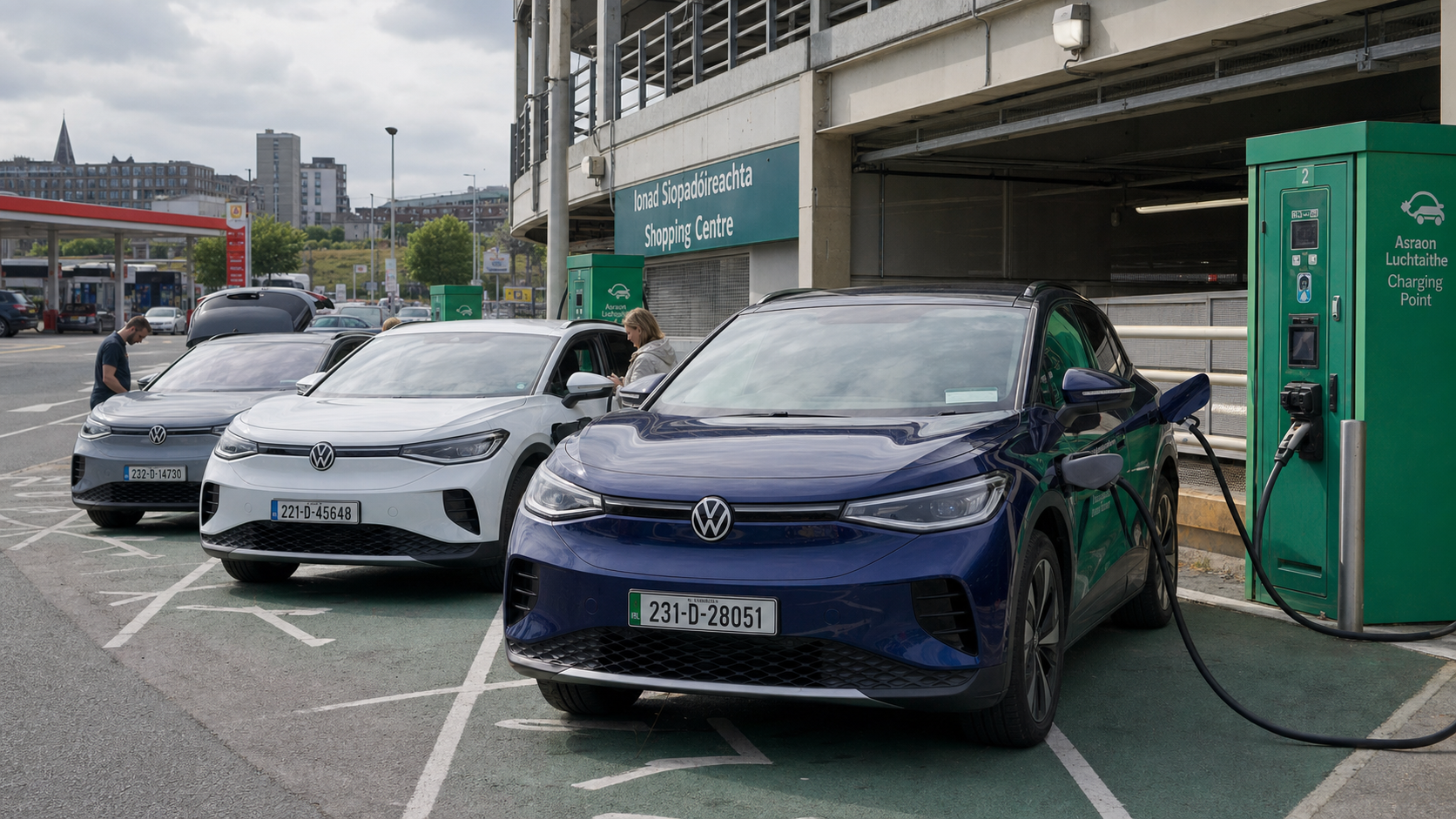
The July figures represent the strongest monthly performance for EV sales in Irish history. The Volkswagen ID.4 was the best-selling model, reflecting the German manufacturer's strong position in the Irish market and the popularity of the SUV body style among Irish consumers. Hyundai, Toyota, and Volkswagen were the leading brands in the EV sector for the month, with the Korean and Japanese manufacturers benefiting from their early investment in EV technology and their established dealer networks in Ireland.
The decline in petrol and diesel car licences — 22% and 24% respectively for the first seven months of 2026 — is a significant indicator of the structural shift that is under way in the Irish new car market. The internal combustion engine, which has dominated Irish motoring for more than a century, is losing market share at a pace that would have seemed implausible just five years ago.
EirGrid's report that the July heatwave boosted solar supply to the national grid — with solar generation reaching record levels during the sustained high-pressure period — has added a new dimension to the EV debate. If EVs are charged primarily from renewable sources, their environmental credentials are significantly stronger than if they draw power from a grid that relies heavily on gas generation. The government's target of 80% renewable electricity by 2030 is therefore directly relevant to the environmental case for EV adoption.
The CSO data also shows that plug-in hybrid and hybrid vehicles continue to play a significant role in the transition, accounting for approximately 26% of new private car licences in the first seven months of 2026 — a market share comparable to that of pure EVs. The hybrid sector is expected to decline as the range and affordability of pure EVs improve, but it continues to serve as a bridge technology for consumers who are not yet ready to commit fully to electric motoring.
Why It Matters
The surge in EV sales matters for Ireland's climate commitments, its energy security, and its economic competitiveness. Transport accounts for approximately 20% of Ireland's greenhouse gas emissions, and the electrification of the private car fleet is one of the most significant levers available to the government in its effort to meet the legally binding 51% emissions reduction target by 2030. The July figures suggest that the transition is accelerating, but the pace of change will need to increase further if the 2030 target is to be met.
The energy security dimension is also significant. Ireland imports virtually all of its fossil fuels, making the country's transport sector highly exposed to global oil price volatility. The electrification of transport, combined with the expansion of domestic renewable energy generation, offers a pathway to greater energy independence that has become increasingly attractive in the context of global geopolitical uncertainty.
Local Impact
The growth in EV sales is driving investment in charging infrastructure across Ireland, with ESB Networks, Bord na Móna, and a growing number of private operators expanding the public charging network. In Dublin, the city council has committed to installing additional on-street charging points in residential areas where off-street parking is limited, addressing one of the key barriers to EV adoption for apartment dwellers and terraced house residents. In rural areas, the expansion of fast-charging hubs at motorway service stations and in market towns is gradually reducing the range anxiety that has deterred some potential EV buyers.
What's Next
The CSO will publish its next monthly vehicle licensing statistics in September, covering August 2026. The government's EV grant scheme — which provides up to €3,500 toward the purchase of a new electric car — is due for review as part of Budget 2027, with some analysts suggesting that the grant could be reduced or restructured as EV prices continue to fall. The National EV Charging Infrastructure Strategy, published in 2023, is also due for its mid-term review before the end of 2026, with a focus on the progress made in expanding the public charging network.