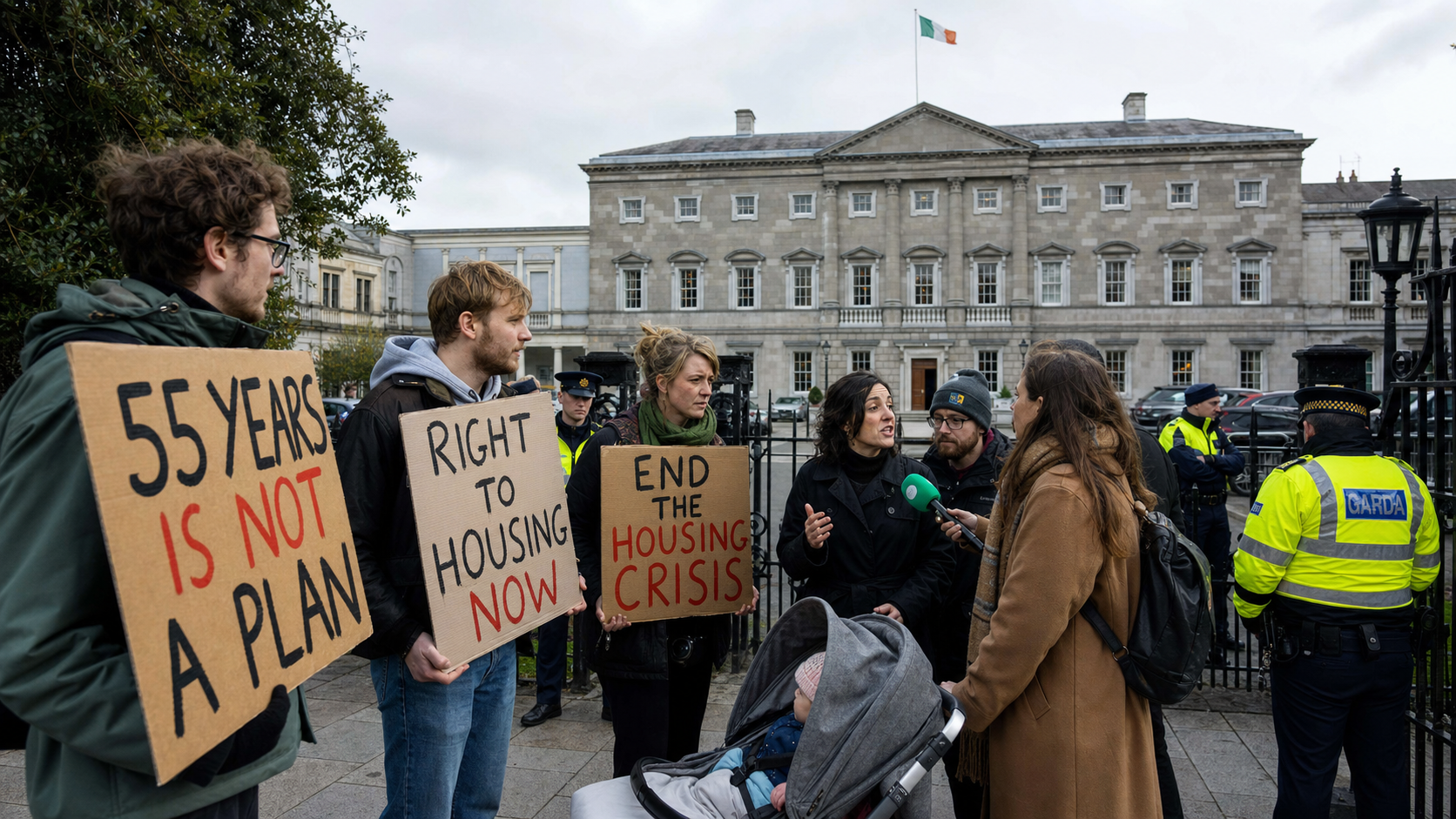
Dáil Told It Will Take 55 Years to Meet Social Housing Need as Opposition Demands Radical Change
The Dáil has been confronted with a projection that Ireland will not meet its social housing need for 55 years at current delivery rates — a figure that has crystallised opposition frustration with the government's housing policy and prompted renewed calls for a fundamental shift in how the state approaches the provision of public housing.
Background
Ireland's housing crisis has been the defining domestic political issue of the past decade. The combination of a rapidly growing population, decades of underinvestment in social housing, a dysfunctional private rental market, and a planning system that has struggled to keep pace with demand has produced a situation in which tens of thousands of households are on social housing waiting lists, homelessness is at record levels, and the prospect of home ownership has receded beyond the reach of a generation of young Irish people.
The government's response has been to point to record levels of housing investment and increasing construction output. The Housing for All plan, published in 2021, set ambitious targets for social, affordable, and private housing delivery, and the government has consistently argued that the plan is on track. Critics, however, have argued that the targets themselves are insufficient to address the scale of the crisis, and that the pace of delivery — while improving — remains far below what is needed.
The 55-year projection, first raised in the Dáil in late June 2026, has given the opposition a powerful rhetorical weapon. The figure, derived from an analysis of current social housing delivery rates against the estimated total need, encapsulates in a single stark number the gap between government ambition and housing reality. It has been cited repeatedly in Dáil debates, media coverage, and public discourse as evidence that the current approach is fundamentally inadequate.
Key Developments
Debate on the 55-year projection continued in the Dáil on 6 July, with opposition parties using the figure to press the government on the urgency of housing reform. Sinn Féin's housing spokesperson Eoin Ó Broin was unequivocal in his assessment: 'Fifty-five years is not a plan; it is an admission of failure. We need a radical change in direction to deliver the public and affordable homes that families desperately need.'
The Social Democrats, Labour, and People Before Profit have all echoed the call for a more ambitious approach, with proposals ranging from a major expansion of direct state construction to the establishment of a new public housing delivery agency with the capacity to build at scale. The government has defended its record, pointing to the 30,000 new homes built in 2025 as evidence of progress, while acknowledging that more needs to be done.
Housing Minister James Browne, who has been in the role for less than six months, has indicated that he is open to reviewing the delivery model, but has stopped short of endorsing the opposition's more radical proposals. The minister has emphasised the importance of the Land Development Agency and the Housing Finance Agency as vehicles for accelerating public housing delivery, and has pointed to a pipeline of approved projects that he argues will significantly increase output in the coming years.
Why It Matters
The 55-year figure matters not just as a political talking point but as a genuine measure of the scale of the challenge facing Irish society. Social housing waiting lists currently stand at over 60,000 households, a figure that represents hundreds of thousands of individuals — children, elderly people, families — living in overcrowded, insecure, or unsuitable accommodation while waiting for a home. The human cost of this failure is immense and largely invisible in the aggregate statistics. For context, the Republic of Ireland's social housing stock as a proportion of total housing is among the lowest in Western Europe, at approximately 9% compared to an EU average of around 15%. Countries such as Austria and the Netherlands, which have maintained strong social housing programmes, have avoided the acute housing crises that have afflicted Ireland and the UK. The 55-year projection suggests that without a fundamental change in approach, Ireland will remain an outlier in European housing provision for generations.
Local Impact
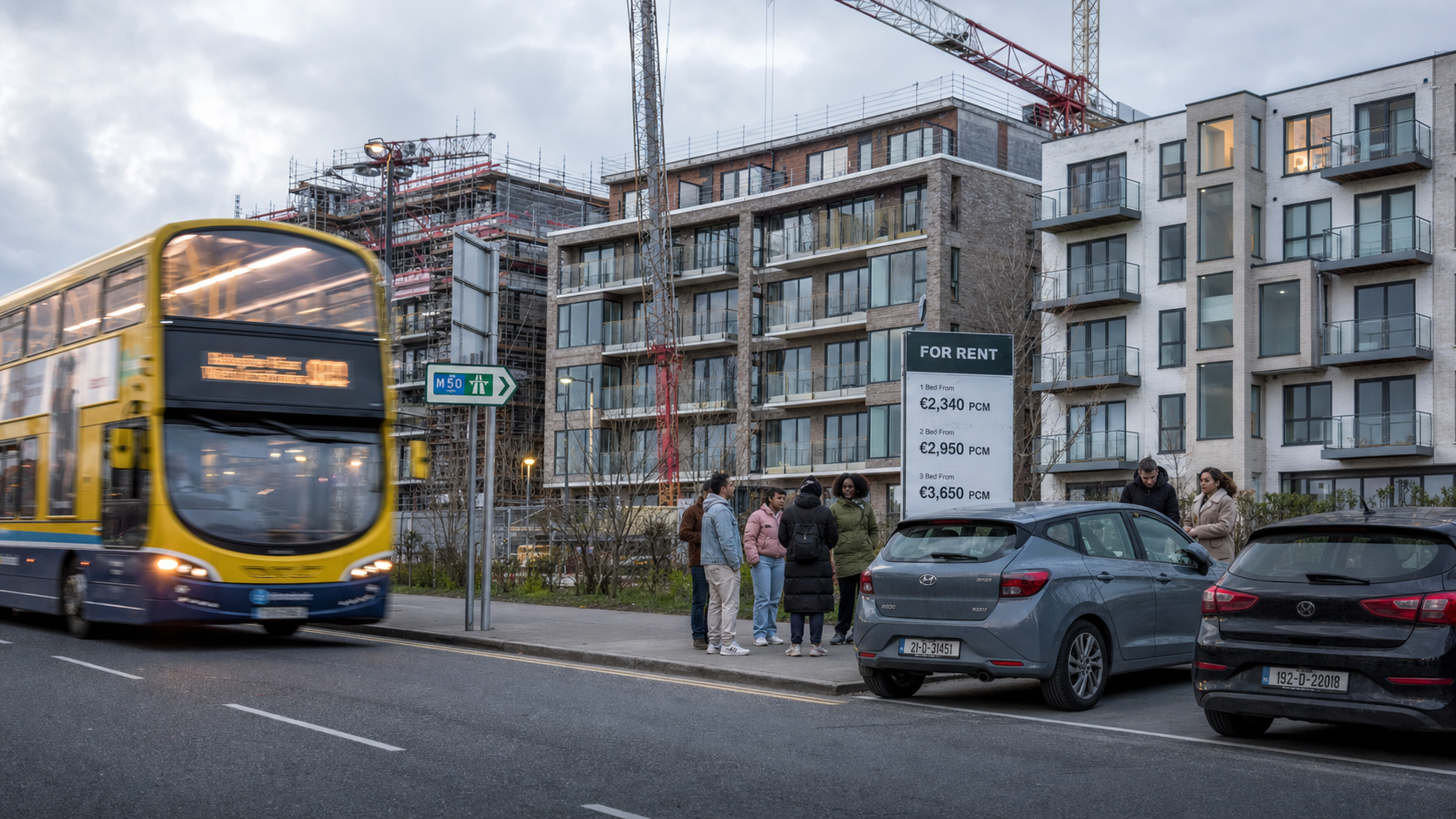
The consequences of the social housing deficit are felt most acutely in Dublin, where waiting lists are longest and the gap between housing costs and incomes is most extreme. In Dublin City Council's area alone, over 15,000 households are on the social housing waiting list, with average waiting times of seven to ten years for a three-bedroom family home. In Cork City, Galway City, and Limerick, similar pressures are evident, with local authorities struggling to meet demand despite increased capital allocations from central government. The HSE's homeless health services, which operate across Dublin, Cork, and Galway, have reported a significant increase in demand for mental health and addiction services among people experiencing homelessness, reflecting the health consequences of the housing crisis. Irish Rail and Bus Éireann have noted increased demand on commuter routes from towns such as Drogheda, Portlaoise, and Mullingar, as workers priced out of Dublin seek affordable housing further from the capital.
What's Next
The Oireachtas Committee on Housing is scheduled to hold a series of hearings in July and August on the adequacy of current housing delivery targets, with the 55-year projection expected to be a central focus. The government is expected to publish a mid-term review of the Housing for All plan in September 2026, which will include revised delivery targets and an assessment of progress to date. The Land Development Agency is expected to announce a new tranche of approved social housing projects in the coming weeks, with sites in Dublin, Cork, and Galway among those expected to be confirmed. A Dáil debate specifically on social housing delivery is expected to be scheduled for the autumn term.