Dublin MetroLink Cost Estimate Soars to €19 Billion as Cabinet Review Looms This Autumn
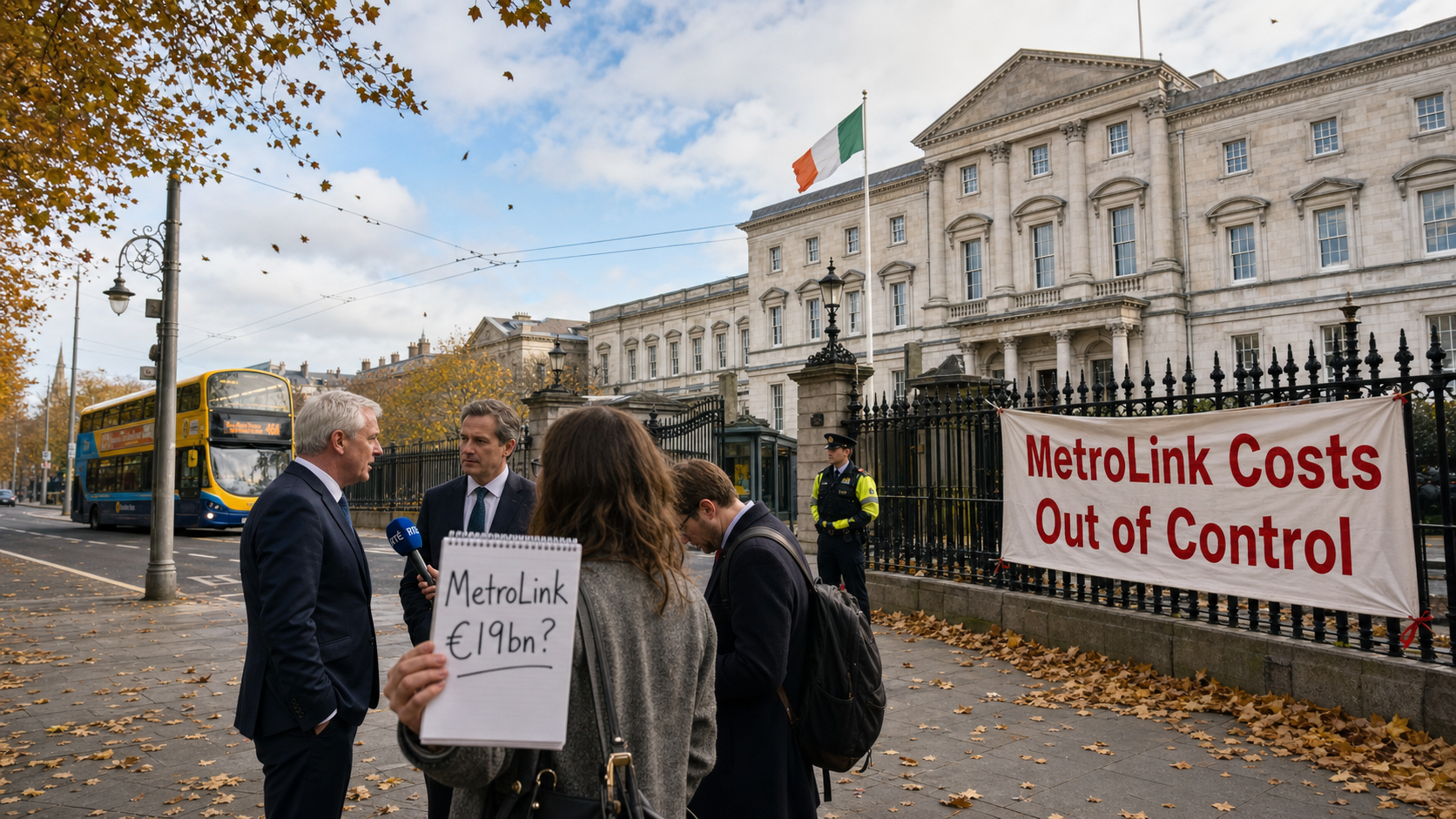
The projected cost of the Dublin MetroLink project has escalated to as much as €19 billion, according to senior government figures, in a development that will test the coalition's commitment to the most ambitious public transport project in the history of the state — and that has already prompted sharp questions about value for money, project governance, and the capacity of the Irish state to deliver major infrastructure on time and on budget.
Background
The Dublin MetroLink is an 18.8-kilometre automated rail line designed to connect Dublin Airport and Swords in north County Dublin to the city centre, with a planned interchange with the existing Luas and DART networks. The project has been in various stages of planning and development since the 1970s, when the first proposals for a Dublin metro were drawn up. It has been cancelled, redesigned, and revived multiple times over the intervening decades, making it one of the most protracted infrastructure planning processes in Irish history.
In 2022, the government approved a preliminary business case for the current iteration of the project, with a cost range of €7.16 billion to €12.25 billion and a midpoint estimate of €9.5 billion. That approval was itself a significant milestone, given the project's troubled history, and was accompanied by commitments to begin procurement in 2026 and to have the line operational in the mid-to-late 2030s.
Transport Infrastructure Ireland, the state agency responsible for the project, has been conducting detailed design and procurement work since 2022. The updated cost estimates, submitted to the National Transport Authority in March 2026, reflect the results of that work — and they make for uncomfortable reading for a government that has staked considerable political capital on the MetroLink as a solution to Dublin's chronic transport congestion.
Key Developments
Updated estimates from TII suggest a cost range of €15 billion to over €18 billion, with senior government figures indicating that the final bill could reach €19 billion. The major contract values advertised by TII illustrate the scale of the investment: tunnelling and excavation alone is estimated at up to €7.9 billion, rolling stock, operations, and maintenance at up to €7.3 billion, and ancillary infrastructure and enabling works at approximately €1.88 billion. These figures do not include the more than €725 million already spent on the project to date.
TII has noted that these represent maximum contract values and expects competitive tendering to result in lower final bids. The Irish Cabinet is scheduled to review the updated financial forecast this autumn, after which the government will decide whether to approve the project for the tendering phase. If approved, enabling works are expected to begin in 2027, with major construction potentially commencing in 2028.
Why It Matters
The MetroLink cost escalation is not an isolated phenomenon — it is part of a pattern of major Irish infrastructure projects significantly exceeding their initial cost estimates. The National Children's Hospital, the National Broadband Plan, and the National Development Plan more broadly have all been subject to substantial cost overruns that have eroded public confidence in the state's ability to deliver large-scale projects. The MetroLink, if it proceeds at the upper end of current estimates, would be by far the most expensive single infrastructure project in Irish history.
The Irish Fiscal Advisory Council has already warned of "sizeable" budgetary overruns in the current fiscal year, and the government is under pressure to demonstrate fiscal discipline ahead of Budget 2027. Committing to a €19 billion infrastructure project in that context is a significant political decision, and one that will require the government to make a compelling case to the public that the investment is justified by the long-term benefits to Dublin's transport network and the national economy.
Local Impact
For the communities along the proposed MetroLink route — from Swords and Dublin Airport through Glasnevin, Drumcondra, and the city centre to Charlemont — the project represents a transformative improvement in public transport connectivity. The areas served by the line include some of Dublin's most densely populated and fastest-growing suburbs, where car dependency is high and public transport options are limited. A functioning MetroLink would significantly reduce journey times to the city centre and the airport, and would support the development of higher-density housing along the corridor. The question is whether the Irish state can deliver it — and at what cost.
What's Next
The Cabinet review of the updated cost estimates is expected in September or October 2026. If the government approves the project for tendering, procurement of the major contracts is expected to begin before the end of the year. The first major contracts — for tunnelling and excavation — are likely to attract bids from a small number of international construction consortia with the capacity to undertake work of this scale. A final investment decision is expected in 2027.