Dublin City Council Approves Rezoning for 25,000 New Homes in Bid to Tackle Housing Crisis by 2032
Dublin City Council has formally approved a sweeping rezoning package that is intended to facilitate the delivery of up to 25,000 additional homes across the capital by 2032, increasing the city's total housing capacity from 49,000 to 73,000 units in what councillors have described as the most significant planning intervention in a generation — though critics have warned that rezoning alone will not solve a crisis rooted in construction blockages and developer inactivity.
Background
Dublin's housing crisis has been building for over a decade, driven by a combination of population growth, under-investment in social housing during the austerity years, and a construction sector that has struggled to scale up quickly enough to meet demand. The city's population has grown by approximately 15% since 2011, adding more than 200,000 people to a housing market that was already under severe pressure. The result has been a sustained surge in rents and purchase prices that has made Dublin one of the least affordable cities in Europe for middle-income earners.
The national government's response has included a series of housing plans and targets, the most recent of which — Housing for All — set ambitious targets for new home construction that have consistently been missed. The government's directive to local authorities to align their development plans with new national housing growth targets was the immediate trigger for Dublin City Council's rezoning exercise, which was finalised in late June 2026 after an extended period of public consultation and political debate.
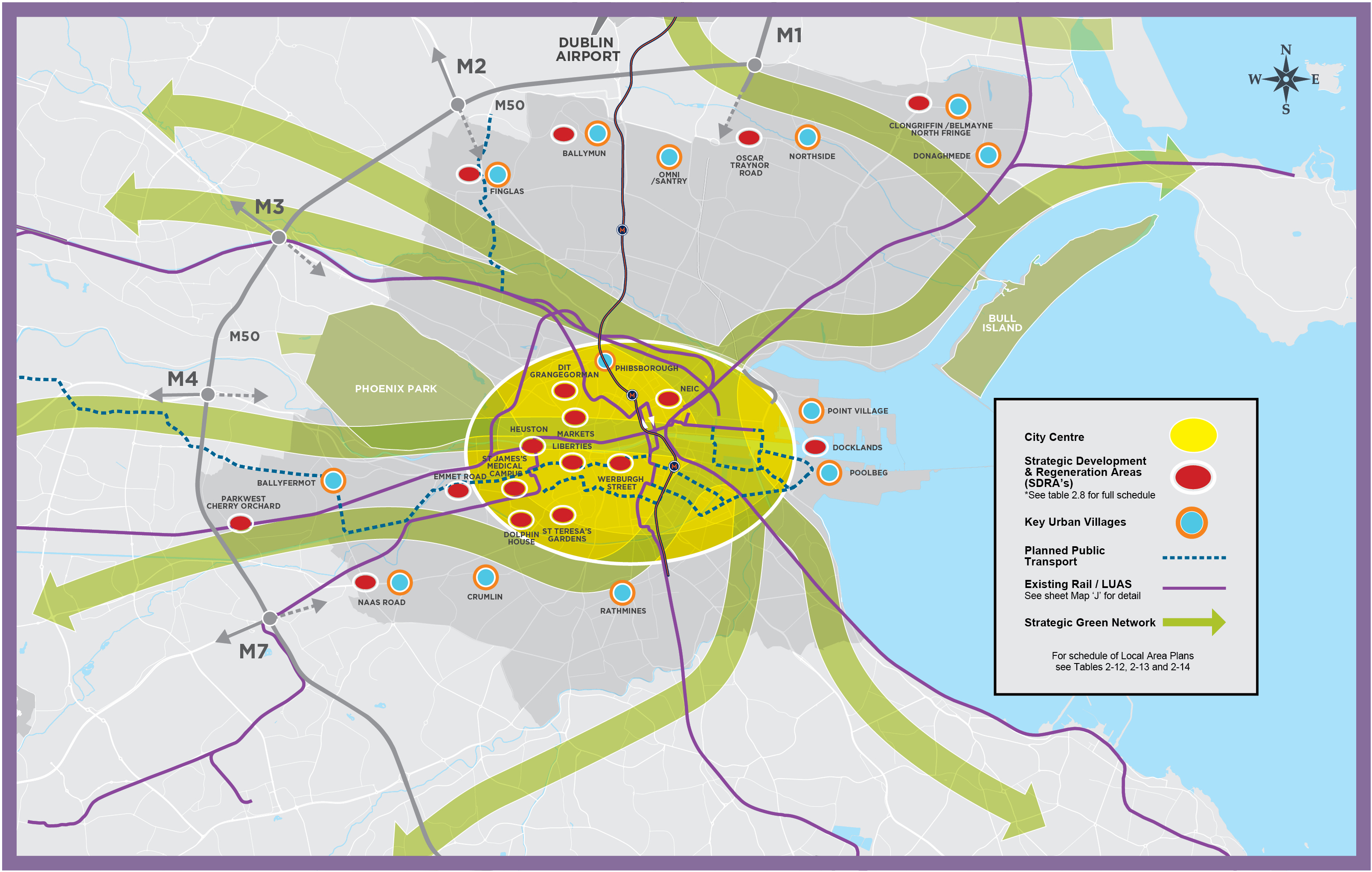
The rezoning package is the most extensive revision of Dublin's land use designations in many years, affecting sites across the city from the north inner city to the outer suburbs. The council's planners identified a series of large, underutilised sites — many of them former industrial or commercial properties — that have the potential to accommodate significant new residential development if the planning framework is adjusted to permit it.
Key Developments
The centrepiece of the rezoning package is the Broombridge–Hamilton Masterplan in Glasnevin, a large-scale development framework for a site adjacent to the Broombridge DART station that has the capacity to accommodate approximately 8,500 new homes. The site, which currently contains a mix of industrial uses and vacant land, is well-served by public transport and is within cycling distance of the city centre, making it an ideal location for high-density residential development.
The second major component is the City Edge project at Kylemore, a joint initiative between Dublin City Council and South Dublin County Council that is intended to provide approximately 5,300 new homes on a large site straddling the boundary between the two local authority areas. The project, which is one of the most ambitious cross-boundary planning exercises ever undertaken in Ireland, will require significant investment in infrastructure — including new roads, schools, and public transport connections — to support the new community.
The rezoning package has not been without controversy. Some councillors have labelled it a "paper exercise" that fails to address the underlying blockages to construction, including a shortage of planners and architects, developer inactivity on already-zoned land, and the high cost of construction finance. Critics have pointed out that Dublin already has a significant stock of zoned but undeveloped residential land, and that adding more zoned land without addressing the reasons why existing sites are not being built out is unlikely to deliver the homes that are needed.
Why It Matters
The scale of Dublin's housing deficit is such that even a successful rezoning exercise will take years to translate into completed homes. The council's target of 25,000 additional units by 2032 is ambitious but achievable if the construction sector can be mobilised effectively — a significant if, given the sector's track record in recent years. The rezoning provides the planning permission framework within which development can occur, but it does not in itself guarantee that development will happen.
What the rezoning does do is remove one of the barriers to development — the absence of planning permission — for a significant number of sites. For developers who have been waiting for clarity on the planning framework before committing to investment, the council's decision provides the certainty they need to proceed. The challenge now is to ensure that the other barriers — finance, construction capacity, infrastructure — are addressed with equal urgency.
The housing crisis in Dublin has a direct impact on the city's economic competitiveness. Companies considering locating or expanding in Dublin cite the difficulty of housing their employees as a significant concern, and the inability of key workers — nurses, teachers, gardaí — to afford to live in the city they serve is a growing source of social tension. The rezoning is a necessary but not sufficient response to a crisis that requires action on multiple fronts simultaneously.
Local Impact
The areas most directly affected by the rezoning are those where the major development sites are located. In Glasnevin, residents and community groups have expressed a mixture of support for the principle of new housing and concern about the impact of large-scale development on local infrastructure, particularly schools, GP surgeries, and public transport. The Broombridge DART station, which will be a key transport hub for the new development, is already operating at or near capacity during peak hours, and significant investment in rail capacity will be required before the new homes are occupied.
In Kylemore, the City Edge project will transform a largely industrial area into a new urban neighbourhood, with implications for existing businesses and residents in the surrounding areas of Ballyfermot, Inchicore, and Clondalkin. The council has committed to extensive community engagement as the project develops, and has indicated that a proportion of the new homes will be designated as social and affordable housing to ensure that the development serves a broad range of income groups.
What's Next
The rezoning package will now be implemented through the council's development management process, with planning applications for individual sites expected to begin arriving in the coming months. The council has indicated that it will prioritise the processing of applications for the major strategic development zones, with a target of issuing decisions within the statutory timeframes. A progress report on the implementation of the rezoning package is expected to be presented to the council in early 2027.