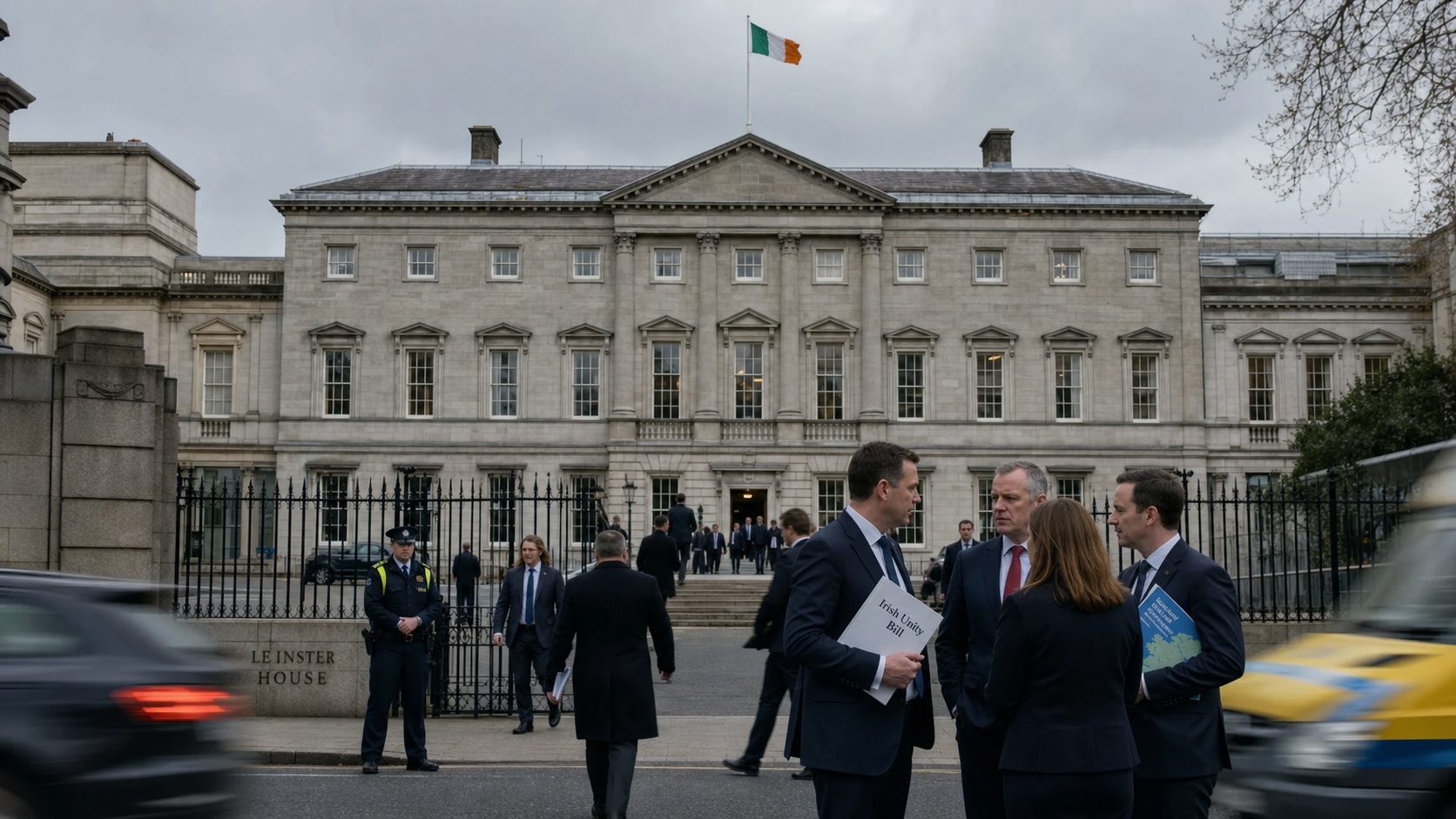
Coalition Blocks Sinn Féin's Irish Unity Bill in Dáil as Taoiseach Labels Legislation 'Not Credible'
The Fianna Fáil-Fine Gael coalition government has formally opposed and blocked a bill introduced by Sinn Féin in the Dáil that sought to compel the state to begin formal planning for a united Ireland, with Taoiseach Micheál Martin condemning the legislation as "not credible" and an attempt to impose "artificial deadlines" on one of the most complex and sensitive political questions facing the island.
Background
The question of Irish unity has moved from the margins to the mainstream of political debate in the Republic over the past decade, driven by the demographic changes in Northern Ireland revealed by successive censuses, the political disruption caused by Brexit, and the growing electoral strength of Sinn Féin on both sides of the border. The 2022 census in Northern Ireland, which showed for the first time that Catholics outnumber Protestants, and the 2023 census in the Republic, which confirmed the continued growth of the island's population, have given fresh impetus to those who argue that the conditions for a border poll are approaching.
Sinn Féin, which is the largest party in the Dáil and the joint-largest in the Stormont Assembly, has made the pursuit of Irish unity a central plank of its political programme. The party's bill, debated in the Dáil in early and mid-July 2026, proposed to mandate the Taoiseach to produce a Green Paper on the implications of constitutional change within 18 months, which would then inform the work of a new Citizens' Assembly on the issue. The legislation was framed by Sinn Féin as a responsible, evidence-based approach to planning for a future that the party believes is increasingly likely.
The coalition government's opposition to the bill reflects a fundamental disagreement about the appropriate pace and process for addressing the unity question. Fianna Fáil and Fine Gael both support the principle of Irish unity in the long term but argue that the conditions for a successful border poll — including broad cross-community support in Northern Ireland — have not yet been met, and that premature or poorly planned moves towards unity could be counterproductive.
Key Developments
Taoiseach Micheál Martin led the government's opposition to the Sinn Féin bill in the Dáil, describing it as "not credible" and arguing that it would impose "artificial deadlines" on a process that requires patience, dialogue, and the building of genuine cross-community consent. He defended the government's "Shared Island Initiative" as the more appropriate vehicle for advancing the unity agenda, arguing that its focus on practical cross-border cooperation and reconciliation is more likely to build the conditions for a successful border poll than legislative mandates.
Tánaiste Simon Harris echoed the Taoiseach's opposition to the Sinn Féin bill but used the debate to announce that Fine Gael would bring forward its own "blueprint for a unified island" by November 2026. The announcement was significant, representing the first time that Fine Gael — historically the most cautious of the main parties on the unity question — has committed to producing a detailed policy document on the subject. Harris argued that Fine Gael's approach would be more rigorous and more honest about the challenges involved than Sinn Féin's bill.
Sinn Féin leader Mary Lou McDonald defended her party's bill with considerable passion, arguing that proactive planning is essential to avoid the kind of "Brexit-style chaos" that results from failing to prepare for a major constitutional change. In a notable tactical move, she directed a "charm offensive" towards the government benches, appealing to Fianna Fáil as "the Republican party" and praising Fine Gael for its theoretical openness to planning for unity. Her efforts failed to sway the coalition, and the bill was defeated on a government majority.
Why It Matters
The Dáil debate on the Sinn Féin unity bill is a significant moment in the evolution of the unity question in Irish politics. The fact that all three of the main parties in the Dáil are now engaged in a substantive debate about how to plan for a potential border poll — even if they disagree profoundly about the pace and process — represents a significant shift from the position of even five years ago, when the question was largely confined to the margins of mainstream political discourse.
Fine Gael's commitment to publishing a "blueprint for a unified island" by November is particularly noteworthy. The party has historically been the most reluctant of the main parties to engage with the unity question, and its decision to produce a detailed policy document suggests that it recognises the political cost of being seen as the party that is least engaged with an issue that is increasingly important to a significant section of the electorate.
The defeat of the Sinn Féin bill does not end the debate — it intensifies it. The party will use the government's opposition as evidence that the coalition is blocking progress on an issue that the public increasingly wants addressed, while the government will argue that its more measured approach is more likely to deliver a successful outcome. The debate will continue to shape Irish politics in the months and years ahead.
Local Impact
The unity debate has different resonances in different parts of the Republic. In border counties like Donegal, Cavan, Monaghan, and Louth, where the practical consequences of partition are felt most directly — in cross-border commuting, healthcare, and economic activity — the question of unity is not abstract but immediate. In Dublin and the other major cities, the debate is more ideological, though the practical implications of a potential border poll for taxation, public services, and economic policy are increasingly being discussed.
The Shared Island Initiative, which the Taoiseach cited as the government's preferred vehicle for advancing the unity agenda, has funded a range of cross-border projects in areas including infrastructure, healthcare, and education. Its work is most visible in the border region, where North-South cooperation has delivered tangible benefits for communities on both sides of the frontier. The initiative's budget has been increased in recent years, reflecting the government's recognition that practical cooperation is the most effective way to build the conditions for a future border poll.
What's Next
Fine Gael's "blueprint for a unified island" is expected to be published in November 2026, ahead of the party's annual conference. The document is likely to address the economic, constitutional, and social implications of unity, and to set out Fine Gael's vision for the process by which a border poll might be called and conducted. Sinn Féin has indicated that it will continue to press for legislative action on the unity question, and is expected to bring forward further bills in the autumn Dáil term. The Citizens' Assembly on Irish Unity, which was established by the previous government, is expected to publish its final report before the end of the year.