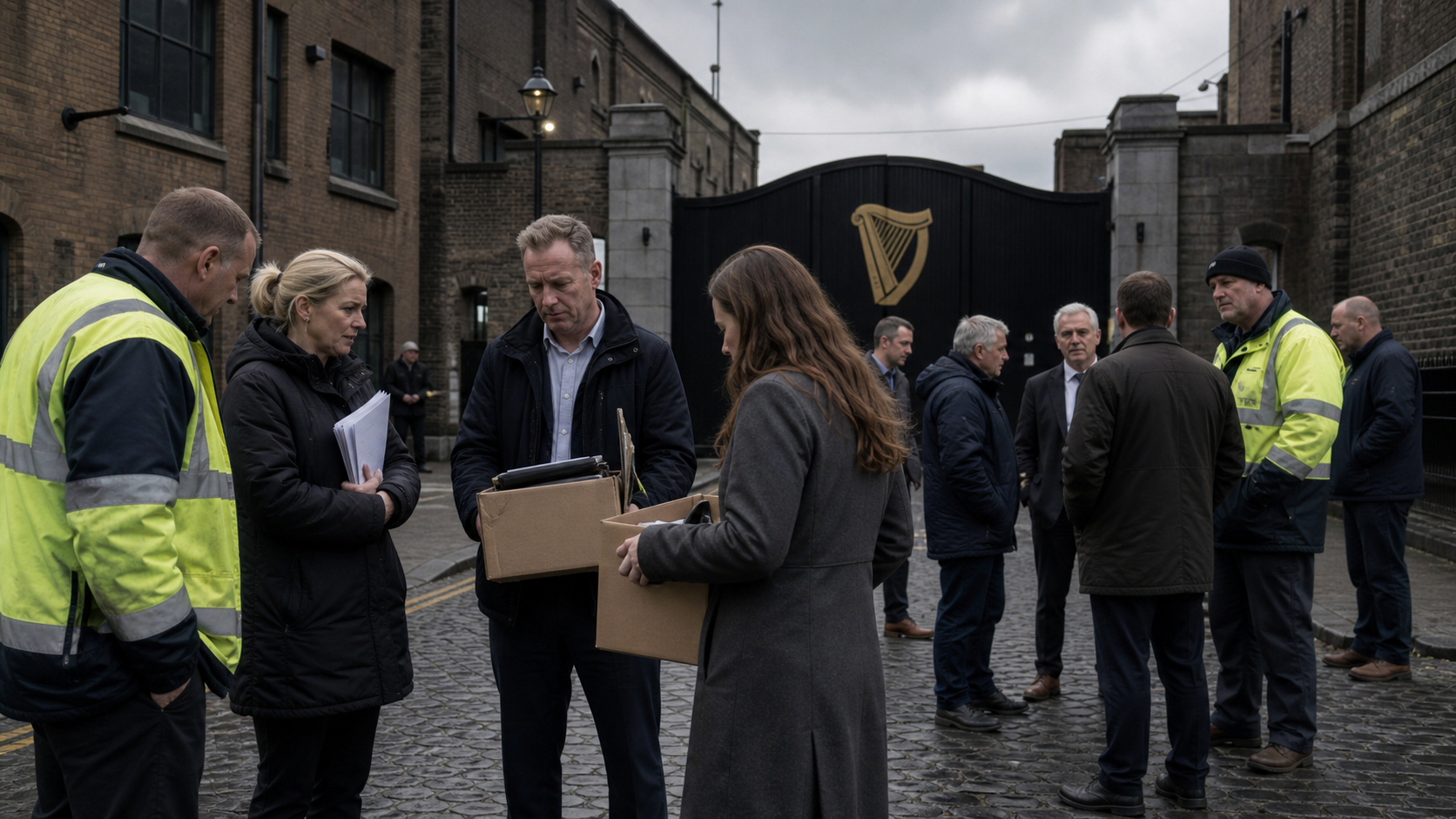
Diageo Sheds Nearly 2,000 Jobs Globally as New CEO Dave Lewis Drives Sweeping Overhaul with 150 Irish Roles at Risk
Diageo has shed nearly 2,000 jobs globally as new chief executive Dave Lewis implements a sweeping restructuring programme aimed at eliminating what he has described as "massive duplication" across the drinks giant's worldwide operations, with approximately 150 Irish roles at risk across the company's Dublin and Cork facilities as part of a $1 billion global savings plan that has already reduced the company's total headcount by more than 6% year-on-year.
Background
Diageo is one of the most significant employers in the Irish drinks industry, with approximately 1,200 people working across its Irish operations in brewing, liqueurs production, marketing, sales, and commercial support. The company's Irish presence is anchored by the Guinness Storehouse in Dublin — one of Ireland's most visited tourist attractions — and by its Baileys Irish Cream production facility, which remains one of the world's best-selling liqueur brands.
Dave Lewis, who assumed the role of CEO in January 2026, brings a reputation for decisive cost-cutting from his previous tenures at Unilever and Tesco, where he earned the nickname "Drastic Dave." His appointment signalled to analysts that Diageo's board was prepared for significant structural change, and the scale of the restructuring announced in the months since has confirmed that assessment.
The global drinks market has been challenging for Diageo and its peers in recent years. Post-pandemic demand for premium spirits has moderated, inflation has squeezed consumer spending on discretionary items, and the company's exposure to emerging markets — which had been a source of growth — has been complicated by currency volatility and geopolitical uncertainty. Against that backdrop, Lewis's focus on cost reduction reflects a judgement that the company's cost base is not sustainable at current revenue levels.
Key Developments
Diageo's annual results, published in August, revealed that the company's average full-time equivalent headcount fell from 29,860 to 27,938 over the past year — a reduction of nearly 2,000 positions, or more than 6% of the global workforce. Some internal teams have faced reductions of 20% to 30% as part of the restructuring, with back-office functions and areas of operational duplication bearing the brunt of the cuts.
In Ireland, the company notified the Department of Enterprise in June 2026 of proposed collective redundancies affecting approximately 150 employees. The notification, which is a legal requirement under Irish employment law, did not specify which roles or locations would be affected, but the company's Irish operations — which span Dublin, Cork, and several other sites — are understood to be subject to the same rationalisation logic as the global programme.
Lewis presented the restructuring to shareholders at a Capital Markets Day on August 6, framing it as a necessary response to competitive pressures and a platform for future growth. He emphasised that the savings generated by the programme would be reinvested in brand building and innovation — a message designed to reassure investors that the cuts are strategic rather than merely defensive.
Why It Matters
Diageo's restructuring is significant for the Irish economy not just because of the direct job losses but because of what it signals about the future of multinational employment in Ireland. The company has been a major employer in the country for generations, and its Irish brands — Guinness, Baileys, Bushmills — are among the most recognisable in the world. A significant reduction in its Irish workforce would be felt beyond the individuals directly affected.
The broader context is one of increasing automation and AI-driven efficiency across the consumer goods sector. Lewis's emphasis on eliminating "massive duplication" reflects a recognition that many of the functions previously performed by human workers can now be handled by technology — a trend that is accelerating across industries and that poses particular challenges for economies like Ireland's, which have built significant employment on the back of multinational investment.
For the Irish government, the Diageo restructuring is a reminder that the multinational employment model — which has been central to Irish economic policy for decades — is not immune to global corporate restructuring. The Industrial Development Authority and Enterprise Ireland will be watching the situation closely, aware that the loss of significant multinational employment in Ireland would have implications for the country's attractiveness as an investment destination.
Local Impact
In Dublin, where Diageo's Irish headquarters is located, the potential loss of 150 jobs is significant but not catastrophic in the context of a city with a large and diverse employment base. The affected workers — many of whom will have skills in marketing, commercial operations, and supply chain management — are likely to find alternative employment in Dublin's competitive labour market, though the transition may not be immediate or straightforward.
For the Guinness Storehouse and the broader tourism ecosystem around the St James's Gate brewery, the restructuring is not expected to have a direct impact. The Storehouse, which attracts more than 1.7 million visitors annually, is a commercial operation that generates significant revenue for Diageo and for the surrounding Liberties neighbourhood.
What's Next
Diageo is expected to provide further detail on the Irish redundancy programme in the coming weeks, including the specific roles and locations affected. The company has committed to engaging with employee representatives and with the relevant government departments throughout the process. The restructuring is expected to be substantially complete by the end of 2026, with the full financial benefit of the savings programme flowing through in 2027.