Death of Michael Fingleton Closes the Book on Irish Nationwide's Catastrophic Legacy and a Dark Era in Irish Banking
Michael Fingleton, the former managing director of Irish Nationwide Building Society whose four-decade stewardship of the lender ended in a €5.4 billion taxpayer bailout and years of legal and regulatory scrutiny, has died at the age of 88, closing a chapter in Irish banking history that remains one of the most damaging and instructive episodes in the State's economic life — with a High Court judgment on a €290 million civil claim against him reserved at the time of his passing on Sunday, August 2.
Background
Michael Fingleton was born in 1938 in Tubbercurry, County Sligo, and his path to the top of Irish finance was an unconventional one. He attended a seminary before leaving without taking his vows, subsequently studying commerce at University College Dublin and qualifying as a barrister in 1973, though he never practised at the bar. He joined the Irish Industrial Building Society — later rebranded as Irish Nationwide Building Society — in 1971, when it was a modest institution with five employees and assets of approximately £2.3 million.
Over the following four decades, Fingleton transformed INBS into a major lender with a peak asset base of €16 billion by 2007. His management style was characterised by a tight, centralised control over the society's operations and a gregarious approach to networking that cultivated relationships with journalists, politicians, and business figures across Irish society. He was, by any measure, a formidable operator — a man who built something significant from very little and who understood, better than most, how power and influence worked in the Ireland of the Celtic Tiger era.
The problem was that the edifice he built was constructed on foundations that proved catastrophically unstable. Under Fingleton's leadership, INBS aggressively expanded into commercial property lending, particularly in the United Kingdom, at precisely the moment when the property market was approaching its peak. By 2008, approximately 80% of the society's €10.5 billion loan book was exposed to commercial property — a concentration of risk that left INBS uniquely vulnerable when the market collapsed.
Key Developments
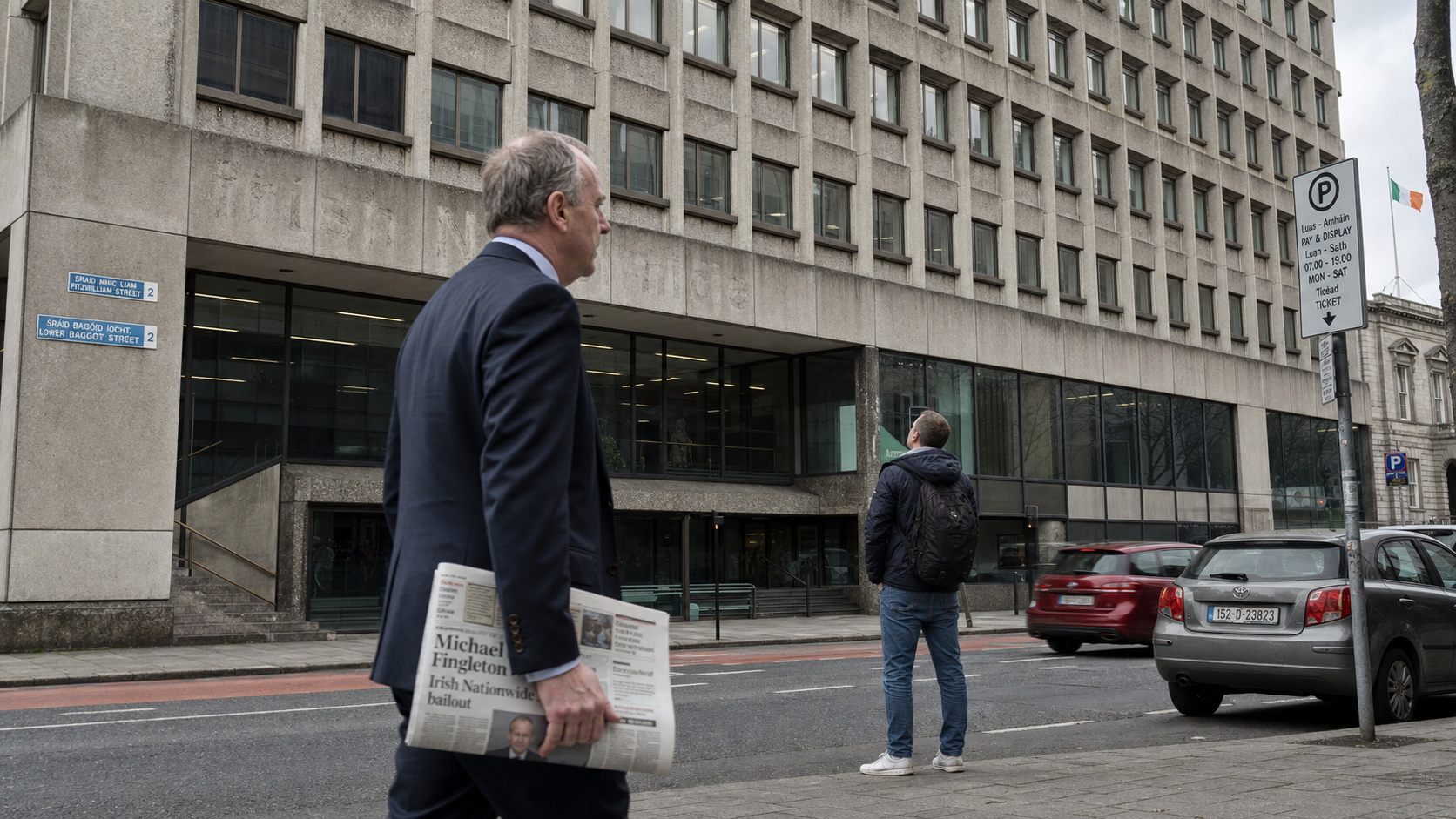
When the property bubble burst in 2008, INBS was identified as having the most toxic loan book among the banks covered by the State guarantee. The society was nationalised in 2010 and eventually folded into the Irish Bank Resolution Corporation, resulting in a final cost to the Irish taxpayer of €5.4 billion — a figure that represents one of the most severe losses in the history of Irish banking and one that contributed significantly to the austerity programme that defined Irish public life for the following decade.
Fingleton retired in 2009 amid intense public pressure, departing with a €27.6 million pension pot and a €1 million bonus for his final year — the latter of which he pledged to return but never did. The Central Bank of Ireland launched an inquiry into his management in 2015, but proceedings against him were permanently terminated in 2019 due to his declining health following a stroke. Separately, IBRC liquidators pursued a civil action against him in the High Court for alleged negligent mismanagement, a claim originally filed for €6 billion before being pared back to €290 million. The case concluded in October 2025, with Justice Michael Quinn reserving judgment — a judgment that will now never be delivered in Fingleton's lifetime.
Fingleton is survived by his wife, Eileen, and their children, Anne, William, Eileen Jr, and Michael Jr. His funeral was held at St Anne's Church, Shankill, County Dublin.
Why It Matters
Fingleton's death matters not because it resolves anything — the €5.4 billion cost to the taxpayer is not recovered, the judgment is not delivered, the accountability that many felt was never fully achieved — but because it marks the end of a period in which the possibility of that accountability, however diminished, still existed. His passing closes a chapter in Irish banking history that should never be forgotten, not as an exercise in blame but as a reminder of what happens when regulatory oversight fails, when institutional culture prioritises growth over prudence, and when the consequences of reckless decision-making are ultimately borne not by those who made the decisions but by the public. The Irish banking crisis of 2008 cost the State tens of billions of euro and imposed years of austerity on a population that had no role in creating the conditions that led to it. Fingleton was one of the central figures in that story, and his death does not diminish the importance of understanding it clearly.
Local Impact
The reaction to Fingleton's death in Ireland has been measured and, in some quarters, pointed. For the generation that lived through the austerity years — the public sector workers whose pay was cut, the families who lost homes, the young people who emigrated in search of opportunities that Ireland could no longer provide — his passing is a reminder of a period of national trauma that has not been fully processed or accounted for. The Irish Nationwide saga was not unique: it was part of a broader pattern of regulatory failure and institutional recklessness that affected multiple banks and building societies. But Fingleton's personal style — the networking, the bonus, the pension pot — made him a particularly vivid symbol of the era's excesses.
What's Next
The reserved High Court judgment in the civil case against Fingleton will now lapse, as the proceedings cannot continue against a deceased defendant without significant procedural complications. The IBRC liquidators will need to assess their legal options in the light of his death. The Central Bank of Ireland has indicated that it will publish a final report on the INBS inquiry, drawing on the evidence gathered during the proceedings, as a contribution to the historical record. The broader question of accountability for the banking crisis — and whether the regulatory and legal frameworks put in place since 2008 are adequate to prevent a recurrence — remains a live issue in Irish public policy.