Daniel Kinahan Remanded in Portlaoise After Appearing at Special Criminal Court
Daniel Kinahan, the 49-year-old alleged leader of one of the most significant organised crime groups in Irish history, has been remanded in custody at Portlaoise Prison after a brief appearance at the Special Criminal Court in Dublin, charged with directing the activities of a criminal organisation — a charge that carries a maximum sentence of life imprisonment and that represents the culmination of years of international law enforcement cooperation to bring him before an Irish court.
Background
The Kinahan Organised Crime Group has been the subject of extensive investigation by law enforcement agencies in Ireland, the United Kingdom, Spain, and the United States for more than a decade. The group has been linked by authorities to large-scale drug trafficking, money laundering, firearms smuggling, and a series of gangland murders that claimed dozens of lives in Ireland and abroad. In 2022, the United States government imposed sanctions on the group and offered a reward of up to $5 million for information leading to the disruption of the organisation or the conviction of its leaders.
Kinahan had been living in Dubai, where he had established himself as a boxing promoter and businessman, for several years before his arrest. He was detained in Dubai in April 2026 on foot of an Irish arrest warrant, following a final ruling by the Dubai Court of Cassation that cleared the way for his extradition under a bilateral treaty between Ireland and the United Arab Emirates. His extradition was facilitated by an Irish government jet, which transported him to Casement Aerodrome in Baldonnell, County Dublin, on the evening of Sunday, 9 August 2026.
The extradition was the result of years of diplomatic and legal work by the Irish government, the Garda Síochána, and international partners. It represents one of the most significant law enforcement achievements in the history of the Irish state.
Key Developments
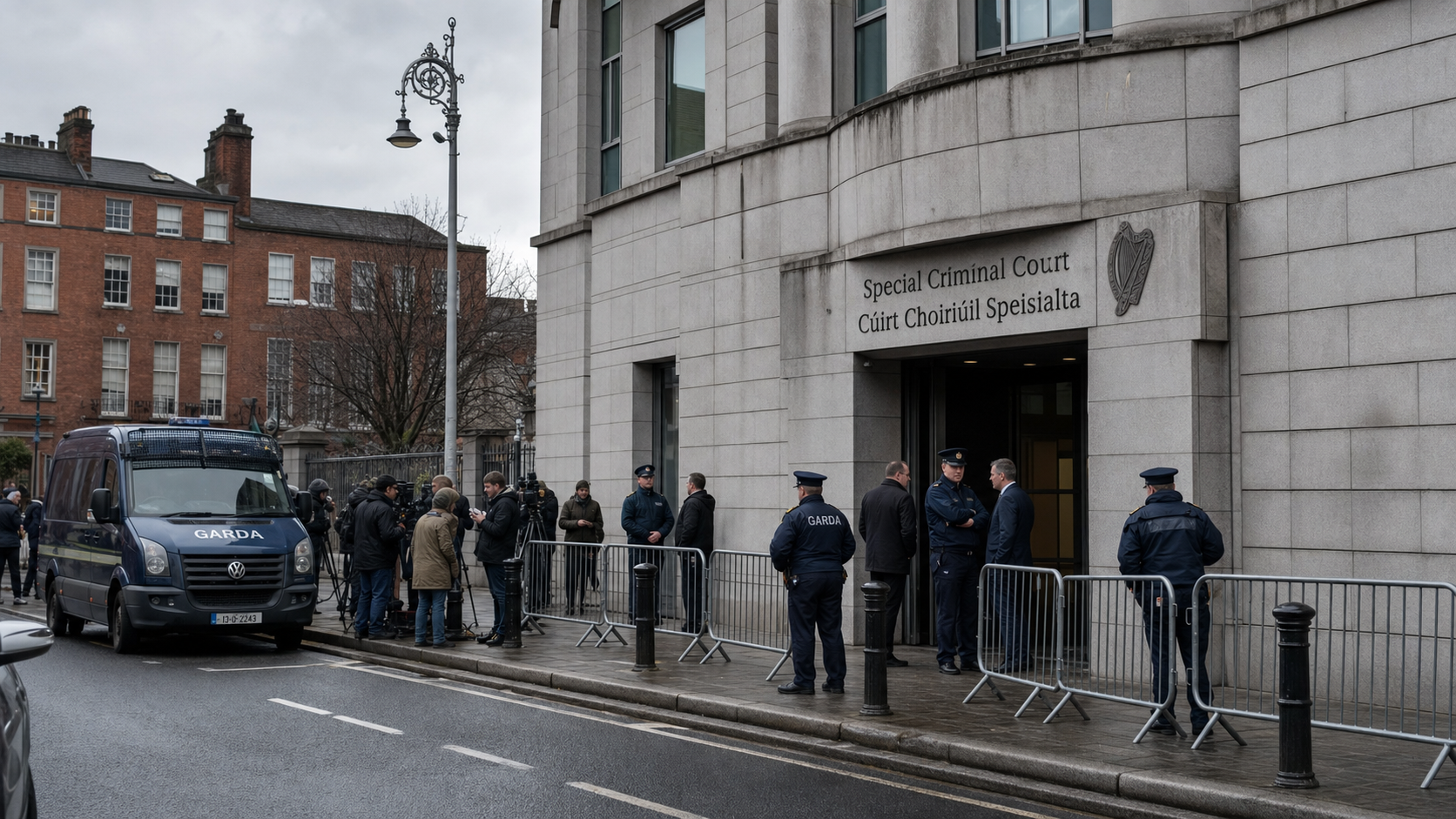
Kinahan appeared before a panel of three judges at the Special Criminal Court in a brief 14-minute hearing, during which he was charged with directing the activities of a criminal organisation between October 2015 and April 2017. He appeared without legal representation, noting that he had not had sufficient time to arrange for counsel. When informed by the court that any bail application would need to be made through the High Court, Kinahan responded: "I think we all know I won't be getting bail, but thank you for your time."
He was transported to the court in a specialised bombproof and bulletproof van, reflecting the exceptional security arrangements that have surrounded his case since his arrival in Ireland. He was subsequently remanded to Portlaoise Prison, the high-security facility in County Laois that houses Ireland's most serious offenders, with his next court date set for 5 October 2026.
Prior to his extradition, Kinahan had denied the allegations against him in a media interview, characterising himself as a "scapegoat" and claiming that the accusations were part of a conspiracy to damage his reputation. His legal team is expected to mount a vigorous defence when the case comes to trial.
Why It Matters
The appearance of Daniel Kinahan before an Irish court is a moment of profound significance for the families of those killed in the gangland violence associated with the Kinahan organisation, for the communities devastated by the drug trade the group is alleged to have facilitated, and for the Irish state's credibility as a jurisdiction capable of pursuing and prosecuting serious organised crime. For years, Kinahan operated from Dubai with apparent impunity, and his extradition demonstrates that the reach of Irish and international law enforcement has extended to encompass even those who believed they had placed themselves beyond its reach.
The case will also test the capacity of the Irish criminal justice system to manage a prosecution of this complexity and sensitivity. The Special Criminal Court — a non-jury court established to try serious offences — is the appropriate venue, but the proceedings are likely to be lengthy, complex, and subject to legal challenges at every stage.
Local Impact
In Dublin's north inner city, where the Kinahan organisation's activities have had the most direct and devastating impact, the news of Kinahan's appearance in court was received with cautious satisfaction. Community workers and residents who have lived through years of gangland violence — including the Regency Hotel attack of 2016 and the subsequent Kinahan-Hutch feud that claimed more than a dozen lives — expressed hope that the prosecution would bring some measure of accountability. The Garda Síochána's Organised Crime Unit, which has worked on the Kinahan investigation for years, confirmed that the investigation into the broader organisation continues.
What's Next
Kinahan is next due to appear at the Special Criminal Court on 5 October 2026, at which point he is expected to have legal representation in place. The prosecution will then set out its case, and the defence will have the opportunity to respond. Given the complexity of the charges and the volume of evidence gathered over years of investigation, the trial itself is unlikely to begin before 2027. The US sanctions against the Kinahan organisation remain in place, and American authorities have indicated that they are monitoring the Irish proceedings closely.