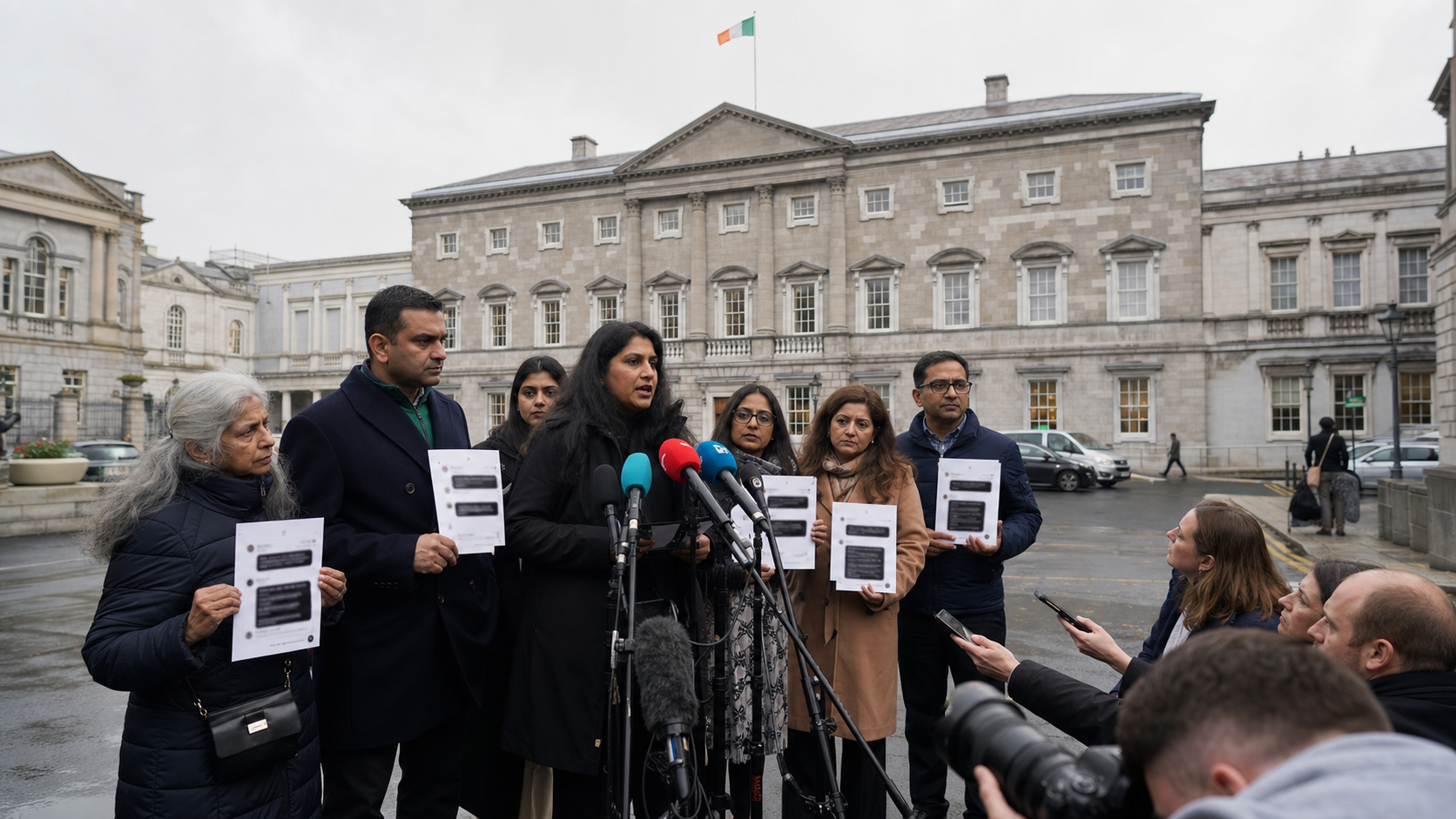
Call to Investigate 'Orchestrated' Barrage of Hate Messages Targeting Indian Community in Ireland
The Ireland India Council has called for a formal investigation into what it describes as an "orchestrated" campaign of threatening messages targeting the Indian community in Ireland, with co-chair Prashant Shukla estimating that 90-95% of the threats originated from the United States. The call comes as the Irish Examiner reports on the scale and coordination of the harassment, which has left many members of the Indian community in Ireland feeling unsafe and unwelcome.
Background
Ireland's Indian community has grown significantly over the past two decades, driven by immigration from India for work in the technology, healthcare, and hospitality sectors. Indian nationals are among the largest non-EU immigrant groups in the country, with a significant concentration in Dublin and in the cities of Cork, Galway, and Limerick. The community has generally integrated well and has made substantial contributions to Irish economic and cultural life.
The summer of 2025 saw a disturbing surge in racially motivated attacks against Indian and South Asian people in Ireland, with at least 11 specific incidents recorded between July and August of that year. The attacks — which included physical assaults, robberies, and verbal abuse — prompted the Indian Embassy to issue safety warnings and led the Ireland India Council to postpone planned "India Day" celebrations. The government condemned the violence, but many in the community felt that the response was inadequate.
The current wave of harassment is different in character from the physical attacks of 2025: it is primarily digital, involving threatening phone calls and social media messages. But the Ireland India Council argues that it is no less serious, and that the apparent coordination of the campaign — with the vast majority of threats traced to sources in the United States — suggests the involvement of organised far-right networks rather than spontaneous individual hostility.
Key Developments
The Ireland India Council's co-chair told the Irish Examiner that the community had been subjected to a "barrage" of threatening messages in recent weeks, with the volume and coordination of the harassment suggesting an organised campaign rather than random individual hostility. "We estimate that 90 to 95 per cent of these threats are coming from the United States," Shukla said. "This is not organic. This is orchestrated."
The council has called on An Garda Síochána to investigate the campaign as a hate crime and to work with US law enforcement to identify those responsible. It has also called on social media platforms to take more aggressive action to remove threatening content and to cooperate with law enforcement investigations. The council has noted that the platforms' existing content moderation systems have been slow to respond to reports of threatening material targeting the Indian community.
Researchers at University College Dublin's Centre for Digital Policy have noted that the pattern of US-based actors targeting minority communities in other countries is consistent with the activities of organised far-right networks that use social media to amplify anti-immigrant sentiment globally. The phenomenon has been documented in the UK, Germany, and Australia, as well as in Ireland.
Why It Matters
The targeting of Ireland's Indian community with an apparently coordinated campaign of threats is a serious matter that goes beyond the immediate harm to those targeted. It reflects the globalisation of far-right organising and the use of social media to export anti-immigrant hostility across borders. Ireland's hate crime legislation, which was strengthened in recent years, provides a framework for prosecuting those who incite hatred, but its application to online content originating in other jurisdictions is legally complex.
The broader context is one of rising anti-immigrant sentiment in Ireland, driven by a combination of genuine pressures — including housing shortages and pressure on public services — and deliberate misinformation campaigns that scapegoat immigrant communities for problems that have structural causes. The government has been criticised for not doing enough to counter this narrative, and the Ireland India Council's call for a formal investigation is partly a demand that the state take the threat more seriously.
Local Impact
For members of the Indian community in Dublin, Cork, Galway, and Limerick, the campaign of threatening messages has created a climate of anxiety and fear. Several community members have spoken of changing their routines, avoiding certain areas, and feeling reluctant to identify themselves publicly as Indian. Healthcare workers, technology professionals, and students — many of whom came to Ireland specifically because of its reputation as a welcoming and tolerant country — have expressed shock and disappointment at the hostility they are experiencing.
What's Next
An Garda Síochána has confirmed that it is aware of the Ireland India Council's concerns and is examining the reports of threatening messages. The force's Garda National Diversity and Integration Unit is understood to be involved in the assessment. The council has requested a meeting with the Minister for Justice to discuss the issue and to press for a formal investigation. Social media platforms have been contacted for comment but had not responded at the time of publication.