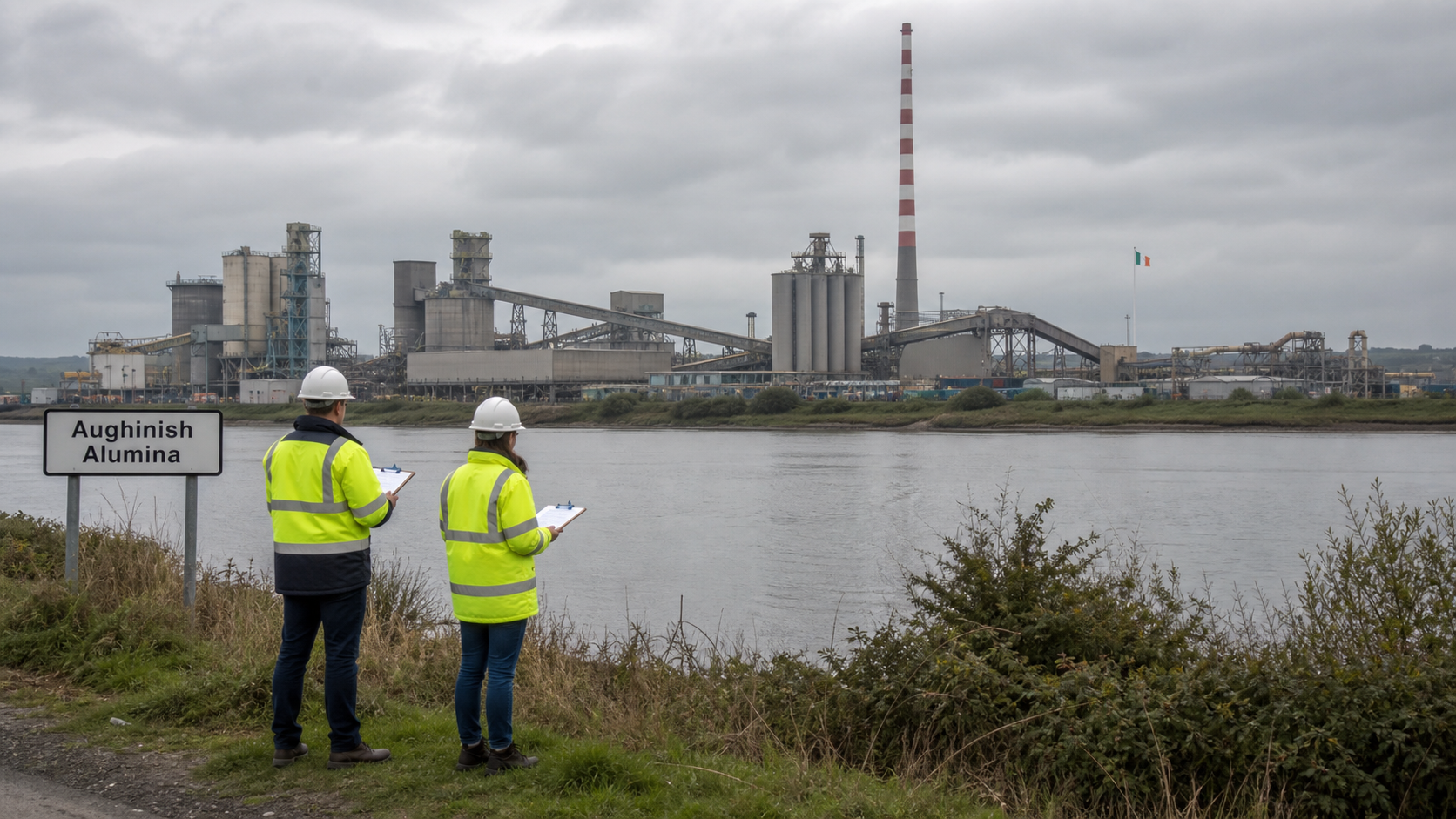
Aughinish Alumina: Government Urged to Act as Limerick Plant's Russian Links Raise Sanctions Concerns
The Irish Government is facing renewed pressure to take decisive action on the Aughinish Alumina plant in County Limerick, owned by Moscow-based Rusal, after a Department of Enterprise report found insufficient evidence to rule out that Irish alumina is being used to supply the Russian military — a disclosure that has intensified calls for emergency legislation and raised fundamental questions about Ireland's approach to sanctions enforcement.
Background
The Aughinish Alumina plant, located on the Shannon Estuary in County Limerick, is one of the largest alumina refineries in Europe and one of the most significant industrial employers in the Limerick region, supporting approximately 1,900 direct and indirect jobs. The plant is owned by Rusal, the Russian aluminium giant that is controlled by oligarch Oleg Deripaska, and has been the subject of intense scrutiny since Russia's full-scale invasion of Ukraine in February 2022.
Alumina is the primary raw material used in the production of aluminium, which has a wide range of military applications including the manufacture of aircraft, missiles, and armoured vehicles. The concern that alumina produced at Aughinish could be finding its way into the Russian military supply chain has been raised repeatedly by politicians, academics, and civil society organisations since the start of the war.
The Irish Government has taken a cautious approach to the issue, implementing a new oversight arrangement that requires Aughinish to provide regular, documented evidence — verified by the Swiss auditing firm SGS — that its products are not being used to supply the Russian military. The government has also passed legislation granting authorities the power to prosecute companies suspected of breaching sanctions.
Key Developments
A Department of Enterprise report, the details of which have been reported by the Irish Times, concluded that while there was insufficient evidence to prove that Irish alumina is currently being used in Russian weapons, there was also insufficient evidence to rule it out. This ambiguous finding has been seized upon by critics of the government's approach, who argue that the burden of proof should be reversed — that Aughinish should be required to demonstrate conclusively that its products are not contributing to the Russian war effort, rather than the State being required to prove that they are.
Minister for Foreign Affairs Helen McEntee has stated that Ireland will support any sanctions packages proposed by the European Commission, but has stopped short of calling for unilateral action against the plant. The Commission has historically hesitated to sanction alumina exports to Russia because of the plant's role in supplying European heavy industry, a consideration that has given the Irish government political cover for its cautious approach.
Critics, including opposition TDs and academic experts on sanctions law, have argued that the government's reliance on the SGS verification process is inadequate and that the only way to ensure that Irish alumina is not contributing to the Russian war effort is to impose a complete ban on exports to Russia.
Why It Matters
The Aughinish question goes to the heart of Ireland's approach to the war in Ukraine and its obligations as a member of the European Union. Ireland has consistently presented itself as a strong supporter of Ukraine and of the EU's sanctions regime against Russia, but the continued operation of a Russian-owned plant that may be supplying the Russian military sits uneasily with that position. The government's argument that it is constrained by EU sanctions policy and by the need to protect 1,900 jobs is understandable, but it has not satisfied those who believe that Ireland is prioritising economic interests over its stated values.
The issue also has implications for Ireland's reputation as a reliable partner in the EU's sanctions enforcement effort. If it emerges that Irish alumina has been used in Russian weapons, the reputational damage to Ireland would be significant and long-lasting.
Local Impact
For the workers at Aughinish and their families in the Limerick region, the ongoing uncertainty about the plant's future is a source of significant anxiety. The 1,900 jobs supported by the plant are a major component of the local economy, and any action that threatened the plant's continued operation would have serious consequences for the region. Local politicians have been careful to balance their support for Ukraine with their concern for the livelihoods of their constituents, a tension that reflects the genuine difficulty of the situation.
What's Next
The government is expected to continue its engagement with the European Commission on the question of alumina sanctions, while maintaining the SGS verification process at Aughinish. The Oireachtas Foreign Affairs Committee is expected to hold hearings on the issue in the autumn, and opposition TDs are likely to table motions calling for stronger action. The situation will continue to evolve as the war in Ukraine progresses and as the EU's sanctions regime is reviewed and updated.