University of Galway Students Sleep Out at Eyre Square to Highlight Accommodation Crisis as Rents Hit €295 Per Week
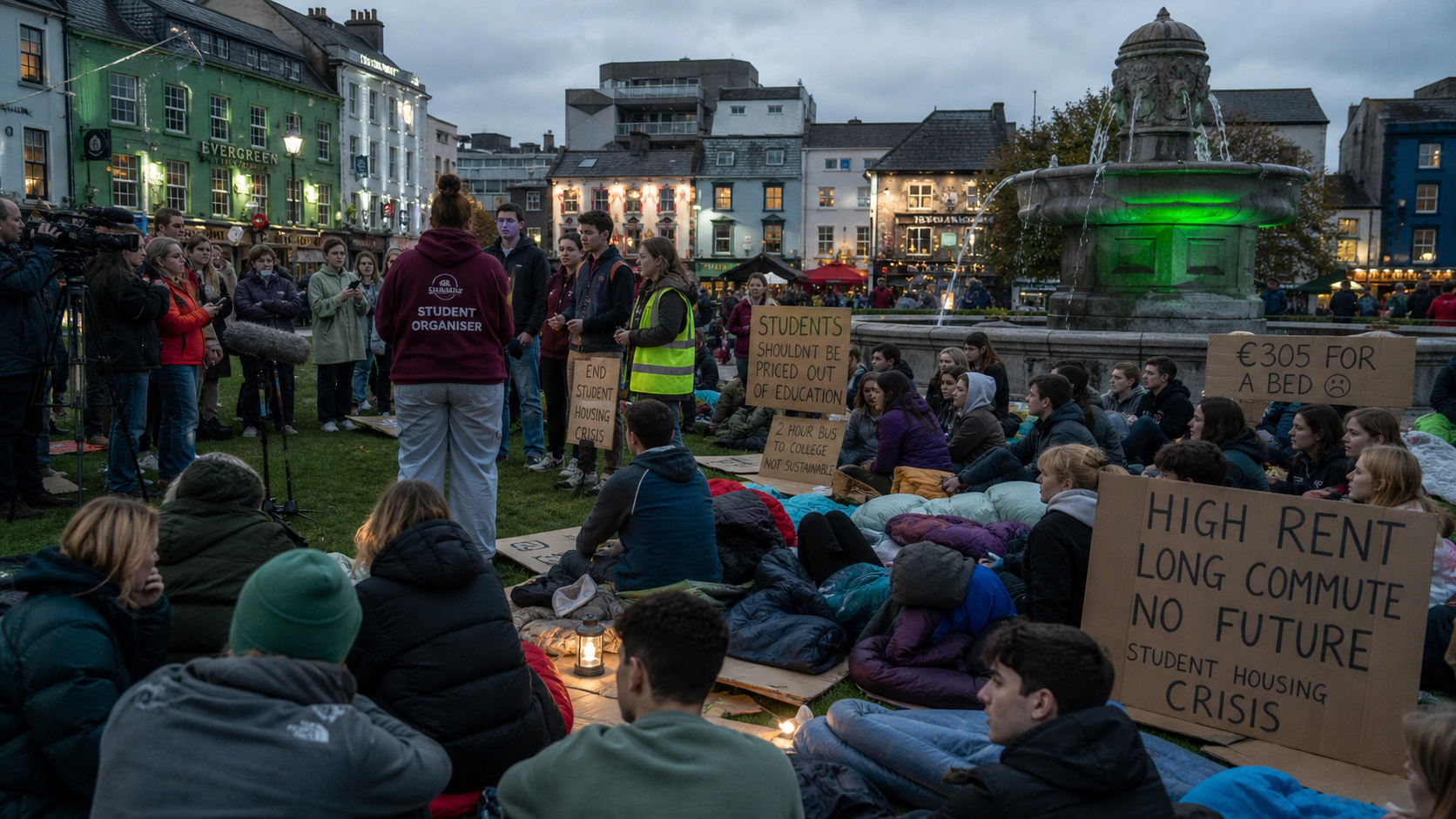
The University of Galway Students' Union staged a protest and overnight sleep-out at Eyre Square on 1 September, as students preparing to begin the new academic year faced a housing crisis so severe that some are commuting up to seven hours a day, sleeping on friends' couches, or considering deferring their studies entirely.
Background
The student accommodation crisis in Galway is not a new phenomenon, but it has reached a new level of severity in 2026 that has prompted the Students' Union to take direct action. The city's rental market has been under intense pressure for years, driven by a combination of factors: the growth of the university's student population, the proliferation of short-term holiday lets that have removed properties from the long-term rental market, the slow pace of purpose-built student accommodation development, and the broader national housing crisis that has pushed rents to record levels across Ireland.
Galway's particular geography — a compact city with limited land for development, surrounded by protected landscapes and a coastline that constrains expansion — has made the accommodation problem especially acute. The city's popularity as a tourist destination has also contributed to the problem, with hundreds of properties listed on short-term rental platforms that could otherwise be available to students and other long-term renters.
The University of Galway, formerly known as NUI Galway, has approximately 18,000 students, of whom a significant proportion require accommodation in or near the city. The university's own on-campus accommodation is heavily oversubscribed, and the private rental market has become increasingly inaccessible for students on limited budgets.
Key Developments
The protest began at the university's Quadrangle at 3:30 pm on 1 September, with students marching to Eyre Square for speeches before setting up camp for the night. Students' Union President Seán de Búrca delivered a passionate address in which he outlined the scale of the crisis facing incoming students.
"The situation is continuously getting worse," de Búrca said. "We have students commuting for up to seven hours a day to attend lectures. We have students paying extortionate rents that leave them with nothing for food or books. We have students sleeping on friends' couches or in hostels. And we have students who are seriously considering whether they can afford to come to university at all. This is not acceptable in a country that claims to value education."
The figures cited by the Students' Union are stark. The cheapest room listings on Daft.ie in Galway start at €750 per month — a figure that, for a student on a part-time wage or dependent on the SUSI grant, represents an impossible financial burden. New purpose-built student accommodation near the docks, which was developed specifically to address the shortage, costs at least €295 per week — more than €1,200 per month — placing it well beyond the reach of most students.
De Búrca highlighted the role of short-term rentals in exacerbating the crisis. "There are hundreds of properties in Galway listed on Airbnb and similar platforms," he said. "Many of them do not have the planning permission required to operate as legal short-term lets. If the government enforced existing laws, it would free up a significant number of properties for students and other long-term renters. The tools exist. The political will is what's missing."
Why It Matters
The Galway student accommodation crisis is a microcosm of a broader national failure. Ireland has, for years, been aware that its housing system is not producing enough homes of the right type in the right places to meet demand. The student accommodation sector has been particularly neglected, with successive governments relying on the private market to deliver purpose-built student accommodation — a model that has produced some supply but at price points that are inaccessible to the majority of students.
The consequences of the crisis extend beyond individual hardship. When students cannot find affordable accommodation near their university, they face a stark choice: commute for hours each day, pay rents that leave them in financial difficulty, or defer or abandon their studies. Each of these outcomes represents a failure of the education system and a waste of human potential. For students from lower-income backgrounds, who are already less likely to attend university, the accommodation crisis acts as an additional barrier that reinforces existing inequalities.
The crisis also has implications for the university itself. The University of Galway has been investing significantly in its research and teaching capacity, and its ability to attract students — particularly from outside Connacht — depends in part on its ability to offer a viable living environment. A reputation for unaffordable accommodation is not one that any university can afford.
Local Impact
In Galway city, the accommodation crisis is felt not only by students but by the broader community. The competition for rental properties between students, young workers, and families has driven rents to levels that are causing genuine hardship across the city. In areas such as Salthill, Shantalla, and the Claddagh, long-term residents have reported being priced out of the rental market by the combination of student demand and short-term letting.
The university has acknowledged the scale of the problem and has indicated that it is working to expand its on-campus accommodation capacity. However, planning constraints and construction costs mean that any new supply is unlikely to come on stream for several years. In the meantime, the Students' Union has urged students still struggling to find housing to utilise the university's accommodation advisory services and platforms like StudentPad, which connects students with landlords offering lower rents.
What's Next
The Students' Union has called on the government and the university to implement urgent solutions, including the introduction of "digs" legislation that would provide a legal framework for students to rent rooms in family homes, and a greater commitment to providing affordable student housing. The union has indicated that it will escalate its campaign if no concrete action is taken before the end of September. Minister for Housing Darragh O'Brien is expected to respond to the protest in the coming days, with the government under pressure to demonstrate that it is taking the student accommodation crisis seriously ahead of Budget 2027.