Irish Manufacturing Hits Near Five-Year Peak in September as Export Demand Drives Growth
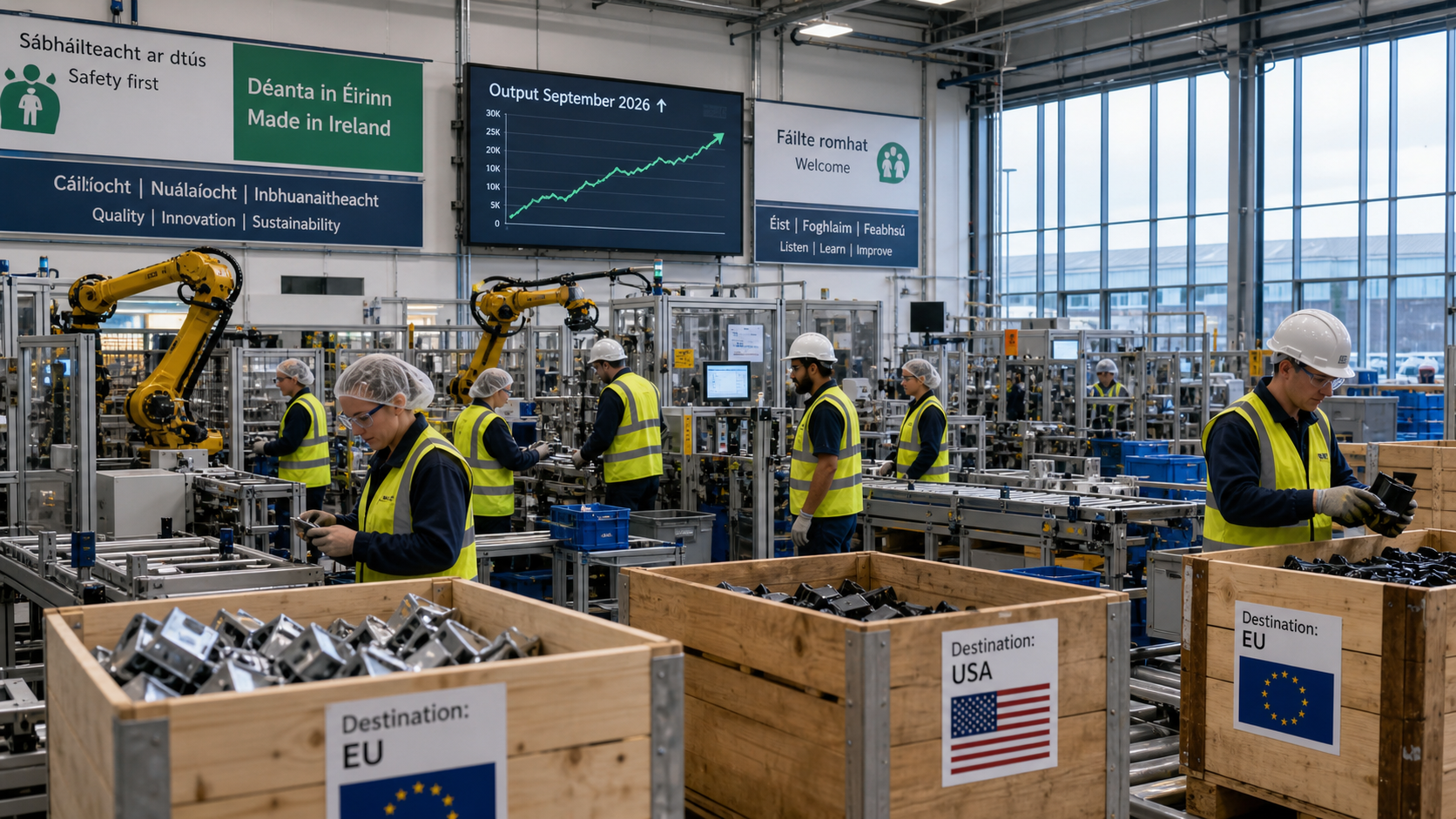
Ireland's manufacturing sector recorded its strongest output growth in almost five years during September 2026, with the AIB Manufacturing Purchasing Managers' Index rising to 55.5 and export orders expanding at their fastest pace in three months — a performance that underscores the resilience of Irish industry even as global economic uncertainty weighs on business confidence.
Background
The AIB Manufacturing PMI is a monthly survey of purchasing managers at Irish manufacturing companies, designed to provide a timely snapshot of conditions in the sector. A reading above 50 indicates expansion; below 50 indicates contraction. The index covers a range of variables including output, new orders, employment, input costs, and business confidence, providing a comprehensive picture of the sector's health.
Irish manufacturing has had a complex relationship with headline economic statistics in recent years. The sector includes a significant multinational component — particularly in pharmaceuticals and medical devices — whose activities can generate large swings in GDP figures that do not reflect the underlying health of the domestic economy. The PMI, which surveys a broad range of manufacturing businesses, provides a more grounded view of what is actually happening on factory floors across the country.
The sector entered 2026 in a subdued state, with output growth constrained by price uncertainty and the geopolitical tensions associated with the US-Israeli conflict in Iran, which disrupted global supply chains and pushed energy costs higher. The recovery that has gathered pace since the summer represents a significant turnaround, driven by strong domestic demand and a recovery in export markets.
Key Developments
The September PMI reading of 55.5 — up marginally from 55.4 in August — represents the second consecutive month at near-peak levels, and the strongest output growth since May 2022. New orders rose sharply, with export orders expanding at a three-month high, suggesting that Irish manufacturers are benefiting from recovering demand in key export markets including the United States, Germany, and the United Kingdom.
Employment in the sector continued to grow at a solid pace, supported by the healthy demand backdrop. However, the strong growth is also creating capacity constraints, with backlogs of work rising for the third consecutive month as firms struggle to keep pace with incoming orders. Raw material shortages — a persistent feature of the post-pandemic manufacturing landscape — continue to affect some sectors.
Input cost inflation reached a three-month peak in September, driven by increased energy, fuel, and transport costs. Many firms have responded by raising selling prices, protecting their margins but potentially creating inflationary pressure further down the supply chain. Despite the strong performance, business confidence declined to a five-month low, with only 38 per cent of firms anticipating higher output over the coming year — down from 49 per cent in August. Manufacturers cited global economic uncertainty as the primary source of concern.
Why It Matters
The strength of Ireland's manufacturing sector is significant for several reasons. Manufacturing accounts for a substantial share of Ireland's export earnings and employment, and its performance has a direct impact on the public finances through corporation tax receipts and PRSI contributions. A manufacturing sector that is growing strongly and creating jobs is good news for the broader economy, even if the headline GDP figures — distorted by multinational accounting practices — do not always reflect this.
The expansion in export orders is particularly encouraging. It suggests that Irish manufacturers are competitive in international markets despite the challenges of rising costs and a strong euro. The ability to grow export revenues while managing cost pressures is a sign of genuine industrial strength, not merely a statistical artefact of multinational activity.
The decline in business confidence, however, is a note of caution. Manufacturers who are performing well today but are uncertain about the future are less likely to invest in new capacity, hire additional staff, or commit to long-term contracts. If global economic conditions deteriorate — as some forecasters are warning — the current strength of the sector could prove short-lived.
Local Impact
The manufacturing sector is spread across Ireland, with significant concentrations in Cork, Limerick, Galway, and the Midlands, as well as in the greater Dublin area. In Cork, the pharmaceutical and medical device sectors — which account for a large share of the county's manufacturing output — have been performing strongly, supported by robust global demand for healthcare products. In Limerick, the Shannon Free Zone continues to attract investment from US multinationals, while indigenous manufacturers in the region have benefited from the recovery in domestic demand. In the Midlands, food and drink manufacturing — a sector that is closely tied to the agricultural economy — has faced more mixed conditions, with input cost pressures weighing on margins.
What's Next
The October PMI, due for release in early November, will provide the next reading on the sector's health. Economists will be watching closely to see whether the strong September performance is sustained or whether the decline in business confidence translates into a slowdown in activity. Budget 2027, due on 6 October, is expected to include measures aimed at supporting the manufacturing sector, including potential extensions to research and development tax credits and investment in skills and training. The government has indicated that maintaining Ireland's competitiveness as a location for manufacturing investment will be a priority in the budget.