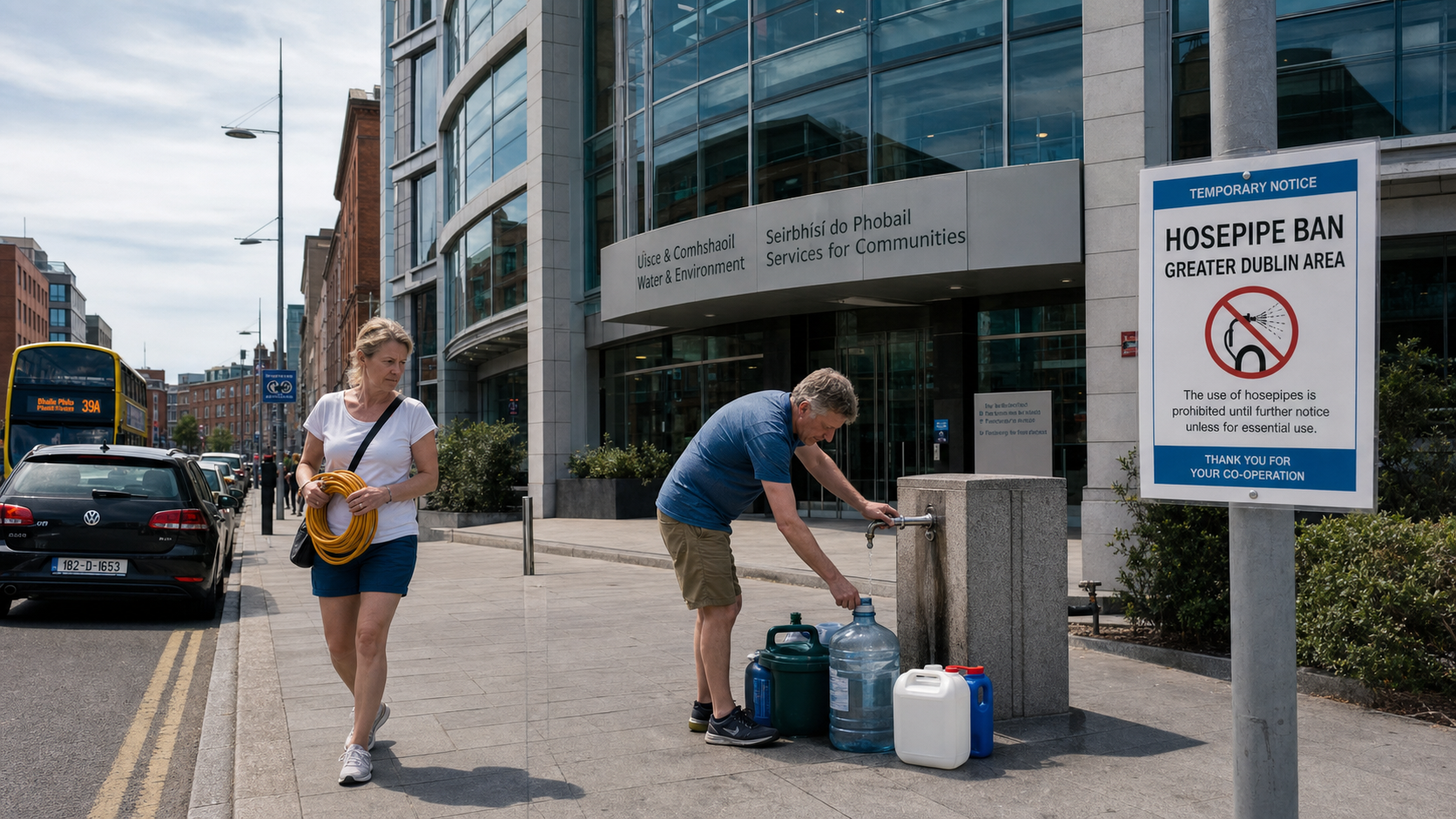
Uisce Éireann Hosepipe Ban Signals Deeper Water Infrastructure Challenge as Demand Surges 20 Per Cent Above Normal
The six-week hosepipe ban implemented by Uisce Éireann for the Greater Dublin Area and parts of six other counties is more than a temporary response to a summer heatwave — it is a signal of a deeper and more persistent challenge facing Ireland's water supply infrastructure, one that will require sustained investment and behavioural change to address as climate change makes extreme weather events an increasingly regular feature of Irish life.
Background
Uisce Éireann was established in 2014 to take over responsibility for water and wastewater services from local authorities across the Republic of Ireland. The utility inherited a system that had been chronically underinvested for decades, with ageing pipes, inadequate treatment capacity, and a leakage rate that was among the highest in Europe. Since its establishment, Uisce Éireann has been working to address these legacy issues, but the scale of the challenge is enormous and progress has been slower than many had hoped.
The Greater Dublin Area is served by a complex water supply system that draws from multiple sources, including the River Liffey, the River Vartry, and a series of reservoirs in the Wicklow Mountains. The system has limited spare capacity during periods of peak demand, and the combination of population growth, climate change, and the increasing frequency of extreme weather events has been placing it under growing strain. The current hosepipe ban is the most visible manifestation of that strain, but it is not the first — similar restrictions have been imposed in previous dry summers, and the frequency of such measures is increasing.
The hosepipe ban applies to Dublin, south Tipperary, and parts of Kildare, Meath, Westmeath, Wexford, and Wicklow. It prohibits the use of hosepipes for garden watering, car washing, and filling paddling pools or garden ponds. Breaches of the order can result in fines of up to €5,000, though enforcement is primarily through public awareness and voluntary compliance rather than active policing.
Key Developments
The ban took effect at midnight on July 16 and is scheduled to run for six weeks, until August 26. Uisce Éireann has stated that daily demand in the Greater Dublin Area reached approximately 693 million litres — about 50 million litres above the recent average — making the conservation order unavoidable. The utility has also implemented night-time water restrictions for 39 schemes across 12 counties, allowing reservoirs to replenish during the hours of lowest demand.
The economic implications of the ban extend beyond the immediate inconvenience to householders. Garden centres, car washes, and businesses that rely on water-intensive processes have been affected, and the agricultural sector — which is not covered by the hosepipe ban but is experiencing its own water stress — is facing significant challenges. The tourism sector, which benefits from Ireland's green landscape, has also noted the potential long-term impact of water scarcity on the country's environmental attractiveness.
Uisce Éireann has used the occasion of the hosepipe ban to renew its call for investment in water supply infrastructure, including the long-delayed Shannon to Dublin water supply scheme, which would provide a major new source of water for the Greater Dublin Area. The scheme has been in planning for over a decade and has faced significant opposition from communities along the proposed route, but the utility argues that it is essential for the long-term security of Dublin's water supply.
Why It Matters
The hosepipe ban matters as an economic issue because water is a fundamental input to virtually every sector of the economy. A reliable, affordable water supply is essential for manufacturing, food processing, hospitality, healthcare, and residential development. As Ireland's population grows and its economy expands, the demand for water will increase, and the ability of the water supply system to meet that demand will become an increasingly important constraint on economic growth.
The ban also matters as a signal about the pace of infrastructure investment. Ireland has been investing heavily in housing, transport, and energy infrastructure in recent years, but water infrastructure has received less attention and less funding than its importance warrants. The hosepipe ban is a reminder that the consequences of underinvestment in water infrastructure are not abstract — they are felt by every household and business in the affected areas.
The climate change dimension is also significant. The increasing frequency of heatwaves and dry spells means that the water supply system will face more frequent and more severe stress events in the coming decades. The hosepipe ban of 2026 may be remembered as an early warning of a challenge that will become much more acute as the century progresses.
Local Impact
In Dublin, the hosepipe ban has been met with a mixture of compliance and frustration. Garden centres have reported a surge in demand for drought-resistant plants and water-efficient irrigation systems. Hardware stores have sold out of water butts and drip irrigation equipment. Dublin City Council has opened its parks for extended hours to provide shade and green space for residents without gardens.
In the counties affected by the ban — Kildare, Meath, Westmeath, Wexford, and Wicklow — the response has been broadly similar, with residents adapting their behaviour and businesses seeking ways to reduce their water consumption. Local authorities have been working with Uisce Éireann to communicate the ban effectively and to provide guidance on compliance.
What's Next
The hosepipe ban will remain in place until August 26, regardless of weather conditions, as Uisce Éireann needs time to allow reservoir levels to recover. The utility has indicated it will review the ban at the four-week mark and will lift it earlier if supply conditions improve sufficiently. A full review of Ireland's water supply resilience in the context of climate change is expected to be published by the Department of Housing in the autumn. The Shannon to Dublin water supply scheme is expected to receive a planning decision from An Bord Pleanála before the end of 2026.