Uisce Éireann Completes Largest Repair in Its History on Critical Dublin Water Main Over Bank Holiday
Uisce Éireann has completed what it describes as the largest and most complex repair operation in its history, with approximately 300 personnel working through the August bank holiday weekend to secure a critical 26-kilometre trunk water main that supplies roughly one-third of the total drinking water for 1.7 million people across Dublin, Kildare, and Wicklow.
Background
The trunk water main in question runs from the Ballymore Eustace Water Treatment Plant in County Kildare to a reservoir in Saggart, County Dublin, and carries approximately 220 million litres of treated drinking water every day. It is one of the most important pieces of water infrastructure in the country, and sections of it date back to the 1940s — a fact that underlines both the age of Ireland's water network and the scale of the investment required to maintain it.
Uisce Éireann, the national water utility established in 2014, has been working to address the legacy of decades of underinvestment in water infrastructure across Ireland. The Ballymore Eustace to Saggart main has been identified as a priority for repair for several years, with inspections revealing a number of significant leaks and areas of structural weakness that posed a risk of catastrophic failure if left unaddressed.
The decision to schedule the repair over the August bank holiday weekend was deliberate. Water usage in Dublin traditionally decreases during this period as residents leave the city for the long weekend, reducing the demand on the network and providing a window in which the main could be taken offline without causing widespread supply disruption.
Key Developments
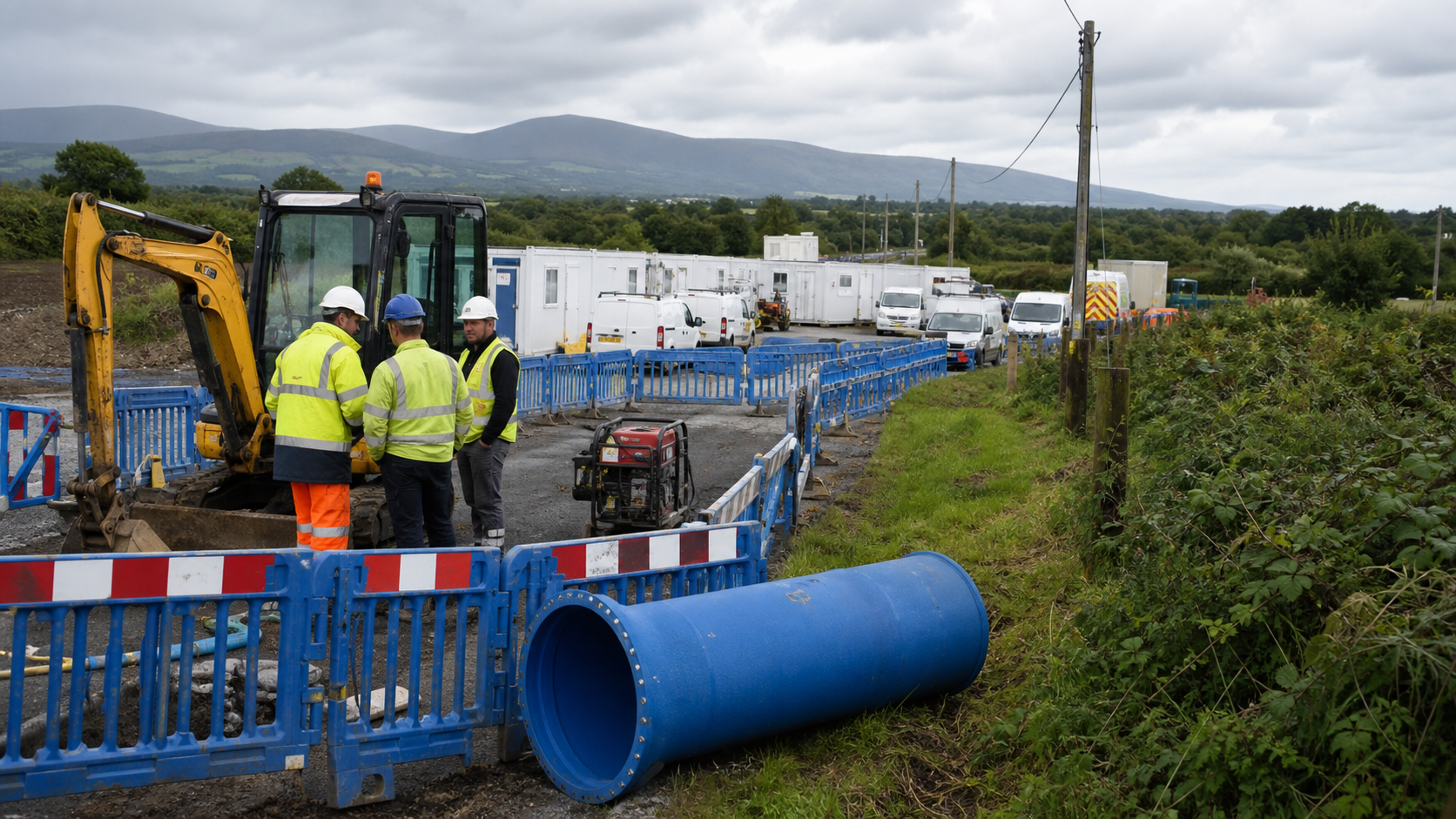
The operation involved approximately 300 specialist personnel working within a strict 27-hour window to complete the necessary repairs. The scope of work included internal repairs on up to 15 significant leaks, the replacement of two large pipe segments at different locations — each described as being the size of a railway carriage — and a comprehensive inspection of the full length of the main.
Because the repairs were performed internally, crews were required to enter the pipeline and navigate up to 300 metres through a dark, damp environment to reach the repair sites — a technically demanding and physically challenging operation that required specialist equipment and training. Uisce Éireann filled treated water reservoirs to capacity ahead of the shutdown to ensure that supply continuity was maintained for the vast majority of customers throughout the operation.
Approximately 1,000 properties in North Kildare, specifically in the Arthurstown and Tipperkevin areas, experienced reduced water pressure during the repair window, but the utility reported that the operation was completed within the planned timeframe and that normal supply was restored ahead of schedule.
Why It Matters
The Ballymore Eustace to Saggart main is not merely a piece of infrastructure — it is a lifeline for a significant portion of the greater Dublin area. A catastrophic failure of this main would have caused severe supply disruption for up to 1.7 million people, with consequences for homes, businesses, hospitals, and schools across three counties. The fact that Uisce Éireann was able to plan and execute a repair of this scale without causing widespread disruption is a significant operational achievement.
The repair also highlights the broader challenge facing Ireland's water infrastructure. The country has one of the highest rates of water leakage in Europe, with Uisce Éireann estimating that approximately 40% of treated water is lost through leaks before it reaches customers. The bank holiday repair is part of a multi-year programme of investment in the network, but the scale of the challenge means that similar operations will be required at regular intervals for years to come.
Local Impact
For the 1.7 million people served by the Ballymore Eustace to Saggart main, the bank holiday repair was largely invisible — which is precisely the point. The careful planning that went into the operation, including the timing, the reservoir pre-filling, and the deployment of 300 specialist personnel, was designed to ensure that the disruption to customers was minimised. In North Kildare, where some properties experienced reduced pressure, Uisce Éireann provided advance notice and maintained a customer helpline throughout the operation. Irish Rail and Bus Éireann services were not affected by the repair works.
What's Next
Uisce Éireann has confirmed that the repaired main is now operating normally and that the risk of catastrophic failure has been significantly reduced. The utility will continue to monitor the main and will carry out further inspections in the coming months to assess the condition of the sections that were not addressed in this operation. A broader programme of investment in the Dublin water network is planned for 2027 and 2028, with further major repair and replacement works expected to be scheduled during future bank holiday periods.