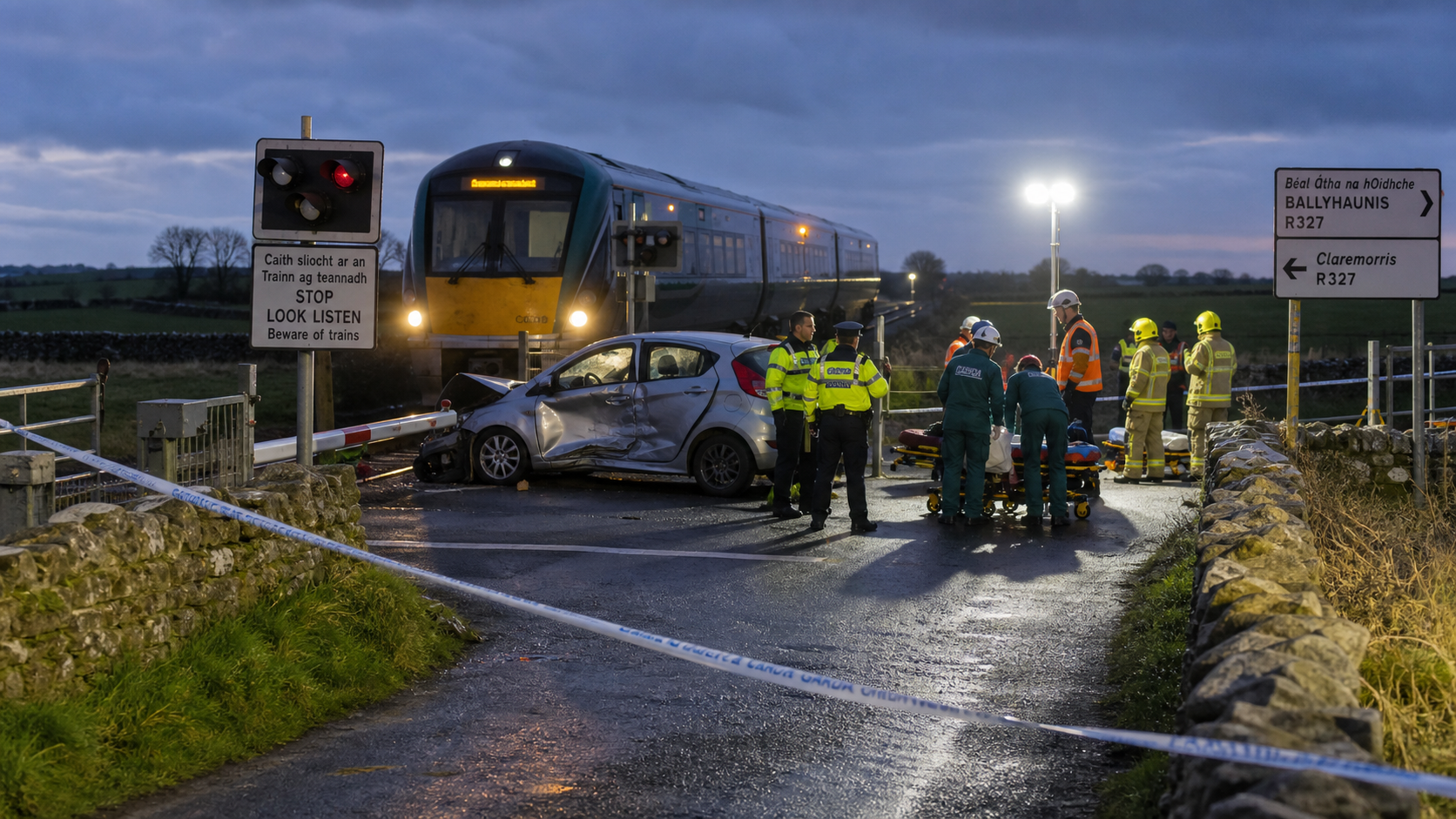
Train Collides with Car at Kiltybo Level Crossing in Mayo, Disrupting Westport-Athlone Line Overnight
A serious collision between a westbound Irish Rail train and a car at a user-operated level crossing at Kiltybo, near Ballyhaunis in County Mayo, caused major disruption to rail services between Westport and Athlone on Thursday evening, with the line remaining closed overnight as engineers assessed the damage and investigators from the Railway Accident Investigation Unit attended the scene. The incident has renewed calls for the accelerated elimination of user-operated level crossings on the Irish rail network, which safety campaigners have long identified as one of the most significant residual risks in the country's transport infrastructure.
Background
User-operated level crossings — where road users are responsible for opening and closing gates or barriers before crossing the railway line — are a legacy of the Victorian era of railway construction, when the cost of building bridges or underpasses at every road crossing was prohibitive. Ireland retains a significant number of such crossings, particularly on rural lines in the west and midlands, where traffic volumes are low and the economic case for upgrading to automatic barriers or grade separation has historically been difficult to make.
The Westport to Athlone line, which passes through County Mayo and County Roscommon before joining the main Dublin-Galway line at Athlone, is one of the routes with the highest concentration of user-operated crossings. The line serves a predominantly rural catchment, with stations at Castlebar, Claremorris, Ballyhaunis, and Roscommon, and is an important transport link for communities in the west of Ireland that have limited alternatives to the car.
Irish Rail has been working to eliminate user-operated crossings on its network for many years, replacing them with automatic barriers, CCTV-monitored crossings, or grade-separated junctions where traffic volumes justify the investment. However, the programme has been slow, constrained by funding limitations and the complexity of negotiating with landowners and local authorities about the design and cost of replacement infrastructure. The Railway Accident Investigation Unit has repeatedly highlighted user-operated crossings as a safety concern in its annual reports.
Key Developments
The collision at Kiltybo occurred on the evening of Thursday, 3 September, when a car was struck by a westbound train at the user-operated crossing. Irish Rail confirmed that the train was travelling at normal line speed when the collision occurred, and that the driver of the train applied the emergency brakes immediately upon seeing the car on the crossing. No fatalities were reported, and the occupants of the car were taken to hospital for assessment; their condition was not disclosed by Irish Rail or the emergency services.
The collision caused significant damage to the front of the train and to the crossing infrastructure, and the line between Ballyhaunis and Claremorris was closed overnight to allow engineers to assess the damage and to enable investigators from the Railway Accident Investigation Unit to examine the scene. Bus transfers were arranged for passengers on affected services, with Irish Rail advising customers to check its website and social media channels for updates on service resumption.
The incident prompted immediate calls from transport safety campaigners for the government to accelerate the programme of level crossing elimination. The Irish Road Safety Authority has previously noted that level crossing incidents, while relatively rare, tend to have severe consequences when they do occur, and that user-operated crossings represent a disproportionate share of the risk.
Why It Matters
The Kiltybo collision is a reminder that the Irish rail network, for all the investment it has received in recent years, retains infrastructure that dates from the nineteenth century and that poses risks that would not be acceptable on a modern railway. User-operated level crossings require road users to follow a specific procedure — stopping, checking for trains, opening the gate, driving across, and closing the gate — that is unfamiliar to many drivers and that is easily forgotten or rushed, particularly on quiet rural roads where the risk of a train may not feel immediate.
The case for eliminating these crossings is not primarily economic — it is a matter of public safety. The cost of upgrading a crossing to automatic barriers or grade separation is significant, but it is a fraction of the cost — human and financial — of a serious collision. Irish Rail and the National Transport Authority have both acknowledged this, but the pace of the elimination programme has been constrained by the availability of capital funding. The Kiltybo incident will add pressure on the government to prioritise this investment in the National Development Plan.
Local Impact
The overnight closure of the Westport-Athlone line caused significant disruption for passengers travelling between Mayo and the midlands on Thursday evening and Friday morning. Bus transfers, while provided, are a poor substitute for rail travel on a route where journey times are already long and connections to other services are tight. For communities in Ballyhaunis and the surrounding area, the closure was a reminder of the vulnerability of a rail service that operates with limited redundancy — when the line is blocked, there is no alternative route.
The Railway Accident Investigation Unit is expected to publish a preliminary report on the Kiltybo collision within 30 days, with a full investigation report to follow within twelve months. Irish Rail has indicated that it will cooperate fully with the investigation and that it will review its safety procedures at user-operated crossings on the Westport-Athlone line in the interim.
What's Next
The line between Ballyhaunis and Claremorris was expected to reopen on Friday morning, subject to the completion of engineering inspections and the clearance of the scene by investigators. Irish Rail has indicated that it will provide a full update on service resumption by 7am on Friday. The Railway Accident Investigation Unit will begin its formal investigation immediately, with investigators expected to interview the train driver, any witnesses to the collision, and the occupants of the car. The National Transport Authority is expected to be asked about the pace of the level crossing elimination programme at the next meeting of the Oireachtas Transport Committee.