Take That Bring 'Circus Live' Spectacular to Aviva Stadium as Ireland's Summer Concert Season Reaches Its Peak
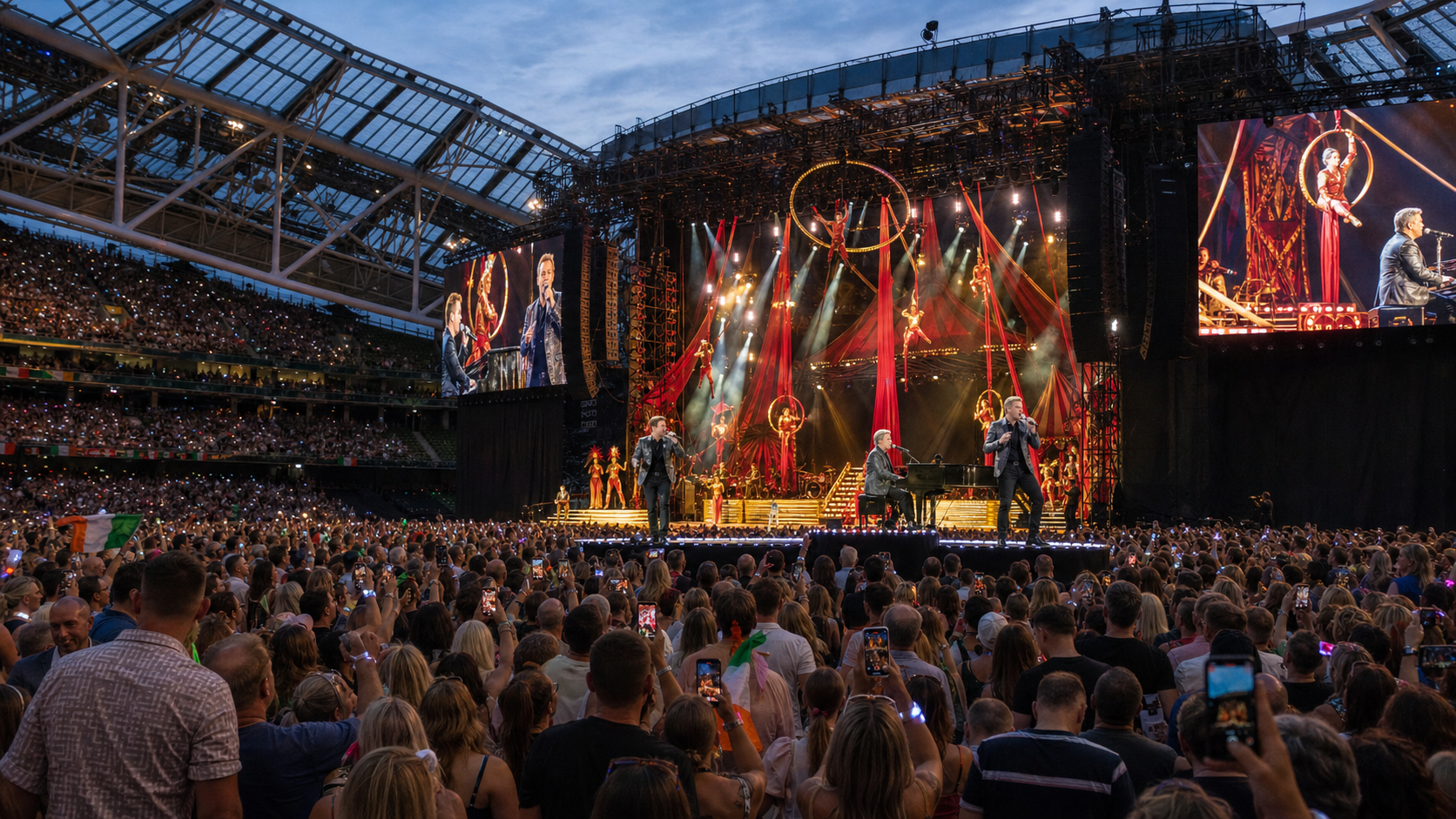
Take That perform at the Aviva Stadium in Dublin on July 4 as part of their "Circus Live" tour — a large-scale production featuring acrobats, aerialists, and elaborate staging that has been one of the most talked-about concert experiences of the summer — as Ireland's July concert calendar reaches its peak with Shania Twain at Thomond Park in Limerick on July 7 and Elvis Costello at Dublin's Iveagh Gardens on July 5 also drawing large audiences.
Background
Ireland's live music market has undergone a remarkable transformation over the past two decades. From a country that was largely bypassed by major international tours — with Irish fans often having to travel to London or Manchester to see their favourite acts — Ireland has become a significant and sought-after destination for the world's biggest artists. The development of major venues, including the Aviva Stadium, the 3Arena, and Croke Park, has given Ireland the infrastructure to host stadium-scale events, while the enthusiasm and loyalty of Irish audiences has made the country a commercially attractive market for touring artists.
The summer concert season has become one of the defining features of Irish cultural life. From June to August, a succession of major international acts perform at venues across the country, drawing hundreds of thousands of attendees and generating significant economic activity in the hospitality, transport, and retail sectors. The season has also become an important platform for Irish artists, who often perform as support acts for international headliners and use the exposure to build their own audiences.
Take That's relationship with Ireland goes back to the early 1990s, when the group first achieved massive popularity among Irish teenagers. The band — now comprising Gary Barlow, Howard Donald, and Mark Owen following the departures of Robbie Williams and Jason Orange — has maintained a loyal Irish following through decades of chart success, hiatus, and reunion, and their Aviva Stadium show is expected to draw a capacity crowd of dedicated fans.
Key Developments
The "Circus Live" tour is Take That's most ambitious production to date. The show incorporates elements of circus performance — acrobats, aerialists, and elaborate aerial rigging — alongside the band's music, creating a spectacle that goes beyond the conventional stadium concert format. The production has been praised by critics and audiences across the UK and Europe for its ambition and its execution, and the Dublin show is expected to be one of the highlights of the tour.
The Aviva Stadium, with its capacity of approximately 51,700, provides the scale that a production of this ambition requires. The stadium's configuration — with the stage at one end and the audience filling the pitch and stands — creates a particular atmosphere for large-scale concerts, and the venue has hosted some of the most memorable live music events in Irish history. Take That's show will add to that legacy.
Shania Twain's appearance at Thomond Park in Limerick on July 7 is another significant event in the summer concert calendar. Thomond Park, the home of Munster Rugby, has been increasingly used as a concert venue in recent years, and its capacity of approximately 26,000 makes it suitable for major international acts. Twain, whose country-pop crossover hits of the 1990s and 2000s have given her a multigenerational fanbase, is expected to draw a large and enthusiastic audience from across Munster and beyond.
Elvis Costello's appearance at the Iveagh Gardens in Dublin on July 5 represents a different kind of concert experience. The Iveagh Gardens — a Victorian walled garden in the heart of Dublin — is one of the most intimate and atmospheric outdoor concert venues in Ireland, with a capacity of approximately 4,000. Costello's show, which will focus on his early-career material from 1977 to 1986, is a more intimate affair than the stadium shows, but no less significant for the dedicated fans who have followed his career for decades.
Why It Matters
The summer concert season matters for Ireland's cultural economy in ways that are easy to underestimate. The economic impact of major concerts — on hotels, restaurants, transport, and retail — is substantial, and the concentration of events in July and August provides a significant boost to the tourism sector at its peak period. For cities like Limerick, which has fewer major cultural events than Dublin, a concert of Shania Twain's scale is a significant economic and cultural event that generates benefits across the region.
The diversity of the July concert calendar — from the stadium spectacle of Take That to the intimate garden setting of Elvis Costello — reflects the breadth of Ireland's live music market and the range of audiences it can support. This diversity is a strength: it means that the market is not dependent on any single genre or demographic, and that there are opportunities for artists of very different styles and scales to find audiences in Ireland.
For Irish music fans, the summer concert season is also a reminder of the country's cultural vitality and its connection to the global music industry. The ability to see world-class artists perform in Ireland — rather than having to travel abroad — is something that previous generations of Irish music fans could not take for granted, and it reflects the country's growing confidence and ambition as a cultural destination.
Local Impact
In Dublin, the Take That concert at the Aviva Stadium will generate significant economic activity in the surrounding area. The Ballsbridge neighbourhood, where the stadium is located, will see increased footfall in its restaurants, pubs, and shops in the hours before and after the show. The city's transport network — including the DART, Luas, and Dublin Bus — will be operating additional services to manage the crowds, and the Garda Síochána will have a significant presence to ensure public safety.
In Limerick, the Shania Twain concert at Thomond Park is expected to be one of the biggest events of the summer for the city. Limerick has been working to develop its cultural profile in recent years, and major concert events at Thomond Park are an important part of that effort. The concert will draw visitors from across Munster and beyond, and the economic impact on the city's hospitality sector will be significant.
For the Iveagh Gardens in Dublin, the Elvis Costello concert is part of a summer programme that has established the venue as one of the most desirable outdoor concert locations in Ireland. The gardens' combination of natural beauty, intimate scale, and central location makes it uniquely attractive for both artists and audiences, and the summer concert series has become one of the most sought-after tickets in the Irish live music calendar.
What's Next
The summer concert season will continue through July and into August, with a series of major events at venues across Ireland. Croke Park, which has hosted some of the biggest concerts in Irish history, has several major shows scheduled for the coming weeks, and the 3Arena in Dublin continues its year-round programme of international acts.
For Take That, the Dublin show is part of a wider European tour that will continue through the summer. The band has indicated that the "Circus Live" production will be one of their most ambitious tours, and the response from audiences across Europe has been enthusiastic. The Dublin show will be a significant moment in the tour, and the band's connection with their Irish fanbase — built over more than three decades — will make it a particularly emotional occasion.
The broader question of Ireland's live music infrastructure — the venues, the ticketing systems, the transport links, and the regulatory environment — will continue to be a topic of discussion in the coming months. The success of the summer concert season has demonstrated the strength of the market, but it has also highlighted some of the challenges: ticket touting, accessibility for fans outside Dublin, and the environmental impact of large-scale events are all issues that the industry and the government will need to address.