Stormont Leaders Meet Treasury as Budget Crisis Threatens Health, Education and Police Staffing
The Northern Ireland Secretary and the Chief Secretary to the Treasury have held urgent talks with Stormont Executive party leaders over the deepening budget crisis facing the devolved administration, with officials warning that failure to reach agreement by 1 August could trigger significant cuts to health, education, and police staffing — cuts that health trust chairs have warned would cause 'avoidable and serious harm' to patients.
Background
Northern Ireland's public finances have been in a state of chronic stress for several years, driven by a combination of factors: the legacy of years of underfunding relative to need, the costs of running a divided society with duplicated public services, the financial impact of the COVID-19 pandemic, and the more recent pressures of inflation and the June riots. The Stormont Executive has repeatedly struggled to agree a budget that balances the competing demands of its departments, and the current impasse is the most serious in several years.
The health service is at the epicentre of the crisis. Northern Ireland's NHS waiting lists are the longest in the United Kingdom, with hundreds of thousands of patients waiting for outpatient appointments, diagnostic tests, and elective procedures. The five health and social care trusts — Belfast, South Eastern, Southern, Western, and Northern — are all operating under significant financial pressure, and their chairs have written jointly to the Executive warning that further cuts would have direct consequences for patient safety.
The PSNI is also facing significant financial pressure, with the Chief Constable having warned that the force cannot maintain current staffing levels without additional funding. The June riots, which cost the PSNI over £5 million to police, have added to the pressure on an already stretched budget.
Key Developments
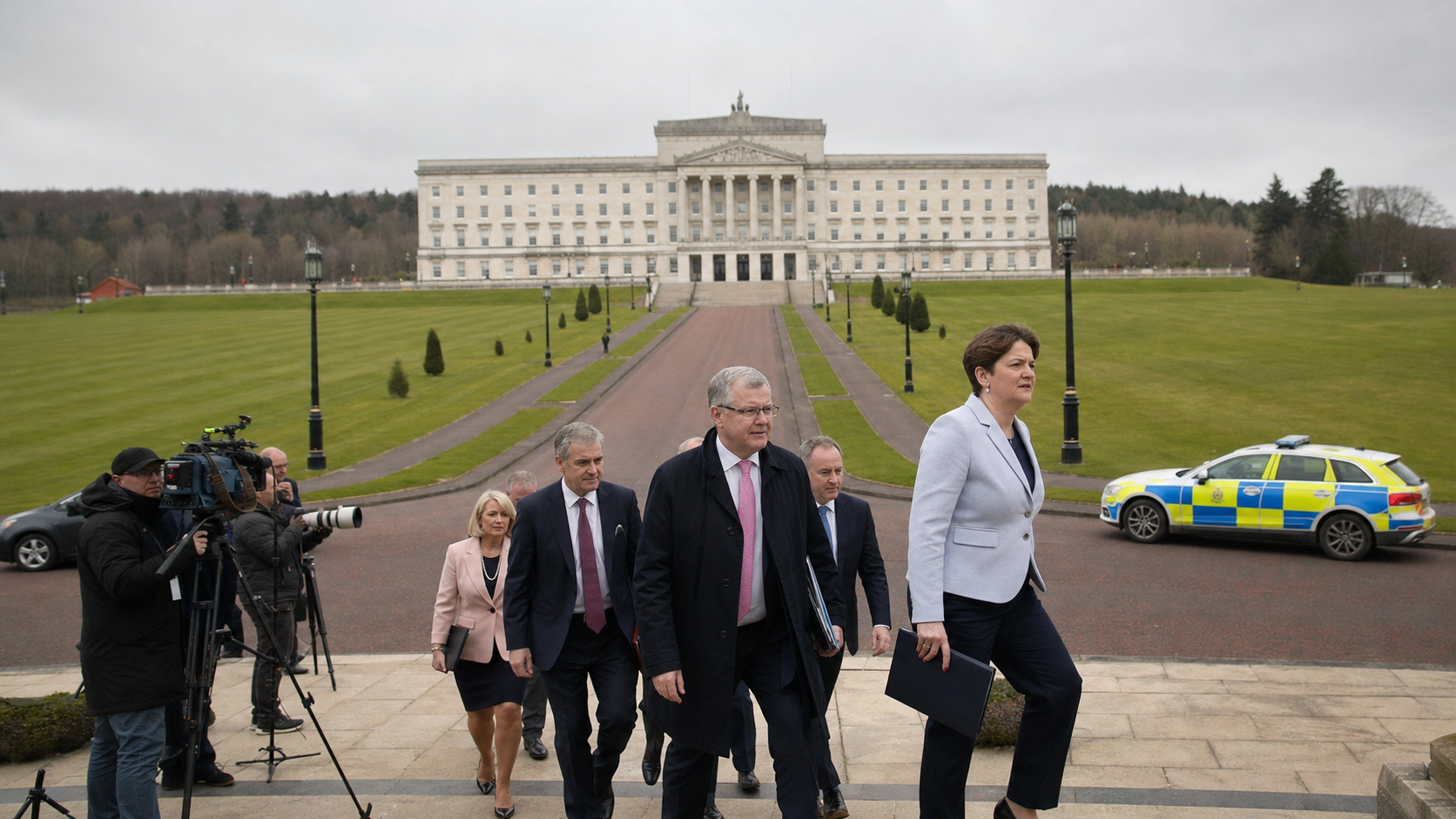
The meeting between the Northern Ireland Secretary, the Chief Secretary to the Treasury, and Executive party leaders took place against a backdrop of growing urgency, with the 1 August deadline for an agreed budget fast approaching. The discussions focused on the possibility of additional funding from Westminster to address the most acute pressures, as well as the structural reforms that would be needed to place Northern Ireland's finances on a more sustainable long-term footing.
The Northern Ireland Secretary indicated after the meeting that progress had been made, but stopped short of announcing any specific financial commitments. The Chief Secretary to the Treasury acknowledged the severity of the situation but emphasised that any additional funding would need to be accompanied by credible plans for fiscal sustainability. Executive party leaders — including representatives of the DUP, Sinn Féin, Alliance, SDLP, and UUP — each expressed their positions on the budget, with significant differences remaining on the question of how any additional funding should be allocated.
Health trust chairs have been particularly vocal in their warnings, with a joint letter to the Executive stating that the current level of underfunding is already causing harm to patients and that further cuts would be 'avoidable and serious.' The chairs have called for an emergency funding package to address the most critical pressures in the health service before the August deadline.
Why It Matters
The Stormont budget crisis is not merely a technical fiscal matter — it is a question of whether Northern Ireland's devolved institutions can function effectively as a government. The repeated failure to agree sustainable budgets has eroded public confidence in the Assembly and the Executive, and has contributed to the sense that devolution is not delivering for the people of Northern Ireland. This is the fourth consecutive year in which the Executive has faced a budget crisis of this severity, a pattern that suggests structural rather than cyclical problems with the funding settlement.
The comparison with the Republic of Ireland is instructive. While the Irish government has been able to run significant budget surpluses in recent years — driven by corporation tax receipts from multinational companies — Northern Ireland's public finances are entirely dependent on the block grant from Westminster, leaving the Executive with little room to manoeuvre in the face of rising costs and growing demand for public services.
Local Impact
The practical consequences of a failure to agree a budget by 1 August would be felt across every public service in Northern Ireland. In the health service, the five trusts have indicated that they would be forced to implement emergency cost-reduction measures, including the cancellation of elective procedures and the reduction of community health services. In education, school budgets are already under severe pressure, and further cuts could affect staffing levels and the provision of special educational needs support. The PSNI has warned that reduced funding could affect its capacity to respond to non-emergency calls and to maintain community policing in areas that most need it.
What's Next
The 1 August deadline for an agreed budget is the immediate focus of attention, with intensive negotiations expected over the coming weeks. The Executive's Finance Minister is expected to present a revised budget framework to the Assembly before the end of July, and the Treasury has indicated that it will respond to any formal request for additional funding within a matter of days. If no agreement is reached by 1 August, the Executive will be required to operate under emergency spending controls, which would effectively freeze departmental budgets at current levels and prevent any new spending commitments.